Sunday, May 31st: Indian students protested in Melbourne against VICTORIAN POLICE, for doing nothing against recent RACIST attacks in Melbourne.

May 31, 2009
Sam Watson:New government, same old racism
 Sam Watson, Socialist Alliance Indigenous Rights Spokesperson
28 May 2009
In his Sorry Speech, delivered on February 13, 2008, Kevin Rudd said "We apologise for the laws and policies of successive Parliaments and governments that have inflicted profound grief, suffering and loss on these our fellow Australians."
More than a year later, the Rudd government has joined this list of successive governments, having not only failed to end Howard's racialist Northern Territory Emergency Response, but also expanding it and forcing Aboriginal housing agencies to sign away their land or miss out on much needed funding.
On Monday, May 25, Indigenous Affairs Minister, Jenny Macklin, added insult to injury by opening Reconciliation Week with the announcement of the compulsory acquisition of Alice Springs town camps which are represented by Tangentyere Council. Macklin's move follows the Council's refusal to sign a 40 year lease deal and transfer control over housing in the town camps to Territory Housing.
When she was shadow spokesperson for Indigenous affairs, Macklin said "We do not want land tenure reform being made a condition of funding for basic services." Yet this is precisely what Macklin is now enforcing in Alice Springs, where she is threatening with compulsory acquisition unless Tangentyere Council signs away the land for 40 years.
Aboriginal people have been fighting for their land and housing in the town camps within the boundaries of the township for decades. Chronic underfunding has led to overcrowding and substandard services, which Macklin now uses as excuse for taking away any decision-making power from Tangentyere Council and the town camps it represents.
The ALP's attack on Aboriginal self-determination and land rights extends beyond Alice Springs and is nothing new.
Indeed, the Rudd government still continues Howard's "Partnership Agreements" which include leaseback agreements signing over land to the government for a minimum of 40 years before funding for new housing or maintenance and repairs of existing housing is released.
In January, 2009, Macklin wrote a letter to state governments instructing them not to use federal funds for Aboriginal housing unless the housing agencies sign leaseback agreements of at least 40 years duration.
Macklin is also defending the discriminatory compulsory income management scheme, which has forced many people into the larger centres, as the cards handed out are only valid at selected shops sometimes hundreds of kilometres away from the community.
On May 20, the Northern Territory government released its new policy titled "Working Futures – Remote Service Delivery". Under this policy, 20 remote communities are selected to become mainstream towns called "Territory Growth Towns" and receive $160 million priority funding for infrastructure such as schools and health services. The remaining 580 communities or outstations are to share $36 million annually.
People living in one of the 580 communities not selected would be forced to commute for access to services or move to one of the "Growth Towns". Yet, as Jon Altman wrote in The Sydney Morning Herald on May 26, "During the past 30 years, a growing body of research has indicated that life at outstations is better – in health out-comes, livelihood options and social cohesion, even housing conditions – than at larger townships, despite neglect."
The ALP's push to coerce all aspects of the lives of Australia's Aboriginals into Western mainstream reflects a capitalist view of human activity and signals a return to assimilation and the destruction of Aboriginal culture.
Socialist Alliance condemns Macklin's hypocrisy and stands in solidarity with our Aboriginal brothers and sisters in the Northern Territory resisting the abolition of self-determination in Aboriginal housing. We demand that the Rudd government release much needed funding to Aboriginal housing agencies unconditionally and immediately, in Alice Springs and elsewhere, and that all remote Aboriginal communities be adequately funded and supported.

May 29, 2009
SLIDESHOW:Stop Rudd Labor grab for Aboriginal land
About 40 people participated in a lunchtime protest today outside the Sydney office of federal minister for housing, Tanya Plibersek, at her office on Friday May 29. Protests were also planned in Alice Springs and around Australia.
Made with Slideshow Embed Tool
The Great Murder Permit Trading Scheme Swindle
 By Peter Boyle
Imagine a government trying to sell to the public a new proposal to reduce murder rates by selling rights to murder. The government brazenly names it the Murder Reduction Scheme.
Here is how it works: The money raised by selling murder rights could be used to subsidise terrified potential victims to arm themselves for self-protection, thus hopefully reducing their chances of being murdered. But that's not all! Some of the money raised from selling the aforementioned murder rights would also be used to compensate professional killers and other commercial organisations that might be adversely. It is hoped that over time, subtle “market signals” will encourage these murderous commercial enterprises to shift their investments to non-murderous activities
Sorry, that's just not good enough, responds the parliamentary opposition that prides itself on being even more committed than the government to protecting business interests. Its leader, who has made so many killings that he's one of the country's 200 richest, says: “Listen up! Over in Yes-We-Can Land, they've got an even better idea. They are going to give their top killers FREE murder permits. Yes, they can!”
Feeling the pressure, the government (of what some are now thinking of as Perhaps-We-Might Land), announces a Grand Opening Sale.
The Crazy Warehouse Salesman is hired to sell the discount murder permits. “Crazy, crazy, crazy! Murder permits going for just $10 each – for one year only. Shootings, stranglings, bashings, stabbings, axe murders – you name it, every permit's got to go. Get them while they last!”
The government then rolls out a Clark Kent lookalike, who allegedly was once a hard-fighting union chief, to threaten the opposition: “I'm warning you Silvertails, if you force the Murder Reduction Scheme back to the drawing board, Murders Inc could end up paying more”, he growls.
Meanwhile, a group of crime researchers released a new study that showed a “90 % probability” that already sharply rising murder rates had been underestimated by half.
[Submitted for publication to Green Left Weekly]
VIDEO:26th May - The Union Show
Aussie Post & CEPU, AWU OHS & Delegates Conference & William Andrews, WWII Merchant Seaman
VIDEO:Raytheon and the Israeli Chamber of Commerce meet in Adelaide.
The military industrial complex meet at the Hilton International In Adelaide - Protesters picket outside.
Raytheon, one of the top three weapons manufacturers in the US, meet with the Israeli Chamber of Commerce.
Raytheon, one of the top three weapons manufacturers in the US, meet with the Israeli Chamber of Commerce.
May 28, 2009
Sri Lankan Crisis Statement
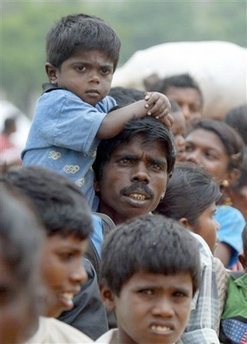 Despite international calls for independent investigations into alleged war crimes and for unrestricted access to aid workers, human rights monitors and media to over 300,000 civilians trapped indefinitely in concentration camps, the Sri Lankan government has remained defiant.
In an attempt to put an urgent stop to the humanitarian catastrophe and the human rights dilemma, a group of young Tamil Australians have written a ‘Sri Lankan Crisis Statement’ for the wider Australian community to sign.
From 15 June 2009 we will take it to the media and the Australian government to raise our concern for this largely unreported war.
If you want to sign this statement, please leave your details as a comment on this page or via email to fastuntoaction@hotmail.com as soon as possible.
Please note : details are required in the following format:
[title] [first name] [surname] [professional or student status] [academic or professional background] [state]
Please forward it to other contacts who maybe interested in signing this statement.
[title] [first name] [surname] [professional or student status] [academic or professional background] [state]
Please forward it to other contacts who maybe interested in signing this statement.
STATEMENT
We are Australian citizens who share a deep concern about the humanitarian crisis in Sri Lanka now affecting more than 300,000 people, according to United Nations (UN) estimates.
We call on the Government of Australia to demand the Government of Sri Lanka immediately:
a) give the UN, International Committee of the Red Cross, non-governmental organisations and all local and international media unrestricted access to the Tamil civilians trapped in the former war zone and those indefinitely confined in detention camps for internally displaced people;
b) treat all members of the Liberation Tigers of Tamil Eelam (LTTE), former members, suspected combatants, non-combatant cadres and their families according to international law, including the Geneva Conventions, which have been ratified by the Government of Sri Lanka and allow independent international monitors to be part of the Government of Sri Lanka’s screening process;
c) release the over 300,000 Tamils from government controlled concentration camps and allow them to return to their homes;
d) release the three doctors – Dr. T. Varatharajah, Dr. T. Sathyamurthi and Dr. V. Shanmugarajah – who treated hundreds of severely wounded civilians in understaffed makeshift hospitals in the country’s war zones;
e) release journalist Mr. J.S. Tissainayagam detained without charges by the Sri Lankan government since March 7th 2008.
We strongly urge the Government of Australia to support the UN High Commissioner for Human Rights Navi Pillay’s calls for an international independent investigation into alleged war crimes by the Government of Sri Lanka and the LTTE.
Furthermore, we recognise the Tamils in Sri Lanka have been subject to ethnic discrimination by successive Sri Lankan governments since Sri Lanka gained independence in 1948.
We acknowledge that all people, including the Tamils, have the right to self-determination and must freely determine their political status and pursue their economic, social and cultural development.
We urge the international community to support and facilitate a political solution that addresses the self-determination aspirations of Tamils and protects the human rights of all Sri Lankans.
Signatories include:
* Prof. Wendy Bacon, Professor of Journalism, University of Technology, NSW
* Mr. Antony Loewenstein, Independent Journalist and Author, NSW
VIDEO:A Gaythering Storm
Great satire too!
The original...
May 27, 2009
VIDEO:Scottish Socialist Party Election Broadcast - Make Greed History
SSP Broadcast for the European elections on June 4th 2009.
Featuring Tam Dean Burn, Directed by Dhivya Kate Chetty & Martin Clark,
Make-up Mark Conlin,
2nd Camera Martin Glegg,
Produced by David Archibald.
Featuring Tam Dean Burn, Directed by Dhivya Kate Chetty & Martin Clark,
Make-up Mark Conlin,
2nd Camera Martin Glegg,
Produced by David Archibald.
VIDEO:Free the Tamils - Boycott Sri Lanka!
On May 23, 2009 members of Sydney's Tamil community joined with the Stop The War Coalition in a march to protest the Sri Lankan government's genocidal war against the Tamil people.
May 26, 2009
VIDEO:'Climate Change' Human Sign - St Kilda Beach, Melbourne Australia - May 17, 2009
More than 5,000 people gathered to spell out the words "Climate Change - The Future Is In Your Hands' on St Kilda Beach in Melbourne, Australia.
www.sisinc.com.au
Radical history conference: A century of struggle
Laborism and the radical alternative - Lessons for today
Saturday 30 May 9.30am (registration) - 5.00pm AMWU offices, 251 Queensberry St, Carlton

Speakers include:
Verity Burgmann, author of many books on labour movement history
Jamie Doughney, economist, National Tertiary Education Union state president
Dave Kerin, CFMEU mining and energy organiser, Latrobe Valley
Chris Spindler, Australian Manufacturing Workers Union organiser
Socialist Alliance is organising a one-day conference on the struggle to build a radical alternative to the deadening hand of the ALP and the lessons we can draw for today. The seminar will draw on the experiences of the communist and trade union movements in Australia over the last century. This will be an important seminar given the global economic meltdown, the crisis of climate change and the dampening impact that the federal ALP government has had on the trade union movement.
Agenda:
10am:
The formation of the ALP. Was it ever a workers' party?
The record of the ALP. High hopes and big disappointments
11.30am:
The Wobblies. Achievements and limitations
The vehicle of socialism? The NSW Socialisation Units in the 1930s
2pm:
Communism in Australia. Some of the issues
Left alternatives in the trade unions
3.45pm
Fighting under Labor governments today
Looking to the future
Registration from 9.30am: $15/$5 concession.
Organised by Socialist Alliance - Sponsored by Green Left Weekly.
For more information phone 9639-8622.

Speakers include:
Verity Burgmann, author of many books on labour movement history
Jamie Doughney, economist, National Tertiary Education Union state president
Dave Kerin, CFMEU mining and energy organiser, Latrobe Valley
Chris Spindler, Australian Manufacturing Workers Union organiser
Socialist Alliance is organising a one-day conference on the struggle to build a radical alternative to the deadening hand of the ALP and the lessons we can draw for today. The seminar will draw on the experiences of the communist and trade union movements in Australia over the last century. This will be an important seminar given the global economic meltdown, the crisis of climate change and the dampening impact that the federal ALP government has had on the trade union movement.
Agenda:
10am:
The formation of the ALP. Was it ever a workers' party?
The record of the ALP. High hopes and big disappointments
11.30am:
The Wobblies. Achievements and limitations
The vehicle of socialism? The NSW Socialisation Units in the 1930s
2pm:
Communism in Australia. Some of the issues
Left alternatives in the trade unions
3.45pm
Fighting under Labor governments today
Looking to the future
Registration from 9.30am: $15/$5 concession.
Organised by Socialist Alliance - Sponsored by Green Left Weekly.
For more information phone 9639-8622.
May 25, 2009
The life and work of Augusto Boal:Theatre for the oppressed
 Augusto Boal presenting a workshop on the Theatre of the Oppresse in New
York City. Riverside Church, May 13th 2008.
I have just learnt that Augusto Boal passed away on May 2nd. I'd like to write an appreciation of his work creating Theatre of the Oppressed -- as a useful political and artistic medium. But for the moment here is a piece I wrote for Green Left Weekly in 1995 on Augusto Boal.
Augusto Boal is a major figure in world theatre. Any contemporary discussion about taking theatre to the people, of popularising it and renewing its relevance, cannot proceed without reference to him. Enthusiastic exponents of his ideas seem to be everywhere, oftentimes working at grassroots -- each in their way dedicated to adapting Boal's theories to their own theatrical practice.
So when Boal addressed the Second World Congress on Drama/Theatre and Education in Brisbane, more than 1500 people were in attendance. The Congress -- IDEA '95 -- ran for five days from July 1 so that teachers of drama could exchange their ideas and workshop their achievements.
While the great bulk of the participants came from Australasia, delegates attended from more than 50 countries, and Boal's was a keynote address open to the general public.
The general enthusiasm for this man rests on his notion of “the theatre of the oppressed”. For the past 40 years, Boal has been developing new forms of theatrical expression which have attempted to fuse politics, practice and poetics into a sustained and integrated dramatic position.
His early experiments were undertaken in his native Brazil during the time of the military dictatorship. In 1971 he was kidnapped by government agents and for three months held in secret until an international campaign secured his release. Thereafter in exile in Argentina, Peru, Portugal and finally France, he developed his ideas into the form that he advocates today. Currently resident again in Brazil, he is an elected member of the council of the city of Rio de Janeiro.
Given this history, it may seem strange that he asked of himself recently: “What am I doing now? Am I doing theatre or psychotherapy? Before, what I did -- was it politics or theatre?”
Boal is an entertaining speaker and is relentless in pursuing the essential components of the creative theatrical process.
He recognises that he has changed his ideas over time. Because experience is what goes on now and reality is slippery, “theatre of the oppressed” must also change. Nonetheless, the pressing reality of Brazil -- the landlessness, urbanisation, mass poverty -- demands that the theatre must be against this injustice.
Back in the 1950s and '60s his Arena Theatre in Sao Paulo took a position about the oppressed and wrote and performed plays -- despite the pervasive censorship -- about these problems. “We did plays about the oppressed, plays against racial prejudice to teach black people to fight (even though we ourselves were white); we taught peasants to resist even though we were living in cities; we told women to organise -- but we were men.”
On one occasion in Brazil's north-east, Boal and his troupe were performing before the local peasants. With prop rifles in their hands and clenched fists held high, the actors would sing: “We have to spill our blood to free our land”. And the peasants loudly applauded. But when the peasants insisted that the actors should march with them on the local hacienda, the gross misunderstanding became apparent.
“Why do you make rifles that do not shoot?”, asked the peasants. Taken aback, the actors said that they were not truly peasants, just make-believe ones.
“You artists”, replied the peasants, “say we shall spill our blood to free our land, but you are talking about our blood, not yours.”
For Boal, the lesson was clear: “I was not prepared to fight. I was asking people to do something I would not do myself. You only have true solidarity when you run the same risk. While I do employ agit/prop [agitational/propaganda theatre] on occasion, I don't say go and do something unless I am running the same risk.
“We artists cannot do didactic theatre. Artists may know how to use the theatre, but that doesn't mean that we know about the people for whom we perform it. I tried to find ways in which the audience could also be actors.”
His first development along these lines rested on “simultaneous playwrighting”. The play would be stopped at a crisis point where both danger and opportunity presented themselves. The actors would turn to the audience and say: the play stops here because we don't know how to go on. Suggestions would then be canvassed and the proffered solutions tried out in performance.
“This was a good way”, says Boal, “to go beyond didactic theatre. Not: do this, do that. There was no sense of an imperative.”
Later Boal recognised some of the limitations even in this approach. Instead of asking the audience how to proceed, when the nature of the topic was close to them, members of the audience were invited to come on stage and show the actors what they meant.
This led Boal to reconsider what theatre was about. While theatre is an event, what makes it so engaging, he asks? “This building here with its lights and stages, in itself is this `theatre'? Of course not! But if a person does not get the point of the performance, there is no theatre.
“Humans make theatre but animals cannot because we carry in ourselves this theatre -- even for those who do not do theatre. Theatre is inside us because we are each our own actor and spectator. I am conscious of what I am saying because I am a spectator and an actor at the same time. Only humans can do that. A bird can be a beautiful singer, but it is not a composer because it is genetically programmed to sing as it does. But we are spectators of ourselves and create culture. We can create an alternative to nature.”
“What is this extra power offered by the stage?” he asked. “It is the activity of the spectator. This is the strength you give me. We extrapolate that strength. You give me power to use this energy you have created.
“But we should try to democratise this relationship between spectator and actor. When we come to a crisis, we performers should ask: do you know better? -- and ask the spectators to replace the major protagonists.”
Boal then drew an analogy between theatre and politics. “Only the spectator has the power to create the space for theatre. Only a spectator can give power to the action. Similarly, citizens give power, but the moment you vote you lose that power. We should do the same in politics as we do in the theatre.”
In dealing with the challenge of people's power, Boal developed the analogy further by trying to mix direct and representational democracy in practice by running for city council. On his election, he hired his actors to do political theatre and set up 19 acting groups to “interact with reality” by taking their democratised performances to the electorate. This method acted as a form of ongoing consultation.
“Theatre”, said Boal, “is an interaction, a form of give and take. Be democratic. Everyone has the right to say what they think. Theatre, just like politics, should always be a dialogue not a monologue.”
SLIDESHOW:Why Should I Come To The National Climate Rallies
Slideshow / Presentation created by John Rice.
We're back!
Flew in yesterday (and boy! are my arms tired!) just so I can attend to various blogging tasks. While away others here at LeftClick posted their all so it wasn't the hiatus in the history of Western Civilisation in the way I imagined it would be.
To be continued....of course.
To be continued....of course.
May 10, 2009
CASTRO’S DECLARATIONS OF RESISTANCE
CASTRO’S DECLARATIONS OF RESISTANCE
The Declarations of Havana
By Fidel Castro, with an introduction by Tariq Ali, Verso 2008
138 pages, paperback £7.99
REVIEW BY ALEX MILLER
As Cuba celebrates the 50th anniversary of the revolution that overthrew the US-backed dictator Batista in 1959, it is fitting that three of the most famous documents relating to the struggle against Batista and the early days of the revolution are published together in a single volume in Verso’s new Revolutions series. By reading the three documents back-to-back, one is able to trace the development of the Cuban revolution from its nationalist-democratic beginnings to its socialist conclusion.
On the 26th of July 1953, a 26 year-old lawyer named Fidel Castro – along with his younger brother Raul - led an armed attack on the Moncada barracks in Santiago de Cuba, hoping to spark an uprising that would remove the hated Batista from power. The attempt failed, and Castro was captured a few days later. He was tried a couple of months later, and the first document in the volume – “History Will Absolve Me” – is the text of the speech that Castro delivered at the trial in his own defence.
In his speech, Castro – who had been held in solitary confinement for 76 days - details the torture and murder committed against the members of the armed uprising who were captured by Batista’s troops, and outlines the revolutionary programme of his movement on land, industrialization, housing, unemployment, education and health. Castro’s legal defence was that Batista’s regime had no legal right to try him because it had itself violated the 1940 constitution by seizing power by force of arms, and it is striking that Castro’s eloquent speech is couched in terms that imply that at that stage the revolution was not socialist, but bourgeois-democratic and nationalist in nature. Although Castro mentions the “great financial interests” standing behind Batista and inveighs against the associated “cold calculations of profits”, in defending the attempted uprising he mentions the American Revolution of 1775 and the French Revolution of 1789, revolutions in which the nascent bourgeoisie broke the bonds of feudalism. And although he mentions the “socialist currents” in the 1940 constitution, the political philosophers he quotes are not Marx, Engels or Lenin, but Montesquieu, Locke and Rousseau.
It is a remarkable and powerful speech, displaying outstanding courage and the great oratorical powers that would in due course make Castro famous. In addition to the thinkers mentioned above, Castro quotes Balzac, Dante, Milton, Thomas Aquinas, Thomas Paine, Calvin, Knox and many others, and the speech ends with the ringing words of defiance that have earned it its title: “Condemn me. It does not matter. History will absolve me”.
Castro was sentenced to 15 years, but – along with Raul – was released as part of an amnesty in 1955. In October of the following year, Castro – along with Che Guevara and 80 other rebels – set sail in the yacht Granma intent on another attempt at removing Batista. What followed was one of the most remarkable and heroic episodes of the struggle against tyranny in the 20th century. On landing, the rebels were surprised by an ambush, and the fifteen survivors – including Fidel, Raul and Che – fled in three separate groups into the impenetrable forests of the Sierra Maestra. Despite having only nine weapons between the fifteen of them, just over two years later, with the support of the vast majority of Cuba’s urban workers and students, Castro’s army routed Batista’s forces, causing the dictator to hastily flee the country, and a revolutionary government was established which despite enormous odds has survived to this day as an inspiration and source of practical assistance to people struggling against oppression the world over.
The second document in the volume – known as “The First Declaration of Havana” – is the text of the speech given by Castro – now leader of a revolutionary government – before one million Cubans in Havana’s Revolution Square on September 2nd 1960. It is a remarkable proclamation of defiance, and a glance at even one paragraph of the speech shows why Castro was quickly demonised by the United States:
“The National General Assembly of the People of Cuba proclaims before America the right of peasants to the land; the right of the workers to the fruits of their labour; the right of children to receive education; the right of the sick to receive medical and hospital care; the right of the young to work; the right of students to receive free instruction, practical and scientific; the right of Negroes and Indians to ‘a full measure of human dignity’; the right of women to civic, social and political equality; the right of the aged to a secure old age; the right of intellectuals, artists and scientists to fight through their work for a better world; the right of states to nationalize imperialist monopolies as a means of recovering national wealth and resources; the right of countries to engage freely in trade with all other countries of the world; the right of nations to full sovereignty; the right of the people to convert their fortresses into schools and to arm their workers, peasants, students, intellectuals, Negroes, Indians, women, the young and the old, all the oppressed and exploited, that they may better defend with their own hands their rights and their future”.
The talk of “nationalizing imperialist monopolies”, together with attacks on the US for its persecution of communists and communist sympathisers, exhibits how the revolution was heading leftwards from its nationalist-democratic starting point. The leftward trajectory of the Cuban Revolution is even more pronounced in “The Second Declaration of Havana”, a speech delivered by Castro on February 4th 1962, in the year following the Revolution’s defeat of the US-sponsored invasion at the Bay of Pigs. Although the speech begins with a quote from José Marti, the great 19th century defender of Cuban independence, the speech quickly becomes explicitly Marxist, with capitalism and imperialism identified as the enemies to be fought down by socialism. At one point, Castro quotes Marx’s claim that “capital comes into the world dripping from head to foot from every pore with blood and mire”, and the speech develops the idea – associated most with Guevara – that active and armed opposition to imperialism should wherever possible replace the more conservative and gradualist approach to the spread of socialism favoured by the Soviet leadership.
Nearly 50 years afterwards, one of the main assertions of the speech remains as relevant and as potent as it did then: “What Cuba can give to the people, and has already given, is its example. And what does the Cuban revolution teach? That revolution is possible, that the people can make it, that in the contemporary world there are no forces capable of halting the liberation movement of the peoples”.
As the world capitalist system crumbles before our very eyes, Castro’s message, and Cuba’s example, are more crucial than ever.
The Declarations of Havana
By Fidel Castro, with an introduction by Tariq Ali, Verso 2008
138 pages, paperback £7.99
REVIEW BY ALEX MILLER
As Cuba celebrates the 50th anniversary of the revolution that overthrew the US-backed dictator Batista in 1959, it is fitting that three of the most famous documents relating to the struggle against Batista and the early days of the revolution are published together in a single volume in Verso’s new Revolutions series. By reading the three documents back-to-back, one is able to trace the development of the Cuban revolution from its nationalist-democratic beginnings to its socialist conclusion.
On the 26th of July 1953, a 26 year-old lawyer named Fidel Castro – along with his younger brother Raul - led an armed attack on the Moncada barracks in Santiago de Cuba, hoping to spark an uprising that would remove the hated Batista from power. The attempt failed, and Castro was captured a few days later. He was tried a couple of months later, and the first document in the volume – “History Will Absolve Me” – is the text of the speech that Castro delivered at the trial in his own defence.
In his speech, Castro – who had been held in solitary confinement for 76 days - details the torture and murder committed against the members of the armed uprising who were captured by Batista’s troops, and outlines the revolutionary programme of his movement on land, industrialization, housing, unemployment, education and health. Castro’s legal defence was that Batista’s regime had no legal right to try him because it had itself violated the 1940 constitution by seizing power by force of arms, and it is striking that Castro’s eloquent speech is couched in terms that imply that at that stage the revolution was not socialist, but bourgeois-democratic and nationalist in nature. Although Castro mentions the “great financial interests” standing behind Batista and inveighs against the associated “cold calculations of profits”, in defending the attempted uprising he mentions the American Revolution of 1775 and the French Revolution of 1789, revolutions in which the nascent bourgeoisie broke the bonds of feudalism. And although he mentions the “socialist currents” in the 1940 constitution, the political philosophers he quotes are not Marx, Engels or Lenin, but Montesquieu, Locke and Rousseau.
It is a remarkable and powerful speech, displaying outstanding courage and the great oratorical powers that would in due course make Castro famous. In addition to the thinkers mentioned above, Castro quotes Balzac, Dante, Milton, Thomas Aquinas, Thomas Paine, Calvin, Knox and many others, and the speech ends with the ringing words of defiance that have earned it its title: “Condemn me. It does not matter. History will absolve me”.
Castro was sentenced to 15 years, but – along with Raul – was released as part of an amnesty in 1955. In October of the following year, Castro – along with Che Guevara and 80 other rebels – set sail in the yacht Granma intent on another attempt at removing Batista. What followed was one of the most remarkable and heroic episodes of the struggle against tyranny in the 20th century. On landing, the rebels were surprised by an ambush, and the fifteen survivors – including Fidel, Raul and Che – fled in three separate groups into the impenetrable forests of the Sierra Maestra. Despite having only nine weapons between the fifteen of them, just over two years later, with the support of the vast majority of Cuba’s urban workers and students, Castro’s army routed Batista’s forces, causing the dictator to hastily flee the country, and a revolutionary government was established which despite enormous odds has survived to this day as an inspiration and source of practical assistance to people struggling against oppression the world over.
The second document in the volume – known as “The First Declaration of Havana” – is the text of the speech given by Castro – now leader of a revolutionary government – before one million Cubans in Havana’s Revolution Square on September 2nd 1960. It is a remarkable proclamation of defiance, and a glance at even one paragraph of the speech shows why Castro was quickly demonised by the United States:
“The National General Assembly of the People of Cuba proclaims before America the right of peasants to the land; the right of the workers to the fruits of their labour; the right of children to receive education; the right of the sick to receive medical and hospital care; the right of the young to work; the right of students to receive free instruction, practical and scientific; the right of Negroes and Indians to ‘a full measure of human dignity’; the right of women to civic, social and political equality; the right of the aged to a secure old age; the right of intellectuals, artists and scientists to fight through their work for a better world; the right of states to nationalize imperialist monopolies as a means of recovering national wealth and resources; the right of countries to engage freely in trade with all other countries of the world; the right of nations to full sovereignty; the right of the people to convert their fortresses into schools and to arm their workers, peasants, students, intellectuals, Negroes, Indians, women, the young and the old, all the oppressed and exploited, that they may better defend with their own hands their rights and their future”.
The talk of “nationalizing imperialist monopolies”, together with attacks on the US for its persecution of communists and communist sympathisers, exhibits how the revolution was heading leftwards from its nationalist-democratic starting point. The leftward trajectory of the Cuban Revolution is even more pronounced in “The Second Declaration of Havana”, a speech delivered by Castro on February 4th 1962, in the year following the Revolution’s defeat of the US-sponsored invasion at the Bay of Pigs. Although the speech begins with a quote from José Marti, the great 19th century defender of Cuban independence, the speech quickly becomes explicitly Marxist, with capitalism and imperialism identified as the enemies to be fought down by socialism. At one point, Castro quotes Marx’s claim that “capital comes into the world dripping from head to foot from every pore with blood and mire”, and the speech develops the idea – associated most with Guevara – that active and armed opposition to imperialism should wherever possible replace the more conservative and gradualist approach to the spread of socialism favoured by the Soviet leadership.
Nearly 50 years afterwards, one of the main assertions of the speech remains as relevant and as potent as it did then: “What Cuba can give to the people, and has already given, is its example. And what does the Cuban revolution teach? That revolution is possible, that the people can make it, that in the contemporary world there are no forces capable of halting the liberation movement of the peoples”.
As the world capitalist system crumbles before our very eyes, Castro’s message, and Cuba’s example, are more crucial than ever.
May 6, 2009
Support democracy in Nepal! Support the Nepalese people!
Over the past few days, a rapid series of events have seen the political and peace processes in Nepal unravel. The conservative forces (both in Nepal and abroad) with a vested interest in maintaining the bureaucratic-feudalist system - and who have consistently sabotaged Nepal's transition to a democratic republic under the Maoist-led government - have now forced the Maoist leader Prachanda to resign the Prime Ministership. Protests are breaking out on the streets, and the situation is extremely volatile.
Below is a statement by the Australian Democratic Socialist Perspective on the crisis. For regular updates and more background, readers should visit the Lal Salaam blog of Ben Peterson, a young DSP activist currently on the ground in Nepal.
Support democracy in Nepal ! Support the Nepalese people!
May 5, 2009
www.dsp.org.au
All supporters of democracy and social justice have reason to be concerned by the recent events in the republic of Nepal .
The military high command, backed by right-wing parties tied to the country’s elite, has openly defied the authority of the elected civilian government, led by the Unified Communist Party of Nepal-Maoist (UCPN-M).
In response, the government sought to remove army chief of staff General Katawal, via legal and constitutional means. Katawal refused to accept his removal and the government’s decision was illegally overturned by President Ram Baran Yadav from the conservative Nepalese Congress party, whose position under the interim constitution is largely ceremonial.
With their coalition partners in government refusing to support the UCPN-M, Nepal ’s prime minister and UCPN-M leader Prachanda announced on May 3 that the Maoists had no choice but to resign and leave government.
The removal of the Maoists from government is nothing less than a coup. It reveals the real situation in Nepal — that despite its democratic mandate for change, the Maoist-led government is being prevented by the old elite from implementing such change.
The Maoists are working to mobilise their large base of support among the poor majority for street demonstrations against this coup.
The peace accords signed by various parties in 2006, on the back of a mass pro-democracy uprising, ended a decade-long armed struggle between the monarch’s army and the Maoist-led People’s Liberation Army. The accords allowed for the April 2008 constituent assembly elections in which — against expectations — the Maoists won the most seats, receiving over 1 million votes more than their nearest competitor.
Seeking the widest possible consensus, the Maoists established a broad coalition government. However, the UCPN-M’s proposals for a peaceful and democratic pro-poor transformation of Nepal that were endorsed at the ballot box have been frustrated by opposition within the parliament, the state and even the coalition government.
It is taken for granted all around the world that if the military is above the elected government and can act as it wishes, there is no democracy.
The Nepalese Army is infamous for its human rights abuses, including murder, torture and rape. It has also been responsible for coups against civilian governments, and the top ranks of the army recently admitted to planning a fresh coup against the current elected government!
The Maoists have simply been attempting to implement the peace accords, under which the PLA fighters could be integrated into the army to create a new, unified military. The army chiefs have refused to do this and instead recruited thousands of new, non-Maoist fighters, in violation of the accords. The right-wing elite know that if the peace agreements are implemented, the army may stop being a weapon they can use to prevent social progress.
In recent years, the Nepalese people, among the world’s poorest, have achieved giant strides forward. A centuries-old feudal monarchy has been overturned and a republic declared. The Nepalese people have voted for a transformation of their nation to one based on equality and pro-people development that ends poverty.
There is nothing more terrifying to the ruling classes globally than the sight of a people winning power. The right-wing forces in Nepal are counting on the support of foreign powers, especially the United States and India .
Nepal’s poor majority need our solidarity. All those who believe in the principles of democracy and social justice, who believe that people should not be condemned to backbreaking poverty simply because the powerful have carved the world up among themselves, need to support the people of Nepal and insist that:
The DSP is a Marxist tendency in the Australia’s Socialist Alliance
Below is a statement by the Australian Democratic Socialist Perspective on the crisis. For regular updates and more background, readers should visit the Lal Salaam blog of Ben Peterson, a young DSP activist currently on the ground in Nepal.
Support democracy in Nepal ! Support the Nepalese people!
Democratic Socialist Perspective
May 5, 2009
www.dsp.org.au
All supporters of democracy and social justice have reason to be concerned by the recent events in the republic of Nepal .
The military high command, backed by right-wing parties tied to the country’s elite, has openly defied the authority of the elected civilian government, led by the Unified Communist Party of Nepal-Maoist (UCPN-M).
In response, the government sought to remove army chief of staff General Katawal, via legal and constitutional means. Katawal refused to accept his removal and the government’s decision was illegally overturned by President Ram Baran Yadav from the conservative Nepalese Congress party, whose position under the interim constitution is largely ceremonial.
With their coalition partners in government refusing to support the UCPN-M, Nepal ’s prime minister and UCPN-M leader Prachanda announced on May 3 that the Maoists had no choice but to resign and leave government.
The removal of the Maoists from government is nothing less than a coup. It reveals the real situation in Nepal — that despite its democratic mandate for change, the Maoist-led government is being prevented by the old elite from implementing such change.
The Maoists are working to mobilise their large base of support among the poor majority for street demonstrations against this coup.
The peace accords signed by various parties in 2006, on the back of a mass pro-democracy uprising, ended a decade-long armed struggle between the monarch’s army and the Maoist-led People’s Liberation Army. The accords allowed for the April 2008 constituent assembly elections in which — against expectations — the Maoists won the most seats, receiving over 1 million votes more than their nearest competitor.
Seeking the widest possible consensus, the Maoists established a broad coalition government. However, the UCPN-M’s proposals for a peaceful and democratic pro-poor transformation of Nepal that were endorsed at the ballot box have been frustrated by opposition within the parliament, the state and even the coalition government.
It is taken for granted all around the world that if the military is above the elected government and can act as it wishes, there is no democracy.
The Nepalese Army is infamous for its human rights abuses, including murder, torture and rape. It has also been responsible for coups against civilian governments, and the top ranks of the army recently admitted to planning a fresh coup against the current elected government!
The Maoists have simply been attempting to implement the peace accords, under which the PLA fighters could be integrated into the army to create a new, unified military. The army chiefs have refused to do this and instead recruited thousands of new, non-Maoist fighters, in violation of the accords. The right-wing elite know that if the peace agreements are implemented, the army may stop being a weapon they can use to prevent social progress.
In recent years, the Nepalese people, among the world’s poorest, have achieved giant strides forward. A centuries-old feudal monarchy has been overturned and a republic declared. The Nepalese people have voted for a transformation of their nation to one based on equality and pro-people development that ends poverty.
There is nothing more terrifying to the ruling classes globally than the sight of a people winning power. The right-wing forces in Nepal are counting on the support of foreign powers, especially the United States and India .
Nepal’s poor majority need our solidarity. All those who believe in the principles of democracy and social justice, who believe that people should not be condemned to backbreaking poverty simply because the powerful have carved the world up among themselves, need to support the people of Nepal and insist that:
- the Nepalese people must be allowed to determine their future, foreign intervention must end;
- the peace accords must be upheld; and
- democracy must be respected and the people’s will implemented.
The DSP is a Marxist tendency in the Australia’s Socialist Alliance
Subscribe to:
Posts (Atom)