Jun 30, 2009

DSP makes major turn towards building the Socialist Alliance

The Democratic Socialist Perspective decided at its June National Committee meeting to make a major turn towards building the Socialist Alliance. .

As Peter Boyle said when he delivered the report to the gathering:
We’ve been held back for far too long already, first, by the hesitations of former Socialist Alliance affiliates and then by the former minority in the DSP. It was the responsible thing to take some time to deal with the destructive factional split in the DSP but that is behind us now and it is time we moved forward to build the Socialist Alliance as a bigger, more influential and more working class-based socialist organisation, than any currently in existence in Australia.
Important opening for the left in Australia
After exploring the current political context Boyle then reviewed the history of the Socialist Alliance and the DSP's engagement with it:

The unprecedented unity of these left groups,[within the Socialist Alliance] which until then had spent lots of energy criticising each other, made a significant impact on the much broader layer of left activists who had not joined any of the pre-existing socialist groups. Hundreds of them joined the Socialist Alliance, quickly becoming the majority of its members. Among those who joined were a number of militant trade unionists – shop-floor delegates as well as a few elected leaders of militant unions, some leading indigenous activists, activists from other social movements and some left-wing intellectuals.

This was an important opening for the left in Australia, which was (and remains) small and relatively isolated in the labour movement. Would the left seize this as a chance to build a multi-tendency socialist party with a significant connection to the labour movement and other key social movements? This was clearly the wish of the large majority of Alliance members who were not members of any of the founding affiliate groups, and the DSP agreed with them. However, all the other affiliated revolutionary socialist groups disagreed. Each thought their own “correct” programs would be liquidated if they built the Alliance as our common party. They could conceive of the Alliance only as a site for their “real” revolutionary parties to intervene in or, at best, as a “united front of a special kind”.

This view is sectarian because it spurned a chance to unite politically with a broader layer of left leadership in the movements. We have learned to treat the question of left unity seriously and not to play with it. Those who play with unity always pay a political price.

By the Socialist Alliance’s May 2005 national conference, it was clear that all the other revolutionary groups affiliated to the Alliance were opposed to taking the Alliance forward. At most, they were willing to participate in the Alliance as a loose electoral front in which a minority retained veto powers by right of their group affiliate status. They began to pull back even the relatively modest resources they had put into the Alliance. By 2007, all the founding affiliates aside from the DSP and Resistance had formally left the Alliance.

The unwillingness of the other affiliates to really build the Socialist Alliance added to the cost on the DSP of keeping the project going – and made it harder for us to see how to move forward.

The DSP then underwent a protracted three-year-long internal faction fight, which took significant energy away from building the Socialist Alliance, Resistance and the DSP. Basically this faction fight was an expression in the DSP of the same sectarian political response of the departing Socialist Alliance affiliates.

But through all this the majority of the non-affiliate group membership of the Socialist Alliance continued to see the Alliance as their party. This resilience of Socialist Alliance is extremely valuable especially in the context of the Australian political landscape (in which it has most often been hard work to recruit and retain serious socialist activists). It is a strong reason why DSP members now need to focus on building the Socialist Alliance as our new party.
The SA today

He then summarized the state of the SA today:

Each one of the small socialist groups outside the Socialist Alliance say they'll be in a new left party if what is on offer is a new mass party. Indeed, they'd be in such a party even if its politics was reformist or liberal. The Socialist Alliance is not a mass party, but it is an opportunity to regroup the willing left around a developing class struggle program. It is already the biggest and most influential socialist organisation in Australia and it continues to regroup the left. Non-DSP members remain a majority of the paid up membership of the Socialist Alliance. So it is a party significantly bigger than the DSP or any other socialist left organisation in Australia today. And with the total efforts of our comrades going into building it, the Socialist Alliance can be even bigger than it is today.
The National Committee meeting unanimously decided that the DSP:
  1. Elects an NE charged with the tasks of investigating and preparing a plan for the merger of the DSP into the Socialist Alliance and to lead a discussion with Socialist Alliance about such a prospective merger.
  2. Opens written and oral pre-Congress discussion from the plenum (ie: national committee meeting).
  3. All DSP branches and districts should attempt to organise as much of their work as possible in the period leading up to the Congress (in January 2010) through the Socialist Alliance branches, districts and caucuses/committees.In this time, the DSP branches and/or districts should meet as needed to facilitate this shift and organise pre-Congress discussion and other preparations for the Congress.
  4. We cease producing the DSP national newsletter and offer to transfer that effort into producing a Socialist Alliance national newsletter.
  5. The DSP NC in October 2009 should re-assess these arrangements and make proposals for the Congress.
Boyle then concluded:
These measures will leave the January 2010 Congress with the full option of altering or reversing these perspectives. It also reserves to the Congress the question of what form, if any, the DSP should continue to take after that Congress. The October National Committee plenum should make proposals on these matters.
Read the full report: Party-building perspectives report (June 2009 National Committee plenum) delivered by Peter Boyle on behalf of the DSP National Executive and adopted unanimously by the DSP National Committee (NC) on June 7.

Jun 28, 2009

The ABC(C) of Utegate


Utes, the exchange and discussion thereof, could not be more Australian. Any Woza, Bluey or Macca will tell you that simply anything to do with utility vehicles is real men’s business.

So it should come as no surprise that so much of our interest recently has been drawn to whether our prime minister Kevin Rudd, or his dedicated treasurer Wayne Swann, are ute-friendly.

Utes also function to sustain the national society of blokeness as indicated by such odes as “She’s My Ute”, “Scrubbabashin”, “Baptise the Ute” and “Love Shack”.

At stake, it seems, is the federal government’s true blue-ness.

So the whole OzCar finance supplement scheme brought in by the Rudd Labor government should be viewed as a generous attempt by a few everyday blokes to save a national icon from what may be a totally unnecessary failure on the part of the locals to visit a car yard.


It’s mateship at its best.

Or is it? As one online ute chat forum raged: “Who would of thought the big political up roar would be over a ute and not only a ute but a ute that would win a feral ute comp at that.” And: “Bloody Ruddy probably hasn’t even driven the damn ute.” And finally: “id like to see them hit a roo at 110 see what bloody happens ay? mind you a polly in the bush that’ll be the day.”

So, to then have our beloved two-door automobile (with integrated cargo bed on a light-duty unibody platform) associated with political corruption is a national scandal. It has given the ute a bad name.

And those headlines!: “Utegate: police chief to shed light on fake email”. “Utegate: The private life of Mr Grech”. “Utegate: PM calls in police”. “Utegate email: Turnbull quizzed on Grech link”. “Utegate debate heats up”. And finally, as national resentment boils over: “Vandals attack: Godwin Grech’s house egged”.

This is obviously very serious stuff. Much newsprint has been dedicated and television programs interrupted so that the nation’s presumed need to know is satisfied.

Forget such headline grabbing acronyms as the ABCC (Australian Building and Construction Commission) — all you are going to be fed are stories on utes.

While Utegate was upon us column-inch-by-column-inch, the Senate was working itself up to reject any change to the coercive powers of the construction industry watchdog.

Nick Xenophon and Steve Fielding lined up with the Coalition to stop even purely cosmetic changes being proposed by industrial relations minister Julia Gillard. What was supposed to be Rudd’s ABCC lite remains old ABCC heavy.

It wasn’t that the ALP was going to change much of what the ABCC gets up to or the way it persecuted workers on building sites.

Now that the Senate has rejected any change to the governing legislation, the trade union movement faces a conundrum — it must fight or surrender.

This is tad more significant than a fake email. As any building worker will tell you, many lives are at stake if the ABCC regime prevails. Australia’s building workers need a struggle against this law even more powerful than some blokes’ love of utes.

Green Left Weekly turns 800!


Green Left Weekly received dozens of solidarity messages for its 800th birthday from Australia and from around the world:

Those of us at Monthly Review would like to reach out our hands in solidarity with our comrades at Green Left Weekly in celebration of its 800th issue. In addition to being Australia's leading radical paper, the GLW has become a global voice for 21st century socialism: Marxist, ecological, anti-imperialist, anti-racist, feminist, and in solidarity with revolutionary struggles throughout the world.
John Bellamy Foster
editor, Monthly Review, on behalf of all those at Monthly Review

As so much of the corporate media becomes a parody of itself, the agents of power not of people, we need the view from ground more than ever and Green Left Weekly more than ever.
John Pilger
journalist and documentary maker

Congratulations on reaching the 800th issue. It is not easy these days for independent left journals to sustain themselves, when they are so badly needed. Look forward to hearing about the 1000th.
Noam Chomsky
radical US activist, writer and intellectual

Many more messages of support here.

Jun 27, 2009

What Web Conferencing platforms for political organising?

I'm researching web conferencing options for the Socialist Alliance. We've always used hookups to meet and discuss what we're doing across the great distances of Australia and after using landlines for some time moved to web based systems like PalTalk.

But after a succession of dropouts over many meetings I think we need to broaden our options. But when shopping for a platform the complication is that you need people to shop with. A key requirement is to have a number over 10 and maybe no more than 20 online at the same time with all participants experiencing good audio.

That's the marker: good audio x 20 with no (if possible) drop outs.

So register..and join us:

The platform we're exploring is DimDim -- and it's free for 20 people online and open sourced.


Introduction to Dim Dim.


Jun 26, 2009

Anti-privatisation : campaigning regardless of who governs Qld

By Dave Riley

After Labor Premier Anna Bligh announced on June 2 that Queensland would be selling off $15.4 billion of the state’s assets, a June 17-18 Galaxy Poll conducted for the Brisbane Courier Mail found that 84% of people opposed the move.

The same poll revealed that, three months after the recent state election, support for the Labor government had collapsed and it would now be easily voted out of office.

The June 7 ALP state conference backed Bligh’s sell-off plans. Since then, only the Electrical Trades Union (ETU) has mounted a public campaign against the privatisation and has committed, regardless of who governed Queensland, to oppose the sale of public assets.

The ETU’s statewide Light on the Hill campaign against privatisation kicked off in Cairns on June 22. Since then it has been working its way down the coast, before a mass rally in Brisbane on July 3.

The campaign includes workplace meetings, rallies, public meetings in regional cities, radio, as well as newspaper advertising and literature drops.

It was only after the ETU’s campaign began that the Queensland Council of Unions (QCU) decided to support the July 3 rally.

Socialist Alliance state co-convenor Paul Benedek told Green Left Weekly that the ETU’s strong position against privatisation had shamed other trade unions and the QCU into supporting the July 3 action.

“That indicates that the pressure is there”, Benedek said, “not only from the ETU but also from the community, because the community is overwhelmingly opposed to this.

“So the potential for a strong campaign is there and the anger is there in the community. But those at the top in the trade union movement, who are also tied into the Labor Party, have tried to water down that potential.”

Benedek said the main challenge was to bring the combined force of the community, the ETU and the broad union movement to bear on the issue.

“The ETU has something like 80% of the population supporting what it is standing for”, he said. “The rest of the trade union movement will be isolated if it does not adopt a strong anti-privatisation position.”

But Benedek also sees a trap if the campaign doesn’t adopt a clear, across-the-board “no privatisation” position.

“We do not want to fight this on a case-by-case basis”, he said. “We do not want to fight in just one union against one particular privatisation, then have another one thrust upon us. We want to be opposed to the general principle of handing over public assets to the private sector and actually start to put the case for more public assets, for nationalisations, for bringing enterprises into the public domain for the social good rather than the bottom line. We want to deal rationally rather than gambling everything on the market only to watch the economic debacle we’re seeing now.”

Drew Hutton, a leader of the Queensland Greens, told GLW: “There needs to be a solid anti-privatisation coalition between the key unions and other organisations, including the Greens, which have a clear anti-privatisation agenda.”

Hutton said that, in state parliament, there was no political party opposed to privatisation. The Greens will be part of the community campaign against the privatisation plan.

Like the unions, the Greens are opposed to the privatisation of public assets on the grounds that “public assets are better structured to serve the public interest rather than private profit”, Hutton said.

“But we particularly emphasise that it is far easier to make a relatively painless and just shift to a low-carbon or zero-carbon economy when you’ve got your key assets like water, energy, transport and communications in public hands.”

David White, the Socialist Alliance’s national environment coordinator, told GLW that climate change was the biggest battle the world was facing at the moment and privatisation was going in the wrong direction. He agrees that the campaign to defend public assets should concern all environmentalists.

“The environment movement insists that the government take immediate and necessary measures to keep the environment under control”, he said. “It loses the power to do that by handing control over to corporations.”

[The “No Sell-Off” Light on the Hill rally will be held at noon on July 3, Emma Miller Place, cnr of Roma and Turbott Streets, Brisbane.]

VIDEO: Agent Orange: The war that continues against the people of Vietnam

Many thousands of Vietnamese people continue to suffer birth defects and cancers as a result of the US military's use of the dioxin-based Agent Orange defoliant during its war on Vietnam but the victims of this unended war continue to be denied compensation by US courts.

Socialist Alliance Statement:Stand With Free Iran!

The Socialist Alliance stands in solidarity with the millions of Iranians who are bravely demanding their rights in the streets despite huge state-sanctioned repression. These are the biggest protests in Iran since the 1979 protests in which the US-backed Shah was deposed.

Millions of people, old and young, ethnic and religious minorities, have taken to the streets, day in and day out since the disputed election on June 12.

They have bravely defied the repressive regime of Mahmoud Ahmedinejad to demand the most basic of rights: the right to freely and transparently elect their representatives.

At least 27 people, including a young woman Neda Agha-Soltan whose death was captured on video, have been killed in the crackdown on protests.

Several hundred have been injured, and a leading student activist is in a coma. Government officials on June 24 announced that there had been a total of 645 arrests in Tehran since June 13. Activists say that several hundred more, including journalists, editors, students, professors, party officials and unionists have also disappeared.

Iran’s unelected Guardian Council, while admitting electoral irregularities, has ruled out a recount or a fresh election.

The regime’s response is no surprise: it uses its repressive apparatus – including the National Guard and the basji – to violently repress trade unions, curb the rights of women, gays and lesbians, national minorities and other oppressed sectors.

What started as a protest in support of opposition candidate and former prime minister Mir-Hossein Mousavi, who claims to have been defrauded, has become a rallying point for Iranians from many sectors fed up with their lack of rights.

On June 20, the Autobus Workers Union of Iran (Sendikaye Sherkat Vahed) declared its support for the protests and protestors, and condemned the state-sponsored repression.

“Iranian society is facing a deep political and economic crisis”, the union, many of whose leaders have been imprisoned and disappeared, said.

“Million-strong protests, which have manifested themselves with a silence that is replete with meaning, have become a pattern that is growing in area and dimension, a growth that demands a response from any responsible person and organization.”

The union demanded that workers’ and democratic rights, in particular the freedom to organise and the freedom to elect, be respected, or “any talk of social freedom and labor union rights will be a farce”.

The autoworkers union has also joined the protestors.

Socialist Alliance salutes those millions of Iranians who are determined not to let this latest attack on democratic freedoms pass by.

The Iranian people are reminding the world that their struggle for democracy and rights is not over. The apparent split in the Islamic ruling elite may assist them in this struggle – and our international solidarity will also be a critical factor. To that end, we commit our support the Iranian community in Australia in their efforts to organise international solidarity.

In addition, we want the Australian government to take a stand in support of democracy in Iran.

FIFTH COLUMNIST: Extreme left ALP candidate promotes rival party

Wow! And I thought the SA comrades (and me too!) were just committed to another Australia...
Colleen Gibbs who is running against diminutive but highly regarded Socialist Lefty Liz Beattie for ALP preselection for the state seat of Yuroke has been caught promoting a rival political party, the Socialist Alliance party and is believed to be a secret member of that virulently leftist and anti-semitic organisation.

Left insiders suspect she is a member of the Socialist Alliance Party’s Geelong branch. We understand this branch is connected with local bikie groups and others involved in crimes of violence at workplaces and elsewhere.

Read more (if you dare) at Vexnews...

VIDEO: Union Show 24th June - Clara Weekes project, May Day in Cuba, Finance Sector, Climate Rally & Cleaners

This week we go to school with Danielle Archer, from the Young Unionists' Network. The Clara Weekes project takes her to schools around Victoria talking about the roe of unions. >>Young Unionist Network The MUA sent a delegation to Cuba for May Day 2009 - they made this video of their trip for us.In the wrap up - the Finance Sector Union has done a deal with ANZ to ensure the security of any worker who has lost their job through a retrenchment. We bring you the highlights of the Climate Emergency Rally, and the celebrations of the Cleaners over their Cleanstart campaign.

Jun 25, 2009

Whither Iran?

This analysis by Babak Zahraie is comprehensive and enriched by a considered historiography. Book mark the site and study it at leisure.
Whither Iran? by Babak Zahraie
Babak Zahraie was editor of the weekly Kargar (Worker) published from 1979 to 1982 in Tehran for which he was incarcerated from 1983 to 1989 in Iran. On April 11, 1979, debated Abol Hassan Bani-Sadr (first president of the Islamic Republic) before a live TV audience on the topic of Islamic economics vs. socialist economics. The debate was viewed by 22 million people. Spoke at meetings which were attended by many thousands during the first years of the Iranian Revolution explaining proposals of the independent working class & socialist politics for various social, economic, political, and cultural problems faced by the country.

VIDEO:John Pilger - Sydney Ferries Privatisation

Award winning author, journalist and documentary film maker John Pilger gives a candid account of the perils of privatisation threatening Sydney's Ferry Service.

Produced by Jamie McMechan Maritime Union of Australia Film Unit

Jun 24, 2009

QLD: Build the July 3 No Sell Off Rally

We finally have a venue for Brisbane. 12.00 noon, Emma Miller Place (Formerly known as the Roma Street Forum) for the QCU Queensland is not for Sale/Light on the Hill rally. A meeting of QCU Affiliates has been called for this Friday to plan a possible march etc. Please let everyone on your network know of the time and new venue for this.
Friday 3rd July
12 Noon
Roma Street Forum/Emma Miller Place


NO to Privatisation now
The Flyer argues:The Electrical Trades Union (ETU) is sponsoring a Statewide community campaign against the sale of public assets, including most of Queensland Rail, by the Bligh Labor Government.
The Light on the Hill campaign gives ETU members and their fellow Queenslanders a chance to speak out against the privatisation of State Government assets.
During the last State election campaign the ETU warned the Liberal National Party it would campaign against them when they announced, “a LNP government would not oppose privatisation of public assets”. The announcement was made in the LNP’s economic platform: Addressing our Economic Objectives.
Well the same applies to the Labor Party, which has now embarked on a massive program of privatisation – and we do not believe it will stop at Queensland Rail if they get away with it.
Electricity and water might be ruled out at the moment, but they will be next if Queenslanders don’t say NO to Privatisation now.
Queensland electricity prices have already jumped signiicantly since the privatisation of the retail electricity market. Actually 17 per cent in two years and in December another 14 per cent rise was announced by the Queensland Competition Authority.
This is what happens all the time with privatisation. The community is spun a line about the virtues of private ownership and competition, most of which never eventuates.The big winners in privatisation are over-paid executives and brokerage irms, while consumers are left to ind the extra money for rising bills. Hasn’t the global inancial crisis taught us anything about this type of behaviour?
We are continually being told the global financial crisis will end at some time and that economic growth will return. So there is no need to panic and start selling off things to fund a temporary problem.
The State Government should hold its nerve and not respond to conservative economic pressures to balance the books in the short term at the expense of the State’s long-term interests.
Haven’t governments, especially Labor governments, learnt the lesson of the 1930s, which is to put the needs of people and the community ahead of the socially-destructive expectations of conservative inanciers and economists.

CRIME FICTION:Putting the black into film noir

Devil in a Blue Dress
Tristar Pictures
Written and directed by Carl Franklin
Based on the novel by Walter Mosley
Starring Denzel Washington, Jennifer Beal and Don Cheadle
Released nationally on February 8
Reviewed by Norm Dixon -- 7 February 1996

Devil in a Blue Dress is a taught, gripping, atmospheric gumshoe thriller set in segregated Los Angeles circa 1948. The film has its quota of corpses, gun fights, crooked politicians, dirty coppers, red herrings, the mandatory femme fatale, and a hero with dry wit and wry observation. But there much more to this film than your average tough, hard-bitten private dick pic. Devil is a parable of 20th century African American urban history in a noir wrapping. It's the context that makes the film so compelling and, it should be noted, the novels of Walter Mosley compulsory reading.

Director Carl Franklin consulted left activist Mike Davis' social history of LA, City of Quartz, to get the racist structure of '40s LA down pat. He meticulously reconstructed the barber shops, record stores and clubs that lined Central Avenue, once the "West Coast Harlem", although Walter Mosley's mum complained there were too many cars in the film, and I would add that they were too new and shiny.

The soundtrack full of great '40s r&b, criminally pushed far into the background, is spellbinding. With millions of other African Americans, soon after the second world war, Ezekiel "Easy" Rawlins (Denzel Washington) joined the "great migration" from the south to the cities to find work. It was a time of great hope. The US had won a war for democracy in Europe, and blacks were going to share in the prosperity and liberty so loudly promised by their rulers. Easy believed the promises. He moved to LA, found a job in an aircraft factory, borrowed enough to buy a neat little house with a lawn, fruit trees and a front verandah.

But Easy's stake in the new order, like that of most blacks, is tenuous and at the whim of the white powers that be. Easy loses his job when he refuses to grovel to the cracker boss. He's behind in his house payments, and his precious home is on the line. It's then that Easy is confronted with an almost Faustian choice when a shady white carpetbagger offers him $100 to find Daphne Monet (Jennifer Beals), who has gone missing in the black part of town.

Easy knows there has to be a catch, but to maintain his little patch of America he decides to do a deal with this white devil. Easy is convinced he can maintain his dignity, his sense of right and his commitment to his community despite it all. Remarkably, by and large, he succeeds. By the end of the film, Easy's illusions in democracy and prosperity are severely tested. The irony is that he survives only because of the loyalty of his best friend, Mouse (Don Cheadle). Mouse is everything that Easy is fighting to avoid becoming: a person without a shred of morality, who can kill and injure without the blink of an eye, whose only goal in life is to survive. It is a paradox that perplexes Easy throughout the film and into Walter Mosley's next three novels.

The release of Devil in a Blue Dress casts a brilliant spotlight on the work of Walter Mosley, whose novels follow in the tradition of the great African American crime writer Chester Himes. During a recent visit to Sydney, Watts-born Mosley explained in a newspaper interview, "I'm interested primarily in poor black people. That's my roots. I write about us -- our lives, our history and the issues which even in today's so-called enlightened society are still murky."

Mosley's novels -- beginning with Devil, then A Red Death, White Butterfly, and finally Black Betty -- are set between 1948 and 1961. As time passes, reflecting the mood of the black population as a whole, Rawlins becomes increasingly conscious and militant. Mouse becomes increasingly desperate and dangerous. See the film, read the books.

This article was posted  from Green Left Weekly --7 February 1996


Is Facebook politically useful or a disease?

Facebook can become addictive on many separate levels. As a handy only online networking tool it is second to none.

But the friggin groups! What a pain they are! There are so many causes being platformed as Facebook groups that it has long ago reached saturation point for the likes of moi.

Spare me the invitations. Spare me the angst of having to say no thankyou to a cause that in most cases is ridgy didge and kosher.

But I do have a tip: While I am not a group junkie on Facebook --- I do note that some groups work where others are simply a proverbial pain. The best of these send what are almost personal messages and updates that draw the group membership into a for real community.

In most instances political type groups adopt the very standard cultural approach of sending memos to the masses-- or at least portions of these masses -- alerting them of some significant fast approaching event.

Rent a Crowd:Just click SEND

And that's' it. Be there or be square. It's a bums on seats approach.

Now I'm not saying that we cut back and do much less of the event creation thing or that we should abhor bums on seats or drop the call for more foot soldiers at rallies or demonstrations.

"Rent a Crowd" is for real -- it is a political imperative.

This calendar fetish is unfortunately a standard across the left I am most familiar with. If T. S Elliot once wrote, "I have measured out my life in coffee spoons." I have measured out mine in event invitations. Not just on Facebook but on egroups and with hard copy flyers.

And I'm drowning. I doubt that a practising CEO could match my in box of invitations.

The problem is that when you focus on the approaching occasion you ... focus on the approaching occasion. It's organising by tick boxes. My whole life on the left has been rooted to honing just that. From paste ups, to leaflet drops, to phone calls, to word-of-mouth badgering...it is a primary collective organising resource. But now in the digital age the ascent of new technologies has obscured our aspirational prize because the weaponry are so easy to deploy -- just click SEND.

And bad habits have become ingrained like a disease.

Let's not be shy and not recognise that there's a personal angst and social comfort issue at stake here. It is so much easier to protect one's personal space by emailing or Facebooking your options. But to actually engage with someone -- even on the telephone -- isn't so easy. We aren't all born with the personality of real estate agents and we all don't have the gift of the political gab.

And I'm definitely no different. So I'm not trying to be smug.

What people don't realize is that in my current of political existence on the left -- within that current which produced, publishes and sells Green Left Weekly -- you so often are out there and on show for the whole world to relate to and you to it. You gotta talk the talk or that sale to what may be the next Che Guevera is missed. So there's a drive to force you to engage.

Oh the thrills of point of sale politics!

Similarly the American socialist leader, James P. Cannon, once argued that the activist's core political activity is to "talk socialism on the job."

Get that: talk. And by talk we mean -- and he meant -- dialogue. It's a FAQ challenge.

There's a penchant on the left , even among Marxists, to forget that the ruling principle of all existence is dialectics. Ideas and actions are to and fro entities that spiral around our noggins by touching upon our experiences and exchanges.

It is not a simple case of didactics. Note that that's a different word: it means instruction. As the late Paolo Freire insisted, didactics is like making a deposit in the same way, I guess, as one would send an email or may run a Facebook group. There's no core attempt to promote an exchange, to generate a two way process which, as he argued, fostered a very different and potent pedagogy.

Showing by example

But is a Facebook group an example of pedagogy? Sure. It can be. But you gotta make it more personal, and, if you like, less alien. What I mean is that the challenge is seeming to be "less digital" .

Here's an example: The Union Show on Facebook. This is run mainly by Debra Weddall -- its creator, and the on screen anchor for this excellent community and web television program -- and it's a fresh source of updates which are nuanced to be informational. As well as that the Union Show runs a multimedia enriched blog.

The impetus for a lot of this was to generate a campaign to sustain funding for the project but the practice of spamming, a Facebook group standard, is not part of the mix.

This makes such good sense. Here we have a group that is self evidently run by a human being not formatted by anonymity. It's fresh, it updates, it goes two ways...and I guess its also very anecdotal. The other core feature of this group is that it is not premised by a single event . which will approach with frenzied digitalising before becoming past tense.

What struck me on a recent visit to Scotland I(my first and so far only escapade over there anywhere ) was how well the Scottish socialists I mixed with related to their working periphery. The business was certainly task driven but the main energy spent was involving others in the discussing and the doing of it. It was not just about bums on seats.

These same Scots are no slouches when it comes to the web. In fact they're blog and Facebook addicts -- they are very web savvy: YouTube, even (for Crissake!) Second Life! But the whole online community thing is embedded in a very rich offline life of , that's right, toing and froing. I mean they take social networking seriously. But not so that they are distracted by the hardware they use.

In this sense the very logic of social networking is enhanced by the fact that it is indeed concretely "social" and assiduously "networked" albeit with a core political agenda.

I think a cause of this penchant I'm exploring is that the left of which Iascribe has for so long been treated as political pariahs by the bourgeois principals that it takes a bit of adjustment to recognise that they-- ie: we -- have no longer just flown in from Mars. We live here among the same community that is looking for the sort of crossroads solutions we have been advocating. Our problem is that we have internalised a distrust of our own motivations and agenda as through it is outside normal every day discourse -- that politics, especially our politics, is foreign.

Balderdash!

HISTORY: Communism in Australia

By Dave Holmes
[This talk was presented at the A Century of Struggle — Laborism and the radical alternative: Lessons for today conference, held in Melbourne, Australia, on May 30, 2009. It was organised by Socialist Alliance and sponsored by Green Left Weekly, Australia’s leading socialist newspaper. To read other talks presented at the conference, click HERE.]
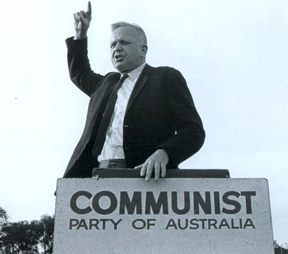
The original Communist Party of Australia ceased to exist in 1991*. So it is a long while gone. Many comrades here would have had no experience of it. Yet for most of its 70-year history the CPA was Australia’s major left party. At times the party had a significant impact on Australian politics — especially in the grim years of the Great Depression, during World War II and during the Cold War. Cynics used to make cracks about the “party” of ex-members of the CPA being the biggest political formation in the country but what is true is that over these seven decades probably scores of thousands of people saw the party as the vehicle with which to fight for a better world.

For decades the CPA was a strong militant force in the trade union movement. It played a key role in supporting various national liberation struggles (Indonesia in its independence struggle against the Dutch after World War II and much later East Timor in its fight); it fought hard for civil liberties (we can mention the Egon Kisch case in the 1930s and the fight against Menzies push to ban the party in the early 1950s). In the field of culture the CPA — through writers such as Jean Devanny, Frank Hardy, Dorothy Hewett and Katherine Susannah Prichard — developed a strong influence.

However, despite the many undeniably positive chapters in the CPA’s history there was another side. The CPA was created to fight for socialism and it recruited on that basis. But a gross contradiction developed. At the end of the 1920s the party became Stalinised. This meant that on all fundamental questions its politics were subordinated to those of the privileged conservative bureaucracy which had usurped power in the Soviet Union.

Read more....

Jun 23, 2009

SLIDESHOW:Justice For Mr Ward,Perth - Rally 20 June 2009

The national day of action for Indigenous rights saw small protest across the country this last weekend except in Western Australia.

See report on background to this protest : Racism kills: Demand justice for Mr Ward.

Made with Slideshow Embed Tool

AUDIO:Chiapas - Blitz on Human Rights: Julie Webb reports


7.4Mb. 100kbps mono. 12 mins

Julie Webb, journalist for "Scoop" gives us an update on the increasingly tense situation in Chiapas, particularly the harassment of the Human Rights organisation Fray Bartholome de las Casas, by Mexican government security and paramilitary forces. Chiapas peasants are living on land that the neo-conservative 'developers' want to get their hands on, and human rights organisations like 'Fray Barta' is often the only thing standing between them and outright pillage.

Popout

Jun 21, 2009

Reaching out one market at a time

In Brisbane we do the Deagon markets each week and I'm convinced that there is a lot to be gained by actually renting stall space at community markets and then promoting the location as you regular weekly 'office'/political space

Market foot traffic is so very different to the pace of other locations and there's a qualiative advance in the sort of exchanges you will be able to encourage.

Markets are also a major urban phenomenon that will continue to prosper for the simple reason that its good retailing economics.

Where we go insurance is covered in our stall fee.

Photo to top right -- Brisbane Northside Socialist Alliance around 8.30am Sunday morning at Deagon Markets

When I was in Glasgow recently, the local Palestinian campaign promoted their work on the basis of the one weekly access stall and handed out "business cards' so descriptive:

Brilliant!

VIDEO:The Unon Show: 17th June - Gippsland & Latrobe Valley

Jun 20, 2009

VIDEO:"Rudd: Your CPRS is a dud!"

Climate Emergency march & rally in Sydney, June 13, 2009.

Jun 18, 2009

Activists condemn massive Taser roll-out

Community activists in the Illawarra have condemned the NSW budget allocation of $10 milllion for more Taser stun-guns. They've renewed calls for a ban on the weapon after the death of a Queensland man last Friday who was shot 28 times with a Taser by police.

Chris Williams, Socialist Alliance convener in Wollongong, said: 'The government has been warned many times about the lethal potential of Tasers. This latest death in Queensland proves yet again the danger involved. The Rees government should reverse this allocation immediately and declare a ban on the use of Tasers.

'In addition to being dangerous, Tasers will be used disproportionately on the already marginalised. Last year's review of Tasers by NSW Ombudsman, Bruce Barbour, found that the weapon has most commonly been used against people with mental health issues. What a disgrace given the inadequate funding for mental health in this country', said Williams.


Jess Moore, Resistance organiser in Wollongong, said: 'Given the proven danger of Tasers, this $10 million roll-out is just outrageous! The Rees government has consistently under-resourced our schools, hospitals and public transport system, and yet it is spending a huge sum of money on this dangerous and controversial weapon.

'Research by Amnesty International shows that Tasers have been used by police officers against children, the mentally ill and the physically disabled. They have been used against people who are restrained. This money should be spent on services to assist the mentally and physically disabled, not on potentially lethal weapon that has been proven to be used on them.


'There is no independent research showing that Tasers are safe but there is a lot of hard evidence that they kill. How many people will have to die before Tasers are banned? They must be stopped from being used!' Moore concluded.


For more information contact Chris Williams on 0425 329 963 or Jess Moore on 0416 232 349

Or visit http://www.socialist-alliance.org/illawarra/

Background Queensland:
Queensland's Police Minister is rejecting claims he covered up details about the use of stun gun, in an incident in which a man later died. He's revealed that he, the Police Service and the police union knew on Monday that the Taser had been used 28 times.

Popout


Activism image

I like aggregating photographs for a Socialist Alliance group "pool" exercise on Flickr.

Some of the images are really good and you'd like them to get their own profile. Heres' one of them:
Taken by Peter Boyle at the June 13th Climate Emergency Rally in Sydney.

Left unity? Not now thankyou. But our day will come....

In my experience of factional polemic on the Australian far left I think this perspective below sums up the attitude of most socialist outfits to left unity and regroupment. So I gotta hand it to the Revolutionary Socialist Party for frankness after its two years of disputation within the DSP during which they sharply argued against the Socialist Alliance project.

Of course, I have a very different POV.
"However, in today’s conditions of continuing working class retreat the creation of a broad-left party of anti-capitalist resistance is simply not on the agenda. The necessary partners for such a party – substantial new class-struggle forces and leaders – do not yet exist and will not come into existence until there is a sustained mass upsurge of working class resistance...

"The only practical steps we can take towards the eventual emergence of a broad party of anti-capitalist resistance are building our own party, the RSP."

- RSP Perspectives Resolution, "Building the Revolutionary Socialist Party" Resolution adopted by First Congress of the RSP, June 6-8, 2009.
I think the late Jim Percy referred to this outlook as the "our day will come" approach to party building and socialism.

The irony is that now outside the RSP -- such local outfits -- local franchises of toy international projects -- as the Socialist Party and Solidarity --- may need to adjust their thinking as their mother parties in the UK , in the light of recent EU election results, are now discussing their options for some form of left regroupment.

Will things change here? And does the RSP realize that it may indeed be going in one direction while the rest of the left, albeit begrudgingly, proceed in another?


National Climate Emergency protests: what next?

A biopsy of our movement

By Ben Courtice

The June 13 Climate Emergency rally in Melbourne is a good opportunity for a biopsy of the local climate movement. Almost a year after the first Climate Emergency rally we can take stock of how much real progress has been made.

A positive protest
The spirited rally of maybe as many as 4000 showed the Melbourne climate movement at its best. A panel of sharp and political speakers played to a receptive and militant crowd. The march down Swanston St and the sit-in outside the Town Hall increased the public impact of the rally and the news coverage of and around the rally nationally was reasonable. The diversity of active groups was highlighted in the colourful array of banners, placards, puppets and so forth that festooned the march through the city streets.

Certainly, this rally was a positive and inspiring event for many. On the other hand, I spoke to at least two activists in the crowd who declared they were quite disappointed in the turnout. Should we be happy with 4000? Or should we be wondering what went wrong given that it was less than the May 17 climate Human Sign at St Kilda? That it was not discernibly bigger than last year’s climate emergency rally?

Just counting the numbers could miss the point. The political message, the public reception, and the way the rally was put together all say a lot too.

The first thing which is very positive is the active preparation for the rally by groups that brought banners, puppets and of course the bicycle band. It helped to turn a walk-down-the-street march into a veritable carnival of politics – as such demonstrations ought to be.

Secondly, in the lead up to the rally we distributed (an estimate) about 40-50 000 leaflets (out of the 60 000 or so we had printed). These disappeared quite easily and assuming they were actually distributed by the people who took piles, this is a pretty good effort for activists on the ground.

There were four banner drops over freeways, organised by people in Yarra Valley CAG, Moreland CAG, Families Facing Climate Change in Ashburton and WeCAN in the west. This effort may not have had a huge impact on commuters (some banners were taken down very quickly at the request of CityLink officers) but it shows a certain growth in suburban activism (relative to last year’s rally, the only real point of comparison I can think of).

The rally was incredibly visible, occupying the main street for an hour or so. One rally participant noted on Facebook that he thought as he sat outside Town Hall, "Gee, I haven't done a sit-in for years! Well, one where I actually end up getting dragged away!" We didn’t get dragged away this time, but the response from the crowd to the prospects of organising “civil disobedience” actions was positive, boding well for mass protests at Hazelwood later this year.

Read more...

Jun 17, 2009

VIDEO: Wollongong Billionaires for Coal and June 13 rally

In Wollongong the Socialist Alliance branch is doing great work. There's a significant coming together on the left which suggest that 'left unity' is indeed a very viable project when away from those who would dismiss its promise(and actuality).

Here are reports featuring local SA members and supporters on the recemt climate protests.

Chris Williams is the local Socialist Alliance convenor and Jess more is a leader of Resistance.

Challenging the "Two-Party System"

Challenging the "Two-Party System"
How far can we go?


A public forum to discuss the Fremantle election result and the prospects for building a workers' alternative to Labor.

Speakers:
Adele Carles (Greens member for Fremantle)
Les McLaughlin (CEPU Electrical division state secretary)
Sam Wainwright (Socialist Alliance state co-convenor)

Tues 30 June
6.30pm, Fremantle Education Centre
(cnr Cantonment & Parry Sts, Fremantle - next to Clancy's)

Entry by donation. Ph 9218 9608, 0412 751 508.
www.socialist-alliance.org

Jun 16, 2009

Billionaires for Coal

Wollongong's Climate Emergency rally - held on Saturday June 13 - was a fantastic success, over 300 people marched through the streets of Wollongong chanting loudly.

The crowd included union contingents, church groups, progressive political parties and concerned members of the community.

The very popular Billionaires for Coal stunt really helped publicise the rally. Check out the Billionaires...!!


House insulation, survival and sustainability.

New Zealand houses: draughty and deadly [ABC Science Show]

Houses in New Zealand don't protect their occupants from the temperate climate of high rainfall and strong westerly winds. The houses' designs are based on those from other parts of the world. And now adverse health effects have been measured. More people die in winter than summer, a higher proportion than in other countries. Even Siberia's houses offer more protection from winter conditions.

The same could be said about Australian housing and how the norm here is neither comfort suited to the climatic conditions nor the pressing rigors of sustainability in the face of Climate Change.

The question is, I suggest, how useful is Rudd's Energy Efficient Homes Package?


Popout

Jun 15, 2009

SLIDESHOW: Climate Emergency rallies around the country

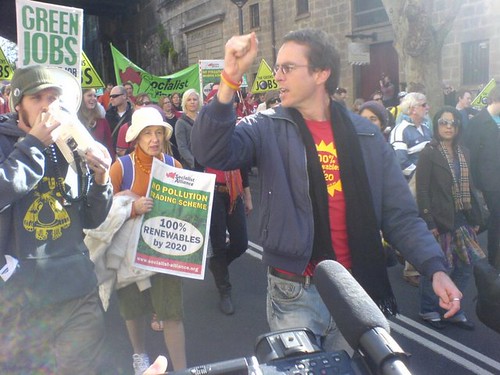
Last Saturday's environment rallies came off as a great beginning to the movement we need to build urgently. See GLW report here:Thousands rally for 100% renewables by 2020

Here are a few presentations on the rallies:


Made with Slideshow Embed Tool
Wollongong

Cairns

Made with Slideshow Embed Tool
Perth

Made with Slideshow Embed Tool
Sydney

Sydney

Made with Slideshow Embed Tool
Hobart

Created with Admarket's flickrSLiDR.
Melbourne

The political joys of delicious Folksonomy

Eh? What's Folksonomy?

And if you don't know , delicious is an online site where you can bookmark files and web pages by using tags.
Delicious (formerly del.icio.us, pronounced "delicious") is a social bookmarking web serviceweb bookmarks. The site was founded by Joshua Schachter in 2003 and acquired by Yahoo! in 2005. It has more than five million users and 150 million bookmarked URLs.[ for storing, sharing, and discovering]
So to order and classify the online files uploaded to the web for sharing for Socialist Alliance, we've deployed delicious for bookmarking.

And Voila!


Jun 11, 2009

NATIONAL CLIMATE EMERGENCY RALLY -- 13 JUNE 2009


JOIN THE RALLY FOR:

GREEN COLLAR JOBS
NO JOB CUTS

- 100% RENEWABLE ENERGY BY 2020

GLOBAL CLIMATE JUSTICE
- AUSTRALIA SHOULD TAKE THE LEAD

CLIMATE POLICIES THAT MAKE THE BIG POLLUTERS PAY

The National Climate Emergency Rallies
are an initiative of Australia's Climate Action Summit


LETS REPOWER AUSTRALIA!

Jun 9, 2009

Stop the SELL-OFF! -- Qld Socialist Alliance

How we can defeat Bligh´s privatisation plan
Queensland Premier Anna Bligh’s announcement that her government plans to sell off public assets including rail, ports, forests & roads is an outrage that has rightly angered workers, unions, pensioners and the Queensland public in general.

We all know that privatisation means workers being sacked, higher prices, and worse services – all in the name of profits for a few. This is exactly our experience with Queensland energy privatisation, Telstra & the Commonwealth Bank. Far from solving ¨budget challenges¨, revenues that previously went to public uses such as hospitals and schools instead flow to corporate bottom lines. And once privatisation is used as a means of ¨balancing the budget¨, it is a slippery slope for more sell-offs in future years.

The Economic Crisis: an argument for more public, not private, ownership


Bligh´s argument that the global financial crisis means she has no choice but privatisation is rubbish. While stating that she´s not “a Wall Street banker” that caused the crisis, but has to deal with it, her sell-off would hand over more assets to the very ¨Wall Street banker¨ forces that have caused the crisis!

And what is the crucial motive that justifies serious harm to workers and communities? Getting back Queensland´s ¨AAA¨ rating from Moody´s - the same Moody´s which has been complicit in the financial crisis! There is nothing sacred about ´AAA´ - even sections of NSW business criticize that State´s obsession with a AAA rating.

Rather than sacrificing communities to privatisations, we need to fight for the expansion of the public sector, in order to create a sustainable Queensland, moving to renewable energy as quickly as possible and radically expanded public transport.

Democracy? We never voted for privatisation!

Queenslanders are clearly opposed to the Bligh Government plan. Even Bligh´s own ALP branch in South Brisbane has voted for her expulsion from the party! Such moves are to be congratulated and should be repeated across the state and at the ALP Conference.

Yet it is clear that Bligh will ignore both her own party and the Queensland people - if she can get away with it.

How can we stop the sell-off?

Even if the ALP State Conference rejects the plan – which it should – the Government will try to ignore the conference decision. What is needed is a massive campaign that mobilizes the enormous opposition to the sell-off, and makes it impossible for the Government to implement their plan.

Such a campaign would include public protests to demonstrate the level of opposition, plus serious industrial action against any privatisation attempts. To build such a campaign we need a union-community alliance that involves all those opposed to privatisation.

The campaign in NSW against electricity privatisation, which brought down Premier Morris Iemma and has forced a partial backdown, shows what is possible.

The Queensland Council of Unions rally outside the ALP conference to show our opposition is a great start - but it´s only the start. A further step would be a mass rally and industrial action on June 16, the day of the state budget. This would send a strong message to the Government of what is coming if it persists with the privatisations. If they don´t back down, Bligh should meet the same fate as Iemma.

Our campaign must continue until the Bligh Government plan is shelved completely - we need to kill off all privatisation.

Get involved - Join the Socialist Alliance
($60 high wage, $30 waged, $15 conc, $5 school student, $100 solidarity)
Ph 07 3831 2644, 0410 629 088.
www.socialist-alliance.org

The European election results and the British far left

Now that the significance of the EU electoral debacle has set in the outcry is strident. Even Lenin's Tomb ( situated in the SWP camp)has had enough. Phil Hearse offers a straight talking analysis in a piece aptly titled If this debacle doesn’t wake up the British Left, absolutely nothing will.
As Lenin writes:We fluffed it, boys and girls. It has been obvious for some time that a fundamental crisis of social democracy was brewing, and that this was going to be deeper than ever before, and that nothing the left could do - even if it was so deranged as to want this - could rescue it. We watched a yawning political vacuum open up and, due to our shibboleths, totems and taboos, our inward-lookingness, our traditions of feuding, and many other flaws, we failed to fill it.Elections are not the be all and end all, and ultimately what will matter far more than such votes will be what we do between elections. But this was one important way for us to assert ourselves in this crisis, and we handed the initiative to everyone but the radical left. I am not saying we should hammer ourselves over the head repeatedly with such facts, but I think it would be healthy to begin by acknowledging them and resolving never to let that happen again.

On similar lines:
Phil Hearse points out: The outcome of the county council and Euro elections means that the British left – the left to the left of New Labour – has to wake up and break out of its dire sectarian, bureaucratic and factional mindsets. Nothing is more shameful than the lack of of united left slate, around a minimal set of demands in the interests of the working class, in these elections. The near-absence of the Left from the electoral field was one important reason – though far from the only one – that such a large number of the protest votes against the main parties went to the hard right UKIP and the fascist BNP. It is shameful that the Left abandons so much of the electoral field to the far right because of nothing more than hardened, bone headed, factional idiocy – topped off by bureaucratic exclusions and anathemas
.
Locally , Duroyan Fertl has a sharp analysis of the results here in the GLW elist.

The tragedy is that the British far left has had years of hard Labour to get its proverbial shit together and has cynically squandered it.

Which part of that do they not understand?

Even the initiative for the No2REU package had to come from outside the main socialist left orgs. Crappy program. Formed late in the show. But hey, it's something ....!

I don't mean to suggest that regrouping the left is a walk in the park. The Australian experience has been very difficult to negotiate (see:Uniting the Socialist Left: the Australian Experience for a review)

But at least we've been able here to keep our eyes on the prize and rather than wank on about unity and collective action, actually work at the coal face creating a small beginning pointed in that direction. Our task has often been handicapped by the very same political myopia that infects the English left -- a myopia that the UK left exports via a distribution network of various toy international franchises.

But will or can the English left change its spots?

See also:

Jun 8, 2009

Uniting the Socialist Left: the Australian Experience

An interview with Peter Boyle. Peter Boyle (pictured right) is National Secretary of the Democratic Socialist Perspective (DSP), a Marxist tendency in the Socialist Alliance in Australia. He was interviewed by Socialist Voice co-editor Roger Annis.
Over the next six months, in the lead-up to a DSP congress scheduled for January 2010, members of the DSP are going to have a serious discussion about party-building perspectives. How do we best build on the gains we have made through the DSP and the gains made through the Socialist Alliance? We’ll be involving Socialist Alliance members who are not members of the DSP in this discussion. It will be public...
SV: The Australian left founded a project of left unity and activism in 2001. Can you describe the early years of that project and what it achieved?

PB: The Socialist Alliance was formed in 2001 on the back of great optimism about the prospects for left revival in the wake of the rise of a movement at that time against capitalist globalization. Some 20,000 people had participated in a three-day long blockade of a summit of the World Economic Forum in Melbourne the previous year. That was Australia’s “Seattle” [1] and it was followed up on May 1, 2001 with mass blockades of the stock exchanges in all the capital cities of the country.

The formation of the Socialist Alliance was just one of a number of initiatives at the time to take this political momentum forward. While it has not had a smooth road since then, the Socialist Alliance is the only one of these initiatives surviving today in Australia. Regroupment projects inspired by anarchist ideology and attempts to create local social forums all proved short-lived.

The Socialist Alliance experience has been shaped by the ebbs and flows of the social movements. It became clear after the forward momentum of the post-Seattle anti-capitalist movement was cut off - after the failure of the global mass movements to stop the 2003 invasion of Iraq - that we were overoptimistic in 2001. We have seen movement retreats since then. But there have been some advances, too.

We should also see the connections between the global wave of anti-capitalist sentiment a decade ago and the new rise of anti-capitalist sentiment today: one builds on the other.

SV: What political forces initiated Socialist Alliance, and what new forces have been won to it?

Read more...

Jun 5, 2009

VIDEO:Celebrating the June 1 FMLN inauguration in El Salvador

On June 1, Mauricio Funes and Salvador Sanchez Ceren were inaugurated as President and Vice President of El Salvador. CISPES was on hand for the historic occasion, at both the official inauguration and the popular celebration at the Cuscatlan Stadium. Que viva!