.

Showing posts with label Crime Fiction. Show all posts
Showing posts with label Crime Fiction. Show all posts
Nov 22, 2011
Two useful documentaries on noir fiction
Useful? Maybe they are essential viewing if you want to get a feel for the scope of what's out there especially in the Nordic countries.

Nov 15, 2011
CRIME FICTION : There is no mourning with dignity: Karin Fossum

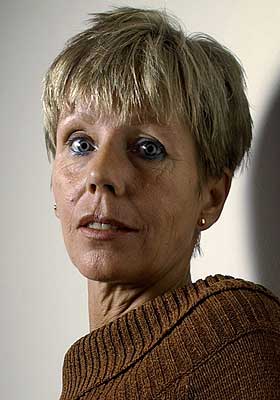 |
| Karin Fossum |
I think Karin Fossum is the most emotionally interesting of crime writers. She moves you and makes you think about our relationships to one another in our communities. Regional Norway becomes a crucible of the rest of our existence and what assumptions may rule our perceptions. Her stories aren't so much about Inspectors Konrad Sejer and Jakob Skarre but about us. These coppers are mere conduits to confronting underlying conundrums. This story has a lot to say about the relationships mothers have with their young sons and sons have with their carers; about the yearning to have children and the struggle of child rearing.
The criticism levied at this novel -- that it indulges pedophilia is bunkum. In Fossum's universe there is no strict separation between good and evil. The medley of humans existing, of growing up and ageing in cohabitation with one another -- in the communities bequeathed to us -- is far more complex and engaging that the simple rule of law. Law, after all won't explain brutality -- it serves at best only as a means to assuage it.
In that sense Fossum isn't a very noir novelist. Darkness isn't as pervasive as the over bearing complexity that we have to deal with every day especially among the other humans with whom we co-exist.
But then Fossum is always open to lightness (and being! if you want to be truly empathetic) , to hope and the pleasures that we can obtain through knowing others -- including, it needs to be said, faithful dogs! We need to celebrate these pleasures because when we lose them -- such as through murder -- the loss is the more difficult to bear.
Pain is given absolute respect by Fossum. It is never a plot device. Pain and anguish, rather than murder and sin, are the most human of our collective existence. It is what enriches our humanity. It's not the dirty deeds --- dirty and brutal as they may be -- but that we must all learn to live with the weight of their dead hand.
So for Fossum the prospect of loss -- of having loved ones brutally taken from us -- is the most painful of what we may have to bear.
The funeral described in the novel captures that anguish so very well. After a ritualised, highly theatrical ceremony, seemingly beautifully engineered, the facade falls apart:
"Then something happened. No one was prepared for it. The vicar was shocked, everyone could see that. Some people clasped a hand over their mouth in fear, and Sejer felt an icy chill shoot down his back. Elfrid Løwe started to scream. The service had helped her maintain her composure, she had clung to the vicar's voice, but now she was screaming uncontrollably heartbreakingly, a protest which made people jump in their pews. The screams came from deep within her and pushed their way out with a force no one would have believed such a tiny woman possessed. For the best part of an hour the vicar had built a fragile construction of comfort and resignation. Now she tore it down. She screamed and she demolished it and people could no longer mourn with dignity."
Mourning with dignity? Evil doers will be punished (if not by us then by some god)? Law and coppers can make it all better again?...that's what society asks of us, or at least, asks us to believe in.
That's not how Karin Fossum tells it.
Jun 26, 2011
CRIME FICTION: The Redeemer -- Jo Nesbø and the consequences of history
 The Redeemer by Jo Nesbø
This guy is one of the best writers page by page in crime fiction. His plotting is convoluted but always engaging and leads to so much mystery you keep wondering who dunnit. His sense of place -- Oslo -- is revetting. Despite Harry Hole's alcoholism, it is a nice change to accompany a sleuth who is not over ruled by angst or depression. He may be handicapped by his demons but not so that that is the over bearing storyline.
Nesbø also has a moral compas -- so very non judgemental -- that I strongly relate to as he does not take the easy peasy 'evil' route out as though that supposedly explains 'crime' and the rest of what ails us. Everyone lives in a Nesbø novel in the real tangible world of everyday life experience. Some grow up to be coppers/others become crims -- seemingly for very good personal reasons.
He also has a handy knack of making the best use of the characters he introduces us to as they come and go. Their roles are always serviceable and coincidentally --as you learn as you read on -- relevant to what may later unfold despite the author's penchant to assemble his novel as montage.
Nesbø also has a great feel for contemporary realpolitick especially the present day politics of Europe. So his stories are open to a lot of input from the rest of the world's penchant for struggle and tragedy. The plots aren't enclosed or inward looking despite the small size of their placement patch in Oslo.
Here there are multiple tragedies and personalities who come together to feed off one another in a multi layered plot about a determined hit man who takes a lot of pride in his work. Determination and pride such that you have to respect it.
But as with other works by Jo Nesbø there is a respect for the dead hand of history which bears down on the present. Both story and characters are placed in this chronological continuum where the individual story -- and a much broader human tragedy -- merges.
In his Redbreast Norway's occupation by Fascism during the Second World War is called to account and played out through a story of retribution.
In The Redeemer a parallel balance sheet is being addressed such that you feel when reading Nesbø you need to go back and check the actual history -- in this case, the slaughter of Croats in Vukovar in 1991.
Nesbø respects the consequences of history -- a sentence we cannot escape.
May 25, 2011
'Gone With the Wind' gone noir : 'Leave Her to Heaven'

Last night I watched -- riveted -- the 1945 noirish color pic 'Leave Her to Heaven' An excessive melodrama with Gene Tierney as a cold blooded murderer come narcissist.
It is 'Gone With the Wind' gone noir -- except for the rich Technicolor and unbearably lavish and picturesque locations. The woman's madness and obsession creeps up on you but for all that dramatic intensity the whole femme fatale moniker -- ie: don't trust women despite their seeming passivity and subservience -- seems to have passed its used by date as the decades moved on into Feminist mode.
More recently the device is used to denigrate Feminist pretensions and undermine confidence and assertiveness-- witness Fatal Attraction. After all it is unnatural for ladies to kill...! [Unless they're being uppity.]
It's roll back spin.
But in the case of 'Leave Her to Heaven' a certain logic kicks in. The crimes make sense in a warped and deviant -- 1940s --way. That the film was made in 1945 when Rosie the Riveters were being sent from the work benches and back to the kitchen sink as breeders, the discomfort generated by the film still echoes now 65 years later.
Tierney's performance however, and the way the story unfolds, suggests something else that makes Leave Her to Heaven's melodramatic intensity a cautionary tale for the time. Tierney's character -- Ellen Berent Harland -- is a woman who is very much a victim of her own desire to possess a man (Cornel Wilde as Richard Harland). In that sense Leave Her to Heaven is a warning that despite any one man's pleasant and loving disposition or appeal -- to allow yourself to be caught up in him rather than be yourself can lead to all sorts of complications for the unwary ... or the unstable.
This makes for a tragic turn. A sentence. Men may not be the enemy but women's dependence on men is fraught with serious complications not assuaged by either manslaughter or suicide.
Last time I looked, this is a very different twist to the Postman Always Rings Twice and Double Indemnity franchise. This isn't women enticing and corrupting men but women making their own customized -- albeit warped -- way. That the murderous intensity is also focused on harm to self as a killing tool makes the whole thing that much more distressing.
This is an unforgettable movie experience. Tierney's performance and her superb dramatic pitch is captured in this pivotal murder sequence (below). Tierney's dark green eyes are shaded to add to the malevolence involved.
As Noel Coward said:
"I want to tell you, Miss Tierney, you gave me one of the most memorable evenings I ever had in the theater in your film Leave Her to Heaven. When I saw the expression on your face in the sequence in which you drowned the boy, I thought, 'That was acting.'"
May 9, 2011
Dark days on the bayou: James Lee Burke

My rating: 4 of 5 stars
I read all I can of James Lee Burke. I guess with so many crime fiction writers of my engagement -- it's an addiction...to character, to location, to attitude.
But Burke is an acquired taste I'm sure because of his over riding lyricism. Some sections of this novel -- the latest in the Dave Robicheaux series -- are achingly evocative of time and place with a sense of humanism that's driven by a rich poetic. His nibs -- Robicheaux -- may be doing one thing but there is always filagree time to stop the doing (like arriving at a front door, or look into the eyes of a corpse or driving along a country road) and make some -- actually more often there are many -- discursive remarks about the weather, the locale, the human condition and our moral context.
Some times I put the novel down at these reading moments and think, "Wow!" this is almost Elizabethan dramatic mode -- modern soliloquies without use of iambic pentameter. In Burke's hands the characters are mere play things in a preset tragedy that unfolds in King Lear mode -- so long as we can assume that the good guys are going to prevail at the end. It even has plenty of thunder and lighning to add to the ambiance.
And towards what end it will be! This is always tragedian stuff, devoid of humor and with a massive slaughter to be negotiated. New Iberia, Louisiana may be a Robicheaux bailiwick -- presumably to guard and protect -- but as is the crime fightin' norm, the local death toll is sure to have significant census implications.
Carnage apparently is as American as apple pie in the gun totting south. If you cannot kill your neighbours and muse on about it, then what sort of patriot are you supposed to be?
And that's Burke's primary contradiction: despite his overriding humanism, his sense of protest and outrage against the oligarchy that rules his patch, Burke resolves conflict by taking out the opposition one carcass at a time . Since this part of Louisiana is Serial Killer Central , we are to assume that this is how justice prevails.
Old Sparky never gets a look in.
But I -- in my own Elizabethan way perhaps -- protesteth too much. It's a fun ride. I love it. You read Burke and you don't really care about the plot, let alone the solution to the crime(s) because it is all about the journey. The Burke iconography of grotesque characters have to be profiled to be believed. These weird inhabitants of New Iberia have substance . They're there on the page. Accented. Clothed. In your face.
Just don't take them home to meet mum.
And their gestures are dramatic in the sense that they are observable and sensuous. They are a sort of Commedia dell Arte recruited to serve no one but James Lee Burke, dramatist.
The Glass Rainbow has all this in heaps. It is Burke business in over drive. With Robicheaux's off sider --- Clete, an ex cop now working as a PI -- mixing in big time with the narrative, this is a double barrel war on evil where ever it lies. Evil that is with a capital Southern drawl 'E'. I don't think Burke has scaled such heights of grotesque melodrama before and bought it off so well. The dark side of Americana here rises up with enough moral challenge and confidence to may be even over-power Robicheaux himself. "Good" has to work very hard indeed to prevail in this novel. Evil is everywhere -- and where it does not invade, or corrupt, it is abetted by indifference and a default complicity.
In fact, The Glass Rainbow is the darkest view of America you'll get from Burke. Grimy and repulsive crime is so entrenched and pervasive that Libertarian solutions at the point of a good guy's gun don't seem enough any more. Government, the oligarchy and organised crime are now politically indistinguishable as their collective pursuit of personal self interest have merged.
It is dark days indeed on the bayou.
Burke's world is great place to visit. But I wouldn't want to live there.
Jun 6, 2010
CRIME FICTION Henning Mankell, Wallander author on the Gaza Flotilla he was part of

Henning Mankell, the renowned Swedish crime writer and author of the Wallander series, was on board the Sophia, which formed part of the Gaza Flotilla, when Israeli commandos raided the ship.
Speaking at a press conference in Berlin after spending 24 hours in an Israeli cell, Mankell accused the Israelis of “going out to commit murder” and says he witnessed the shooting an elderly passenger with a stun gun.
Mankell described how he was woken at 4am and told that the ship Mavi Marmara was under attack.
Passengers on the Sophia could see helicopter spotlights and hear weapons firing. They couldn’t find out exactly what was happening because communication had been stopped by the Israeli military.
Then, at 4.35am, the Israelis attacked the Sophia. Passengers and crew had decided not to resist, and stood on the bridge. Masked commandos landed, carrying submachine guns and forced them all below deck.
“We had elderly people among us, who perhaps weren’t so quick on their feet,” says Mankell. “One of them was shot in the arm with an stun gun and he fell to the floor in pain. Another man was hit with a rubber bullet and also fell to the floor.”
The soldiers then searched the ship. After a while they came back and said they had found weapons. “We said, ‘What weapons? There aren’t any weapons on board this ship.’
“Then they showed us a wet razor—my razor. Then they showed us a little knife from the kitchen, which the Egyptian cook used to open provisions.”
“When we got to land, something happened that I will never forget. One after the other, we were led into a prison—we had to run a gauntlet between two lines of soldiers.
“The soldiers never identified themselves but they filmed us the whole time, though Geneva Convention forbids treating civilians like this.
“And I can testify that they stole everything I had. They stole my camera, my phone, my money, my credit card, my clothes—everything.
“A policeman said to me, ‘Either we’ll deport you or you’ll go to prison.’
“I asked, ‘What am I accused of?’ He said, ‘You have entered Israel illegally.’
“I replied, ‘What are you talking about? I was kidnapped and forced to come here’.”
Mankell angrily rejects accusations that people who protest against Israel are anti-Jewish.
“I’m not an antisemite. I am against the current policy of Israel towards the Palestinians. I’m against it, because it’s a kind of apartheid. I was against apartheid in South Africa and I’m against apartheid today.”
“I prefer not to be one of the useful idiots who sit around and cynically assert that solidarity isn’t worth anything. I’d rather not belong among them.”
Mankell vowed to continue the fight to free Palestine.
“This time we came with six ships, and we’ve seen the Israeli reaction,” he said. “But what if we came back in a year with a hundred ships? What would Israel do? Bomb us?
“Wouldn’t it be a better idea for Israel to lift the blockade?”
Apr 22, 2010
CRIME FICTION Ken Bruen's cops: post traumatic stress disorder as a literary form

Ammunition by Ken Bruen
(St. Martin's Minotaur), July 2007 US
Synopsis and reviews
Bruen's even handed commitment to rough noir may seem a bit relentless if it wasn't so often a seemingly true take on the way people -- such as coppers -- go about their lives. Quaint English Bobby stereotyping this aint.Amid the Metropolitan Police Force these characters are in the main ethically challenged as though registered cowboys had gone mad in sync with one another and taken over the town. This is Dodge City in London town fueled by drugs and alcohol -- and that's only the wallopers' sustenance!
(St. Martin's Minotaur), July 2007 US
Synopsis and reviews
Bruen's even handed commitment to rough noir may seem a bit relentless if it wasn't so often a seemingly true take on the way people -- such as coppers -- go about their lives. Quaint English Bobby stereotyping this aint.Amid the Metropolitan Police Force these characters are in the main ethically challenged as though registered cowboys had gone mad in sync with one another and taken over the town. This is Dodge City in London town fueled by drugs and alcohol -- and that's only the wallopers' sustenance!
Maybe Bruen's an acquired taste. While I cannot unconditionally embrace Bruen's characters -- I find I'm still uncomfortably resistive in their presence -- I can relate to them as disheveled products of where're they're at and while I would not invite any one of them home to meet mother, I defer to the fact that their stories are told with precision and some very sharp prose.
I so love the way Ken Bruen writes. No thrills nor pretension nor manipulated point-of-view 'attitude'. With verbiage kept to a minimum there's nothing to get between you and what's happening on the page.
Detective Sergeant Tom Brant -- Bruen's hero in a series of (so far, seven ) crime novels (this is the latest -- 2007) -- may be for all intents and purposes a dedicated sociopath. But if you step back and look at the genre overall, Brant wears all the contradictions that rule the lives of so many crime fiction heroes -- whether gumshoe or copper -- who simply reign over their own slice of the creative universe with impunity. Regardless of what they get up to -- it's Ok because there's a story in it and, in fiction, the creative ends justifies the means.
With Brant, there's the rest of the Old Bill to deal with. While the top brass may try to maintain a certain protocol and format order for showcase purposes, Bruen leaves us in no doubt that policing is a sham exercise ruled by self interest and politics. So Brant and his creator are governed by deep cynicism and perhaps a sense of the tragedy of it all. Here there is no room left for idealism. The cops are as one -- a spent force running on auto pilot serving only to manage crime rather than solve or prevent it.
Bruen's knack is his ability to explore the consequences of giving legal power and weaponry to individuals as a career path, and then monitoring the ongoing consequences on their psyche. It's post traumatic stress disorder as a literary form as the gutter they are employed to clean up, inundates them.
And when you come down to the wire -- cop or crim? -- we're left with the choice betwen the lesser of two evils.
Mar 5, 2010
CRIME FICTION Dominique Manotti remakes the crime novel
 American crime fiction, despite its many addictive attractions, always seems to be caught up in replicating the libertarian laissez faire of the American Old West. With writers such as Elmore Leonard there was an easy transition as he stopped writing Westerns, continued to utilize the same archetypes, and wrote contemporary crime fiction instead.
 The man who could write such stand out Western yarns as Hombre and Three-Ten to Yuma, later found a comfortable niche creating Mr. Majestyk and Get Shorty from the same stuff. The ethos was more or less the same.
But elsewhere on the planet that template has been broken , or simply by passed. European crime fiction today is also much richer and more variious than the exploits of John Rebus, Maigret or Kurt Wallander . And within that capacity to remake the crime novel, is Dominique Manotti.
Rough Trade is the first of her novels to be translated from its original French (originally published in 1995). This is as far from a neatly orchestrated who-dun-it? as you can get. Most of the time you aren't sure who is supposed to be the hero as there is so much activity driven by cynical street politics that there are no self evident good guys to latch onto. While this is a police procedural , the gendarmes are not to be trusted. Nothing is what it seems in this tale set in the Sentier district of Paris -- just after the 1979 Iranian Revolution, and prior to a major shift in the international drug trade that followed.
How these events relate to the brutal murder of very young Thai girl is uncovered by Inspector Daquin who has to watch his back as much as he investigates the murder. But nothing is even that simple as the Sentier is not only the centre of the Parisian rag trade, but those who mostly work in the district's sweatshops are Turkish, and many members of the workforce are illegal immigrants. So the take home pay and working conditions of illegal immigrants has a lot to do with the many layers of corruption that infect the industry. While the Turkish workers are trying to organise a trade union to secure base rates of pay, others are seeking a return from more nefarious pursuits and among those so engaged are some leading politicians, mandarins ... and coppers.
Manotti's novel has been called neo-realist and it certainly has a pervasive grubbiness that is very palpabe, even shocking at times. Because it unfolds consecutatively day by day, even hour by hour, it has a stark immediacy that meanders through a complex web of inter-relationships and competing self interests. But for all that, Manotti writes as a detached observer leaving events to speak for themselves as even the many incidences of violence and corruption merge with a much broader, even international, political reality.
How she has managed to reference her work on such an epic scale, make political sense of it and still create bona fide crime fiction at the level of a few neighboring Parisian blocks is a major literary achievement.
Manotti, Dominique -'Rough Trade (translated by Margaret Crosland and Elfreda Powell)Paperback: 272 pages (Apr. 2006) Publisher: Arcadia Books ISBN: 1900850877
Mar 3, 2010
CRIME FICTION Leonardo Padura Fuentes -- the doyen of Cuban crime fiction

The Havana Culture website when not promoting Cuban rum carries a few interesting cultural titbits such as this video interview with Leonardo Padura Fuentes -- the Cuban crime fiction writer.
Leonardo Padura Fuentes is the most widely known author working in Cuba today. He has written movie scripts, two books of short stories and a series of detective novels translated into 10 languages at last count. His political essays serve as teaching aides for university courses around the world.
I love Padura Fuentes fiction and his The four seasons/ Havanna Quartet is an observant window into contemporary Cuba and the outlook of his generation, born after 1959. I highly recommend the read for an insight into the contradictions of the present Cuban experience.
His writing is a seductive mix of outlooks which mesh together and try , you could almost say they compete with one another, to come to some sort of political resolution -- even though the novels don't seem to be "political " in the ideological sense we may expect. But the stories house an ongoing dialogue that moves back and forth through time in order to give the present a substance that may give it tolerable meaning. Padura's characters may be alienated but their estrangement has neither a meaning nor etiology that can be identified in the way we may engage with our own disaffections.
So if you want to begin to understand Cuba today -- maybe in the crime fiction of Leonardo Padura Fuentes is where you can start.
LEONARDO PADURA / Leonardo Padura's interview
Jan 29, 2010
CRIME FICTION -- Ian Rankin ‘Crime fiction is about social inequality’

The Hindu newspaper has carried an interesting piece featuring Scottish crime writer Ian Rankin in conversation with Prakash Karat about the Rebus novels, new trends in crime fiction writing, politics in India, and more.
Ian Rankin is the best-selling writer of crime fiction in the United Kingdom, accounting for 10 per cent of all its crime book sales. The Edinburgh-based Scottish writer is best known for his 17-novel series featuring Inspector Rebus, which has been translated into 22 languages and won him a worldwide following. Prakash Karat, general secretary of the Communist Party of India (Marxist) who studied political science at Edinburgh University, describes himself as an “avid Rankin fan.” He has read every Rankin novel and has impressive knowledge about recent trends in crime fiction. The Hindu arranged for a conversation between the writer and his fan in Chennai, with the help of the British Council. Like a Rankin novel with multiple plotlines that encompass many ideas, the discussion covered subjects from crime fiction writing to politics in India.
Prakash Karat: It’s a pleasure to meet you. I have read all the books in which [Inspector] Rebus figures. What accounts for the phenomenal popularity of Rebus?
Ian Rankin: I wish I knew. Because then I could pass the information on to other people. The books weren’t successful in the beginning. The first book came and went and it was hardly reviewed by anybody and sold very few copies. It wasn’t put forward for any prizes.
Karat: That was Knots and Crosses.
Rankin: Knots and Crosses. It didn’t even get shortlisted for the Best First Crime Novel of the Year Award. Then I brought Rebus back. That was meant to be just the one book. It was never meant to be a series. But I brought him back because I got intrigued by his character. I found him quite a complex individual with a lot of problems and of course that makes somebody interesting to write about. But the books were still very unsuccessful right up until Black and Blue, which was I think book number eight or nine in the [Rebus] series and something like my 14th or 15th novel.
It just clicked. It sold four times as many copies as previous books. Word of mouth helped. A lot of booksellers were very good. People would come in and say, ‘I’m looking for a crime novel.’ ‘Oh, have you tried this guy’ or ‘If you like Ruth Rendell, you may like Ian Rankin’ and that was useful as well.
And the books became better and better as I learnt the craft. So the books did get better. So I guess all the early novels were an apprenticeship and the apprenticeship was leading to Black and Blue.
Karat: Like Rebus, you belong to the coal-mining country or working-class Scotland. How much of that has pervaded your books?
Rankin: A fair amount, I think. Rebus’s background or upbringing is very important. It is what made him. He’s a self-made man. Unlike me, he didn’t go to college or university. He represents the way my life could have gone. My parents were working class. My dad worked in a dockyard. My mum worked in a factory canteen serving up food. They never owned their own house. They never had a car. They didn’t do much travelling. And I was the first member of my family to go to university.
By the mid-Seventies, the coal mines were finished, mining was uneconomic. So the time we grew up in Cardenden was depressed and a lot of people were out of work. And about the only jobs that were available were with the police or the armed forces. Rebus does both. He starts off leaving school at 15 and joining the armed forces and then when he leaves under a cloud, he eventually gets taken on as a police officer. So maybe that is me saying this was the alternative life waiting for me, if I hadn’t been the black sheep of the family and gone to university.
Karat: You introduced Rebus and policing in Knots and Crosses. How did you get interested in police affairs or police work?
Rankin: I wasn’t interested in crime fiction. I am the only crime writer I know who wasn’t a fan of crime fiction before I became a crime writer. What interested me is what a police officer could do – the access that was available to him. I wrote to the Chief of Police in Edinburgh, ‘I’m writing my first novel and it’s about a detective and can you help me?’ He sent me to a police station in Edinburgh, where two detectives were waiting. Sadly for me, it turned out that the plot of my first novel, Knots and Crosses, was very similar to a real crime they were investigating at that moment. So in my first foray in research I became a suspect in a murder inquiry! The first Rebus novel I did research. Two, three, four, I didn’t do any research. And it wasn’t until a detective came up to get a book signed, at a book shop in Edinburgh, and said, ‘Ian, I like your books but you make some procedural mistakes,’ that I started to get the details right. He became a friend and he became a good source of information.
Karat: I studied at Edinburgh University in the late Sixties. In your books, Edinburgh is so different from the popular perception of being a picture postcard city. You write about the underbelly of Edinburgh — the criminal enterprises, the gangs. That comes as a surprise to many people who don’t know Edinburgh. Was Edinburgh like this some 30 or 40 years ago, or has it become like this now?
Rankin: That was part of my original intention. I started writing stories, poems and eventually novels about Edinburgh to try and make sense of the city. This was at a time in the early Eighties, when Edinburgh had the worst per capita problem with heroin and AIDS/HIV in Europe. But nobody was discussing it, nobody was writing about it, and nobody seemed to be trying to change the situation. Edinburgh also had housing estates that were so run down. The politicians didn’t seem to be doing anything about it. When you arrive in Edinburgh, if you arrive in the centre, it’s almost like Disneyland. You know, there are monuments, museums, the castle, the history, the tradition…Old Edinburgh, tourist Edinburgh, is ringed by problem areas that the tourist never has to see. What I really wanted to say to people was that Edinburgh was a more complex city than you think, and that it’s a city that despite appearances has a lot of social issues and problems. And again, crime fiction is perfect for discussing those problems.
Karat: Crime fiction as a genre is now doing very well. And you and Henning Mankell in Sweden and Michael Connelly in the United States have been at the forefront of this new breed of crime fiction writers over the last two decades. Is crime fiction being taken more seriously?
Rankin: It is being taken more seriously than it was previously. But it is still the case in some cultures, and the U.K. is one of them, there is still a certain literary snobbery. A lot of people won’t read crime fiction, because they think it means Miss Marple…it means obscure poisons used to kill the cardinal in the billiard room. I’m afraid crime fiction has moved a long way from there now. What I like about crime fiction is the sense of place. You are right to mention Michael Connelly and Henning Mankell. If I want to find out about contemporary Sweden or contemporary Los Angeles, I will go to these writers. Not to the literary writers, but the crime writers.
The situation has changed in perceptions about crime fiction, because crime writers are writing better and better books that deal with serious issues and big moral questions. The quality of writing has improved since the early days of crime fiction and I think the moral core of the books is stronger than ever. So I think because better writers are writing crime fiction, doing it with more serious intent, it is being taken seriously. You can now study my novels in high school in Scotland. There are various literary courses at the universities in the U.K and beyond where you can study crime fiction. This is a good example of how the situation has changed. There is a Professor of English at the St. Andrews University who has written a book about my books. Thirty years ago, when I went as a young man to the University of St. Andrews, in my final year at high school, to ask them what modern literature would I study here as a student, the answer — straight-faced, no irony — was John Milton. Paradise Lost! That was modern. Now you can study the novels of Ian Rankin. So there have been changes, and the changes in academia will eventually translate into changes in popular perception. And then the prizes will start to consider — the Booker Prize, the Pulitzer in America — will start to consider crime fiction.
Karat: I’ve read a book on Black and Blue, written by Gill…
Rankin: Gill Plain! The very person I’m thinking of!
Karat: Oh I see, right (laughs). Are we going to have to get used to a world without Rebus now that you’ve retired him?
Rankin: I don’t know. I mean the Rebus series did something fairly unusual in crime fiction – allowed the detective to age in real time. You get very little sense that Poirot or Miss Marple or Sherlock Holmes or many previous characters in crime fiction get older or learn from the experiences, learn from the cases they’re involved in. I knew that Rebus would be changed by every case he worked on and also I wanted him to live in real time, so that I could trace the way Edinburgh was changing over time. I couldn’t see how the city could change and the main characters remain exactly the same. So come 2007, when he was 60, he had to retire, because that is the retirement age for detectives in Scotland. This was problematic for me because I didn’t feel I’d finished with him, and he didn’t want to retire. But he had to. I’ve since learned that there are various ways that he can come back.
Karat: In your books there’s always something about the contemporary situation, about politics. So what exactly is your politics?
Rankin: Well, a television interviewer tried to find out a while ago. I was going to go on a show called ‘Question Time,’ which has mostly politicians on the panel and people ask them questions. They interviewed me for an hour before the show to try and discover my politics. And they said, ‘It’s very difficult Mr. Rankin, very difficult. In some ways you’re liberal, in some ways you’re slightly to the right, and in others you’re quite far to the left.’ That’s how I feel; like a lot of people, I think, I slide between issues and I slide between parties. I think it’s possible to like one MP and think that you agree with them but you don’t agree with their party. I guess I’m independent if I’m anything, and I want to feel independent. But the closest friendships I have in politics are with the Left, from Gordon Brown, the Prime Minister, to Alistair Darling, who’s currently in charge of the Treasury, who lives very near me in Edinburgh, to the local MPs and MSPs [Members of the Scottish Parliament]. But I also know liberal MPs and MSPs, and one or two on the right, one or two Conservatives, not too many.
Karat: I think a good crime fiction writer cannot be right-wing. All of them deal with real problems in society and being right-wing, I imagine, would make them look at issues in purely black-and-white terms.
Rankin: I think you would be surprised. I am never sure with P.D. James. If her politics is to the right, centre-right, I think. She’s in the House of Lords. Ruth Rendell sits in the House of Lords on the Labour benches. P.D. James, I think, is a cross-bencher, which means she isn’t affiliated to one particular party. In America, I know several crime writers who are quite right-wing, I mean several Republicans. James Ellroy, I think you would find if you talk to him, he would be Republican.
Karat: He likes your books (laughs).
Rankin: I know he likes my books (laughs). But you don’t need to like the person’s politics to like his books! You don’t need to like the writer sometimes to like his books. In the U.K., a thriller writer like Jeffery Archer is a Conservative politician. And Frederick Forsyth, very famously, is also of the right.
Karat: But they are thriller writers.
Rankin: You are right, thriller writers. Thriller writers in the U.S. tend to be right-wing. That is an interesting distinction perhaps.
Karat: You have been in India now for a few days. Do you think there is a serious readership for crime fiction? You have met quite a lot of people in different places now.
Rankin: Well, I would say there is. I have had very good audiences, very passionate audiences who not only know my work but know the work of my contemporaries and of course other writers from round the world. There is now a burgeoning crime fiction scene, there are young writers in India beginning to write crime novels. I have picked up a couple of them that I will read when I get home. I think crime fiction is almost like a product of capitalism. It’s about social inequality. Why do people do bad things to each other? Much of the time, it’s economic. It’s to do with basic human nature — greed, a sense of injustice, other people having things that you want, a sense of grievance that something’s happened at work. That’s what I like about crime fiction specifically. It tells us that the civilised world is just a veneer, a very thin veneer. And the things that tie us together as a society can be torn apart at any second — torn apart by domestic terrorism, by international terrorism, by uprisings, by disasters that are human-made like the earthquake in Haiti. It took only a few days for the veneer to break down, and for people to start fighting each other for food and looting. We do have the potential for goodness, the potential to do wonderful things. But we all have the potential to do bad things. That’s why I am fascinated by Jekyll and Hyde. All my books are really about reworking the basic theme of human beings containing within them the ability to do terrible things as well as good things.
Karat: Do you have anything to ask me about Indian politics? Or the Left in India?
Rankin: Indian politics, I’m only just beginning to scratch the surface. It’s such a huge country. I have been asking people — there must be distinction between national politics and regional politics. Because with a country this size, I think you can’t have a centrist approach. Different areas will have different [characteristics]. Then you’re very dependent on the people working locally. Do you have a popular grassroots approach?
Karat: There is a very strong trend working for a more federal India. Because the real India is in the various States. We have a wide variety of regional politics and regional parties. Here in Tamil Nadu, for example, the governments have been run by regional parties for more than four decades. None of the national parties has been able to win elections here. At the centre, you have to have coalition governments because the regional parties also have a lot of clout in their own States. The Left has its own spheres of influence; we have three State governments. Therefore, it’s become more decentralised in one sense. At the same time, it is still, according to us, too highly centralised and we want more decentralisation, more autonomy for the different States. It’s ongoing work, to try and restructure the Indian state.
Rankin: What I’m very impressed by is that India actually works. Because you’ve got different cultures, different religions, people of different political colour, all trying to work in this huge vibrant country. As technology comes in, as the middle class becomes established, a much broader middle class than used to exist, I think some vast changes are under way in this country and it’s up to the politicians to keep it together.
Karat: We’ve just done 60 years as a Republic today. We have a democratic system which works, at least. We’ve made it work in these last 60 years. I think that’s the biggest achievement.
Rankin: That’s fantastic. Scotland has just had devolution for 10 years. We’ve got a certain amount of autonomy from the government in London. And we’ve got a nationalist party in power for the first time ever in Scotland, which would very much like to take Scotland forward to full-scale independence. I mean, that’s the whole reason a nationalist party exists. People in Scotland seem to be very happy with the way the nationalists are running the country as part of a devolved government. They don’t seem to be so happy with the notion of independence.
Nov 26, 2009
CRIME FICTION Sjöwall and Wahloo's denoument for the post war boom

My rating: 5 of 5 stars
Is this the best of the 10 written by Sjöwall and Wahloo? Ironic, more bitter and cynical than its predecessors (it is the second last novel published), more than any other it is sharply critical of Swedish society of the mid 70s. If there is a Martin Beck world view, and Martin is no ideologue, this is it. Separated from Stockholm and working a case in Skane there's more opportunity for reflection and for the plot to explore a wry satirical look at the way modern journalism and state power bends reality for preferential ends.
The way these two writers construct their plots and engineer their POV is superbly crafted. They set a threshold for crime fiction that seems now only to relate to those Swedish writers who came after them. The pity is that they warrant much more deference than they get. This isn't pulp fiction by any stretch of the imagination but literary works that masquerade in a simplicity and coherency of language that ensured that none of these novels are either over written, or dramatised to the point of exaggeration. Beck is not living a fictional lifestyle, or inhabiting a mythic capacity to solve crime. He is a character in a broader existence which he cannot control or manipulate but which throws at him -- and us -- the capacity for evil through what we do to one another as our society trims our options and corporatizes our resources.
The irony is that the political dialogue that is housed in the Martin Beck series is a dénouement for the post war e boom that by the time Beck was being written up was running its course. If the welfare state was the best of all possible worlds then god help us, it is a sham.
So for those who may share a mixed nostalgia for the days before Neo-Liberalism took over, the novels of Sjöwall and Wahloo are a sharp warning that the trickle down effect wasn't trickling much at all even in everyone's favorite welfare state template, Sweden.
The one draw back with the Beck series is that after you've read the ten novels, that's it.One was published after Per Wahloo's premature death and we've had to wait until this recent republishing to be reminded of what a remarkbale series these novels are.
So there's only one thing for it: read them again, and again....
Nov 25, 2009
CRIME FICTION Rain Gods -- living out our tragedian lot

Not your regular James Lee Burke character but an aging town sheriff with more in common with King Lear than a mythic Wyatt Earp. Burke's protagonists are usually pursued by demons -- often gathered up in past imperialist wars -- and with Sheriff Hackberry Holland the dead hand of the Korean War rests on his mind as a nightmare of regret.
Despite the very busy plot, this novel is about the mind of a man who knows that life is finite and often, in the choices we are forced to make, the nemesis with which we struggle is so often a mirror of what rests within ourselves. So in his pursuit of mass murderer and elusive apocalyptic madman, Preacher Jack, Holland has to stretch his measure if only to keep up with the slaughter with a few notches of his own.
It can be bloody hell in Texas, even today -- but when Burke addresses the criminal intersection between people smugglers, drug dealers and pimps; his novels function as tragedies -- or, to be more precise, near tragedies -- as despite the murder and mayhem some one has to live through it all so there can be a sequel.
That Holland or another Burke hero will survive may be a given, but en route it's all about the getting of wisdom and Burke's novels are meditations on the human existence formatted by competing moralities and coarse pragmatisms played out at the point of a gun.
Evil makes sense in Burke's world. All deeds are sensible. What may seem like a good idea at the time is really about making a living the best any character knows how. There is judgment that separates good from evil, and punishes accordingly and the price for victory is always too high. But at least, in the end, things can get back to normal.
That we fight these fights in a world of stunning beauty, of sunsets and lightning storms, is mere ambiance not the gods making a ruling on our petty squabbles at the point of a gun.
In that sense 21st Century James Lee Burke has moved on from William Shakespeare and now under the regime of our modern democracies we get to live out a tragedian's lot so long as we do harm to others.
Sep 15, 2009
CRIME FICTION:Steig Larsson -- socialist and anti-Fascist activist.
Now here's something I didn't know.Organized Rage informs us:
Read a brief review of the second novel in Larsson's trilogy here in our Crime Fiction pages.
It seems the genre of the detective novel is highly popular in Sweden; and Mankell’s great rival there was Stieg Larsson, whose trilogy of novels have sold over 14 million copies worldwide, and like Mankell’s Wallander, are also to be adapted for Swedish TV. The Girl who Kicked the Hornet’s Nest, the last of the three book trilogy is due to be published in the UK on October 1st.
The key to Stieg Larsson books is class privilege and arrogance, justice and revenge. I new little about the authors and I was pleasantly surprised to read in a recent article by Nick Cohen of Stieg Larsson background as a socialist and anti fascist activist, although sadly he died aged 50 in 2004. ...Before become a best selling author Stieg Larsson had edited Fjärde Internationalen, the journal of the Swedish section of the Trotskyist Fourth International, he was also a co-founder of the Swedish anti Nazi/racist Expo Foundation, similar to the British Searchlight Foundation, and was a hate figure for the Swedish far right.
We're hanging out until October when the final book in the series is to be published here in Australia.
Sep 13, 2009
CRIME FICTION: Havana Red -- Padura's quest for meaning
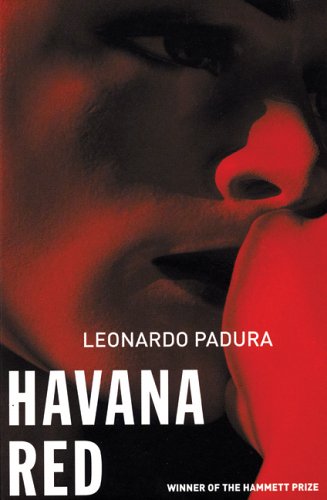
 Havana Red by Leonardo Padura Fuentes
Unfortunately I'm still missing one volume in Padura's Havana Quartet so I cannot make a ruling on the 'set' overall. However, Havana Red -- the first in the series -- is the most thoughtful.
Leonardo Padura is a remarkable novelist not only in the way he engages his themes but also in the way he constructs his stories.
Superficially, the Havana Quartet is made up of 4 stories about the Havana police inspector, Mario Conde, who is depicted as a contemporary hard boiled investigator, a la Philip Marlowe. He even comes across as a bit of a gender dinosaur fueled by plenty of Cuban machismo (and rum). But this impression, seductive as it may be in delivering to your hands some Latin pulp fiction exotic, is deceptive.
For one thing Padura doesn't write to rule. The plot and the murder that justifies the plotting is really a frame to hang a discourse on about Cuban society. To do this Padura utilizes some creative effects which turn his novels into drama and like some ancient Greek play, you get treated to these long monologues articulating much more that what supposedly is a record of a police interrogation .
Padura does indeed call his novels 'metaphors' and after you've read a few of them you get the meaning of the fictional journey much sooner than if you were only reading with relaxation in mind.
In that regard, Havana Red is the most sophisticated of the three I've read from the quartet. While it certainly deserves its numerous literary prizes, Padura also has a mission other than a purely literary one. He deploys the 'Count' -- Conde's nickname -- as a excuse to explore the Cuban approach to homosexuality and creative freedom.
In the novel, a gay character had suffered much for his sexual preference and his avant-garde approach to the theatre. This tragedy, which reflects the actual impact of some approaches that were pursued in the early seventies, is the montage that deepens the political and social meaning of the murder of a young transvestite.
Anyone familiar with the history of homophobia in Cuba should recognize that "Latin machismo, Catholic bigotry, and anti-gay Stalinism combined in the early years of the Revolution to limit specific legal reforms for lesbians and gays." What Padura does is try to draw up an accounting of that as it relates to , what was, when the novel was published, the early nineties. This quest for meaning in the context of the actual revolution as is -- warts and all -- is the most exciting and , I think, creative feature of Padura's writing.
I think a lot of readers may miss this insightful approach to these topics and read Padura's works as throwaway paper backs. But there's real artistry here, and there is a lot more than story telling being told. I think Padura has been able to take the crime novel into the realm of a broader significance without being in the least bit polemical about it. In doing that he launches into a discussion with his generation of Cubans.
This isn't the intense outcry of angry young men and women, in the protest way we are used to in our capitalism. Mario Conde's mission -- one fueled by alcohol, cigarettes, sex and an obsessive sense of righteousness-- is a quest for identity.
Leonardo Padura is a remarkable novelist not only in the way he engages his themes but also in the way he constructs his stories.
Superficially, the Havana Quartet is made up of 4 stories about the Havana police inspector, Mario Conde, who is depicted as a contemporary hard boiled investigator, a la Philip Marlowe. He even comes across as a bit of a gender dinosaur fueled by plenty of Cuban machismo (and rum). But this impression, seductive as it may be in delivering to your hands some Latin pulp fiction exotic, is deceptive.
For one thing Padura doesn't write to rule. The plot and the murder that justifies the plotting is really a frame to hang a discourse on about Cuban society. To do this Padura utilizes some creative effects which turn his novels into drama and like some ancient Greek play, you get treated to these long monologues articulating much more that what supposedly is a record of a police interrogation .
Padura does indeed call his novels 'metaphors' and after you've read a few of them you get the meaning of the fictional journey much sooner than if you were only reading with relaxation in mind.
In that regard, Havana Red is the most sophisticated of the three I've read from the quartet. While it certainly deserves its numerous literary prizes, Padura also has a mission other than a purely literary one. He deploys the 'Count' -- Conde's nickname -- as a excuse to explore the Cuban approach to homosexuality and creative freedom.
In the novel, a gay character had suffered much for his sexual preference and his avant-garde approach to the theatre. This tragedy, which reflects the actual impact of some approaches that were pursued in the early seventies, is the montage that deepens the political and social meaning of the murder of a young transvestite.
Anyone familiar with the history of homophobia in Cuba should recognize that "Latin machismo, Catholic bigotry, and anti-gay Stalinism combined in the early years of the Revolution to limit specific legal reforms for lesbians and gays." What Padura does is try to draw up an accounting of that as it relates to , what was, when the novel was published, the early nineties. This quest for meaning in the context of the actual revolution as is -- warts and all -- is the most exciting and , I think, creative feature of Padura's writing.
I think a lot of readers may miss this insightful approach to these topics and read Padura's works as throwaway paper backs. But there's real artistry here, and there is a lot more than story telling being told. I think Padura has been able to take the crime novel into the realm of a broader significance without being in the least bit polemical about it. In doing that he launches into a discussion with his generation of Cubans.
This isn't the intense outcry of angry young men and women, in the protest way we are used to in our capitalism. Mario Conde's mission -- one fueled by alcohol, cigarettes, sex and an obsessive sense of righteousness-- is a quest for identity.
Aug 30, 2009
CRIME FICTION:Jose Latour's old time Havana cesspool
 Havana World Series: A Novel by José Latour
Latour is a skilled storyteller and seems to bring a fresh POV to all his novels. While known as a crime fiction writer the excuses deployed on the wrong side of the law seem always formatted by a pragmatic approach -- despite what may be the consequences, the crimes always seems like a good idea at the time.
In this case, the 1958 Baseball World Series is a element and backdrop to a heist executed a few months before the victory of the Cuban Revolution. With the Batista dictatorship in hock to the Mob, and real life crim,Meyer Lansky,reaping a windfall from his Havana casino investments, the fly in the ointment isn't just the guerrillas in the Sierra mountains.
Because he keeps competitors out of Cuba, inter mob rivalries look upon relieving Lansky of some of his largesse as an investment worth the risk. So a heist, in Danny Ocean style, seems like a good idea.
Developing a fictional story at such a historical cusp seems a stunning dramatic ploy but the advancing revolution is nonetheless relegated to background fill. Latour utilizes the Cuba of a past epoch as an excuse to explore crime interaction in a Caribbean sin hole with very little dynamic , aside from atmosphere and corruptable government, driven from the historical circumstance.
That wasn't what I was expecting. You have to read novels like James Elroy's American Tabloid to be served political intrigue obsessed with the old regime in Havana as Latour's story could comfortably sit in isolation among the any one of the Oceans Eleven franchises -- prettified with rum and Cuban cigars-- but set in Las Vegas.
Why Latour avoided the import of the impending revolution in his story seems a bit strange as he is now, after emigrating to Spain and more recently to Canada, hostile to the revolution from which he has turned his back. So the self evident question of whether the 1959 Revolution was a good idea or not is simply left hanging and the only happiness pending is the prospect of escaping the Mob's revenge or Batista's torturers.
What a cop out! But one thing's certain: Old Havana -- as run by the likes of Lansky and Batista's cronies -- like any cesspool, needed a thorough cleansing.
Aug 22, 2009
CRIME FICTION:Lisbeth Salander in situ and in Stockholm
 The Girl Who Played with Fire by Stieg Larsson
Volume Two of the trilogy which is an addictive page turner primarily due to the main protagonist -- Lisbeth Salander.
All the other devices Larsson has used are second fiddle to this core characterisation which take the books (I've read two and a third is to be published in English in October) to an exceptional level.
It is nonetheless good story telling and whatever may be your hesitancy when you first begin to read these pot boilers -- Lisbeth will win you over as something very real in a hostile world.
The core themes about misogyny and media spin are buoyed up , as in Volume I , by another conspiracy driven plot line. All rather shallow except for.... our heroine.
The contrived plotting doesn't really dwell in the identifiable real world of our own experience of big money and credibility -- but really once you engage, you're hooked and of the millions who are reading Stieg Larsson's trilogy, many of those are reading the 400 odd pages in each volume in one sitting.
So something is happening between these covers. While Larsson's moralism is laid on pretty thick through the person of Lisbeth's partner in sleuthing, Mikael Blomkvist — a crusading journalist and publisher -- you can't complain that he has chosen to target sex trafficking as the novels' primary exposee.
Liberal good will carries these novels a long way but in order, inevitably, to settle upon an explanation of why things occur as they do, you have to be ever ready to accept another conspiracy of complicity.
Sweden has a history of socially engaged crime fiction and the main writers in the genre feed off one another. But with Larsson the exploration is very insular and shallow with no attempt to explore anything broader than a few on hand evil bastards who seem to come out of the Ikea woodwork fully kited out for their role.
But with Lisbeth Salander in situ and in Stockholm, all is forgiven.
CRIME FICTION:Leonardo Padura Fuentes: the imperialist vulture and the making of Havana Noir
 Havana Black: A Lieutenant Mario Conde Mystery by Leonardo Padura Fuentes
My rating: 3 of 5 stars
I intend to write a more general review of the crime fiction of Leonardo Padura Fuentes on another occasion.While I'm no expert on Cuban literature I'm going back and forth between Padura and those fellow crime writes, unlike Padura, such as José Latour, who have turned their back on the revolution in order to get a feel for the fictional dialogue that is in motion.
And it is fascinating -- almost, in its own way, unique. If there is indeed a Havana Noir driven by evil and violence -- where is that coming from? What's its root source? I mean, what's the motivation for the criminal deeds?
If you are going to write crime fiction set in Cuba what crimes do you invent to tell your story?
I'm not suggesting that Cuba is free of crime but you'd expect the crime pattern to be a little different from what we may be used to in our comfortable capitalisms. What's also fascinating is how politically engaged these novels are in the way that their narratives are played out within the chronology of the Cuban experience -- the 1959 revolution, the relentless blockade, the Angolan war, Marielistas and the exile community in Miami, etc.
And bearing down, investing the cultural context with a very dark noir, is the impact of "the Special Period" and the consequential growth of income disparities and the Black Market.
So in a remarkable way, Cuba today is ripe for crime fiction because it is ripe for crime in the plebeian way it has not been for some time.
While we so often associate crime fiction with a sort of decayed cynical capitalism, wherein the state op or the PI explores crime as a symptom of a broader decay, in Cuba the same etiology prevails. And inasmuch as I've read enough stuff to make a ruling, inevitably the criminal experiences there -- both for real and in the writer's imagination -- are skewed by the refraction of Cuba's experience of the festering sore of imperialism which bears down upon the island like an opportunistic vulture -- performing at one and the same time the role as promised land and as brutal master who can so often only be embraced through some form of corruption.
This isn't so very hard to comprehend. Any Cuban knows that to survive in the belly of the neighbour to the north, you'll need gringo dollars and to accumulate those in Cuba ain't an easy ask.So what you see is this back and forth ambivalence in regard to the US threat and the US promise. It aint easy to primitively accumulate capital in Cuba so exile isn't a easy or necessarily clean way out of the rigors and deprivations of the "Special Period".
But embedded among all this is, in the case of Leonardo Padura Fuentes at least, is the frustrated aspirations of Cuba's 'lost generation' -- those like the post war baby boomers who enjoyed the fruits of the 59 revolution, only to yanker for more of what they cannot quite put their finger on. In that sense, Havana Noir -- esp Padura's novels of the Inspector Conde quartet -- panders to the frustrations and pessimism of a revolution now stuck in a sort of historical idle mode.
The Conde quartet -- the four seasons comprise:
- Pasado perfecto ("Havana Blue", 2007), 1991
- Vientos de cuaresma ("Havana Yellow", 2008)), 1994
- Mascaras ("Havana Red", 2005), 1997
- Paisaje de otoño ("Havana Black", 2006), 1998.
Jun 24, 2009
CRIME FICTION:Putting the black into film noir
Devil in a Blue DressReviewed by Norm Dixon -- 7 February 1996
Tristar Pictures
Written and directed by Carl Franklin
Based on the novel by Walter Mosley
Starring Denzel Washington, Jennifer Beal and Don Cheadle
Released nationally on February 8

Devil in a Blue Dress is a taught, gripping, atmospheric gumshoe thriller set in segregated Los Angeles circa 1948. The film has its quota of corpses, gun fights, crooked politicians, dirty coppers, red herrings, the mandatory femme fatale, and a hero with dry wit and wry observation. But there much more to this film than your average tough, hard-bitten private dick pic. Devil is a parable of 20th century African American urban history in a noir wrapping. It's the context that makes the film so compelling and, it should be noted, the novels of Walter Mosley compulsory reading.
Director Carl Franklin consulted left activist Mike Davis' social history of LA, City of Quartz, to get the racist structure of '40s LA down pat. He meticulously reconstructed the barber shops, record stores and clubs that lined Central Avenue, once the "West Coast Harlem", although Walter Mosley's mum complained there were too many cars in the film, and I would add that they were too new and shiny.
The soundtrack full of great '40s r&b, criminally pushed far into the background, is spellbinding. With millions of other African Americans, soon after the second world war, Ezekiel "Easy" Rawlins (Denzel Washington) joined the "great migration" from the south to the cities to find work. It was a time of great hope. The US had won a war for democracy in Europe, and blacks were going to share in the prosperity and liberty so loudly promised by their rulers. Easy believed the promises. He moved to LA, found a job in an aircraft factory, borrowed enough to buy a neat little house with a lawn, fruit trees and a front verandah.
But Easy's stake in the new order, like that of most blacks, is tenuous and at the whim of the white powers that be. Easy loses his job when he refuses to grovel to the cracker boss. He's behind in his house payments, and his precious home is on the line. It's then that Easy is confronted with an almost Faustian choice when a shady white carpetbagger offers him $100 to find Daphne Monet (Jennifer Beals), who has gone missing in the black part of town.
Easy knows there has to be a catch, but to maintain his little patch of America he decides to do a deal with this white devil. Easy is convinced he can maintain his dignity, his sense of right and his commitment to his community despite it all. Remarkably, by and large, he succeeds. By the end of the film, Easy's illusions in democracy and prosperity are severely tested. The irony is that he survives only because of the loyalty of his best friend, Mouse (Don Cheadle). Mouse is everything that Easy is fighting to avoid becoming: a person without a shred of morality, who can kill and injure without the blink of an eye, whose only goal in life is to survive. It is a paradox that perplexes Easy throughout the film and into Walter Mosley's next three novels.
The release of Devil in a Blue Dress casts a brilliant spotlight on the work of Walter Mosley, whose novels follow in the tradition of the great African American crime writer Chester Himes. During a recent visit to Sydney, Watts-born Mosley explained in a newspaper interview, "I'm interested primarily in poor black people. That's my roots. I write about us -- our lives, our history and the issues which even in today's so-called enlightened society are still murky."
Mosley's novels -- beginning with Devil, then A Red Death, White Butterfly, and finally Black Betty -- are set between 1948 and 1961. As time passes, reflecting the mood of the black population as a whole, Rawlins becomes increasingly conscious and militant. Mouse becomes increasingly desperate and dangerous. See the film, read the books.
This article was posted from Green Left Weekly --7 February 1996
Apr 27, 2009
CRIME FICTION:REBUS'S EXIT
REBUS’S EXIT
Exit Music
By Ian Rankin, Orion 2007
460 pages, paperback £6.99
REVIEW BY ALEX MILLER
Exit Music is the 17th and final novel in Ian Rankin’s Rebus series. The series, which began in 1987 with Knots and Crosses, features the hard-bitten and hard-drinking Edinburgh detective John Rebus.
The book takes us up to Rebus’s official retirement from duty, and is up to the high standard set by Rankin in the previous books in the series. As always, Rankin manages to combine a gripping storyline withy vivid characterisation of person and place, and displays his usual skill in capturing the mood and pulse of Edinburgh.
Published just before the current crisis besetting global capitalism, Exit Music sees Rebus having brushes with various unsavoury characters connected with the enormously successful First Albanach Bank (FAB). FAB is surely a thinly-disguised reference to the Royal Bank of Scotland (RBS). A sign of how much of what is solid has melted into air since 2007 is that FAB and its nearest competitor are described as having profit margins larger than the GDPs of many small countries. Of course, these days RBS and HBOS (Halifax Bank of Scotland) have potential deficits larger than the GDPs of many small countries.
Musing on the upper echelons of FAB – “with their games of golf and their ‘quiet words’, their stitch-ups and handshakes, palm-greasing and scratching of backs” – Rebus comes to a conclusion that most socialists would agree with: “it wasn’t so much the underworld you have to fear but the overworld”. Indeed, later in the book Rebus appears to edge unintentionally close to Marx. One character in the book describes poets as “our unacknowledged legislators”, and following on from his experiences with FAB, Rebus reflects that the title of unacknowledged legislators really belongs “to the men in the pinstripe suits”. Or as The Communist Manifesto puts it: “The executive of the modern state is but a committee for managing the affairs of the whole bourgeoisie”.
Overall, Rankin’s Rebus books do for contemporary Edinburgh what McIlvanney’s Laidlaw books earlier achieved for Glasgow, and Exit Music provides a fitting finale to an ingenious and compelling series.
Exit Music
By Ian Rankin, Orion 2007
460 pages, paperback £6.99
REVIEW BY ALEX MILLER
Exit Music is the 17th and final novel in Ian Rankin’s Rebus series. The series, which began in 1987 with Knots and Crosses, features the hard-bitten and hard-drinking Edinburgh detective John Rebus.
The book takes us up to Rebus’s official retirement from duty, and is up to the high standard set by Rankin in the previous books in the series. As always, Rankin manages to combine a gripping storyline withy vivid characterisation of person and place, and displays his usual skill in capturing the mood and pulse of Edinburgh.
Published just before the current crisis besetting global capitalism, Exit Music sees Rebus having brushes with various unsavoury characters connected with the enormously successful First Albanach Bank (FAB). FAB is surely a thinly-disguised reference to the Royal Bank of Scotland (RBS). A sign of how much of what is solid has melted into air since 2007 is that FAB and its nearest competitor are described as having profit margins larger than the GDPs of many small countries. Of course, these days RBS and HBOS (Halifax Bank of Scotland) have potential deficits larger than the GDPs of many small countries.
Musing on the upper echelons of FAB – “with their games of golf and their ‘quiet words’, their stitch-ups and handshakes, palm-greasing and scratching of backs” – Rebus comes to a conclusion that most socialists would agree with: “it wasn’t so much the underworld you have to fear but the overworld”. Indeed, later in the book Rebus appears to edge unintentionally close to Marx. One character in the book describes poets as “our unacknowledged legislators”, and following on from his experiences with FAB, Rebus reflects that the title of unacknowledged legislators really belongs “to the men in the pinstripe suits”. Or as The Communist Manifesto puts it: “The executive of the modern state is but a committee for managing the affairs of the whole bourgeoisie”.
Overall, Rankin’s Rebus books do for contemporary Edinburgh what McIlvanney’s Laidlaw books earlier achieved for Glasgow, and Exit Music provides a fitting finale to an ingenious and compelling series.
Apr 18, 2009
CRIME FICTION:Cuba: crime fiction and free health care
 Detectives Beyond Borders: A Forum for International Crime Fiction --Peter Rozovsky's self evident musings on crime fiction has some interesting comments about the Cuban crime writer, Jose Latour.
 I've not read any of this Cuban exile's novels but Rozovsky digs up a quote from his latest, Comrades in Havanna that's worth a hearty scoff :
"Under capitalism, many nations had achieved what he had been led to believe only communist societies could: free education and health care."Cuban artists (and sportspeople) who high tail it outter there for big bucks elsewhere always play up to the role assigned to them by the US ideological template -- while always failing to note that their experience of recognition and encouragement of their achievements relied so much on the conditions of the very process they now professionally denigrate.
This actual situation is touched on in a comment and interview with Leonardo Padura, in the ShotsMag crime fiction zine, who is referred to as Cuba's Hammett -- and the Godfather of crime fiction on the island:
In case you are thinking that I'm too black and white, Rozovsky notes another segment of Latour's novel as a reflection on what's on offer for Cubans from the outside 'forces of democracy' if they retake the country:For those who tend to support the revolution blindly and those who tend to attack it from a position of ideological ignorance, this book should be particularly challenging. For it is clear that Padura is a critical voice from within. At times the sarcasm and behaviour of his policeman indicates an almost heretical attitude. Yet Padura remains in Cuba and is celebrated, certainly by the artistic community and the general population, as one of the nation’s greatest authors.
Padura’s presence in the island and his novels are a great achievement because they illustrate that Cuban socialism is not as repressive as its enemies claim it to be, while at the same time showing that Cuba is perhaps not as perfect as some of its friends might want us to believe.
Padura’s Havana is a heterogeneous place, where the macro politics of the Cold War, the blockade and the confrontation with the United States is not mentioned but broods ominously behind the text where the characteristic scarcities and contradictions of the 1990s are ever present. Padura’s reality is thus carefully nuanced and not easily bracketed into any ideological point of view.
In a sense therefore, Padura exemplifies the maturity of Cuban socialism in that it has been able to produce an author of such ability and education (his influences are wide-ranging - from Shakespeare to Salinger, Cervantes to Montalban, Mozart to Lennon) who is able to create a credible fictional Cuban world that is recognisable to visitors and Cubans alike and which is relevant to the times we are living through.
Some Cuban politicians might feel uncomfortable reading these stories, but then that is precisely the kind of popular literature that Gramsci called for. True art, said Gramsci, is about depicting life as it is now - whereas politics is always about some great future that is going to be. For that reason, he explained, the politician would always be at loggerheads with the artist.
Padura is such an artist. He makes the reader sit up and think, using the medium of the detective story not to propagandise but to philosophise. His novels might be described as morality tales for the post-Soviet era.
One of the defectors, a central figure in the novel:"`But we've reflected on the excesses of democracy and the shortcomings of communism a hundred times. Are we going to do something about it? No, right? So leave it to the naive dissidents who risk their freedom, maybe even their lives. They haven't figured out that when communism falls, Cuban-Americans will give them a medal and a pension before rigging the elections and taking charge. Politics sucks, Victoria."
Subscribe to:
Posts (Atom)