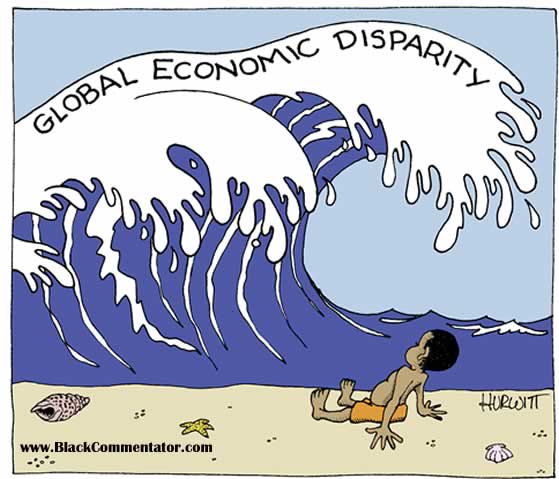

In the current issue of GLW, there are interviews with keynote guest speakers John Bellamy Foster and Ian Angus and also a profile article about the three young Cambodian women activists who are coming to the conference.


Low-Wage Capitalism describes in sweeping detail the drastic effect on the working class in the United States of new technology and the restructuring of global capitalism in the post-Soviet era. It uses Karl Marx's law of wages and other findings to show that these developments are not only continuing to drive down wages but are creating the material basis for future social upheaval.
The analysis rests on three basic developments in the last three decades:
While the book concentrates on changes in the U.S., restructuring is a world phenomenon. Goldstein's general analysis also applies to the imperialist countries of Western Europe and Japan. The book discusses how:
- The world's workforce available to exploitation by transnational capitalist corporations doubled in the wake of the collapse of the USSR and Eastern Europe.
- The technological revolutions of the digital age, in both production and communications, have allowed transnational corporations to destroy high-wage jobs and simultaneously expand the global workforce to generate a worldwide wage competition.
- The decline in the economic condition of the workers, driven by the laws of capitalism and the capitalist class, is leading to the end of working-class compromise and retreat and must end up in a profound revival of the struggle against capitalism.
Presented in May 2008 at the international conference in Cuba on "The work of Karl Marx and the Challenges for the 21st Century." Now expanded into a full book, Fred Goldstein lays a basis for workers to understand and respond to the deep crisis rocking the world economy.
- Advanced processes of production promoted by the corporate giants in low-wage countries have changed the international division of labor within world capitalism.
- The "national wage" is being supplanted by an international determination of wages as worldwide wage competition lowers the floor.
- Since the late 1970s, the vast majority of U.S. workers have seen a decline in wages and living conditions as permanent, high-paying jobs with benefits disappear.
- The rise of the multi-earner family represents a hidden, class-wide wage cut for U.S. workers.
- Restructuring and technology have especially impacted on African-American workers.
- Women have flooded into the workforce, most at low-wage jobs, in order to survive.
- Increased exploitation of Latin@s and other immigrants is an integral part of globalization.
- Highlights from past struggles provide a guide to future action and organization.
- It takes a broad workers' movement to fight for the economic and social needs of all.
- Breaking out of the traditional capital-labor relationship is essential to the defense of the multinational working class in the era of low-wage capitalism.

Author and former investment banker, John Talbott, joins The World Today to explain why he believes the President's proposed reforms won't prevent another economic collapse. Mr Talbott's books warned about economic instability, and predicted the US housing market collapse.
Can we afford a roof over our heads?

I fear that I have become extremely trendy without knowing it. I’ve never been one to partake of fashion’s brief moments of in-ness. Instead I always assumed that I moved to the beat of my own drum.| The Daily Show With Jon Stewart | M - Th 11p / 10c | |||
| CNBC Financial Advice | ||||
| comedycentral.com | ||||
| ||||
Are you worried about the future of the environment, or war, or hordes of refugees? The solution is not to manipulate population growth. Past results have been tragic, and ineffectual. Historian Professor Matthew Connelly of Columbia University proposes some alternatives.
This is an exploration of the background and causes of the Capitalist Economic Crisis and what should be the response from workers and pensioners. I had composed it initially in powerpoint and then followed that up with reviews and re- editing.
So for the experience, I transposed the presentation into video format. It scrubbed up rather nicely I think and I'm sure to be doing more of the same(Although -- make note of please David -- I should have created a larger file for better image quality)

I.O.U.S.A. – the 30-Minute Version from IOUSA the Movie on Vimeo.
I.O.U.S.A. is a film that examines the rapidly growing US national debt and its consequences for the United States and its population. It comes from a conservative perspective but it reviews the financial context very well. The key question is: who is gonna pay? Them or us?
...And they say socialism can't work!