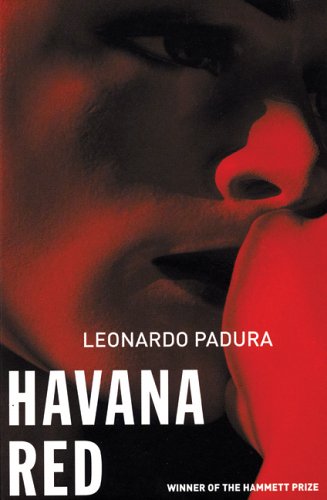
Havana Red
by
Leonardo Padura FuentesUnfortunately I'm still missing one volume in Padura's
Havana Quartet so I cannot make a ruling on the 'set' overall. However,
Havana Red -- the first in the series -- is the most thoughtful.
Leonardo Padura is a remarkable novelist not only in the way he engages his themes but also in the way he constructs his stories.
Superficially, the
Havana Quartet is made up of 4 stories about the Havana police inspector, Mario Conde, who is depicted as a contemporary hard boiled investigator, a la
Philip Marlowe. He even comes across as a bit of a gender dinosaur fueled by plenty of Cuban
machismo (and rum). But this impression, seductive as it may be in delivering to your hands some Latin pulp fiction exotic, is deceptive.
For one thing Padura doesn't write to rule. The plot and the murder that justifies the plotting is really a frame to hang a discourse on about Cuban society. To do this Padura utilizes some creative effects which turn his novels into drama and like some ancient Greek play, you get treated to these long monologues articulating much more that what supposedly is a record of a police interrogation .
Padura does indeed call his novels 'metaphors' and after you've read a few of them you get the meaning of the fictional journey much sooner than if you were only reading with relaxation in mind.
In that regard, Havana Red is the most sophisticated of the three I've read from the quartet. While it certainly deserves its numerous literary prizes, Padura also has a mission other than a purely literary one. He deploys the 'Count' -- Conde's nickname -- as a excuse to explore the Cuban approach to homosexuality and creative freedom.
In the novel, a gay character had suffered much for his sexual preference and his avant-garde approach to the theatre. This tragedy, which reflects the actual impact of some approaches that were pursued in the early seventies, is the montage that deepens the political and social meaning of the murder of a young transvestite.
Anyone familiar with the history of homophobia in Cuba should recognize that "Latin machismo, Catholic bigotry, and anti-gay Stalinism combined in the early years of the Revolution to limit specific legal reforms for lesbians and gays." What Padura does is try to draw up an accounting of that as it relates to , what was, when the novel was published, the early nineties. This quest for meaning in the context of the actual revolution as is -- warts and all -- is the most exciting and , I think, creative feature of Padura's writing.
I think a lot of readers may miss this insightful approach to these topics and read Padura's works as throwaway paper backs. But there's real artistry here, and there is a lot more than story telling being told. I think Padura has been able to take the crime novel into the realm of a broader significance without being in the least bit polemical about it. In doing that he launches into a discussion with his generation of Cubans.
This isn't the intense outcry of angry young men and women, in the protest way we are used to in our capitalism. Mario Conde's mission -- one fueled by alcohol, cigarettes, sex and an obsessive sense of righteousness-- is a quest for identity.


 Alexis García Iribar was born in Cuba, in the province of Guantánamo. He suffered from a congenital cardiopathy known as persistent arterial duct. At the age of 6 and after successive deferrals and hemodynamic complications, he had to be submitted to an open-heart surgery on March 9, 2009, because the government of the United States prevents the US companies NUMED, AGA and Boston Scientific from selling to Cuba the ‘amplatzer’ and ‘embolization coil’ devices required to perform a catheterization that will spare children from this type of surgery. I could mention another 12 cases of children between the ages of 5 months and 13 years who have had to undergo a similar procedure in the course of the last one and a half years –two of them underwent surgery after last January 20.


 By Fidel Castro Ruz