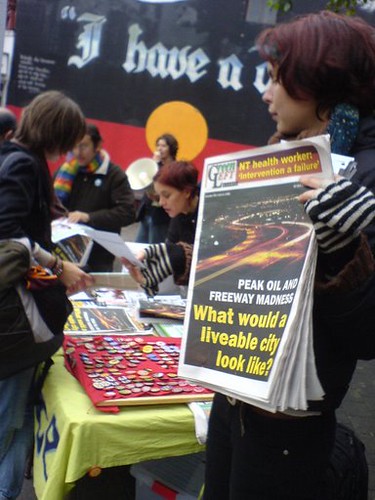
Sam Wainwright with Justine Kamprad.
Justine Kamprad is a co-convenor of the Fremantle branch of the Socialist Alliance, in Western Australia (WA), and was the party's campaign director for the October 17, 2009, Fremantle City Council election, which saw socialist Sam Wainwright top the poll and get elected with 33.44% of the vote. Wainwright is the first member of the Socialist Alliance to be elected to public office in Australia, and one of only two socialist party members currently in an elected local council position in the country. Jim McIlroy spoke to Kamprad about the successful campaign.
* * *
What were the main aims of Sam Wainwright’s election campaign?
The main goals of the campaign were to engage the local community, and create the hope that their activism could be effective. That was a huge part of the campaign. When Sam announced he was going to run a number of people approached him about forming policy with him and actively engaging in developing community interest.
The clearest example of this is the disability rights area. There were many people who came to Sam wanting to become involved as individuals and with their organisations in writing quality policy for the Fremantle council around disability support services.
But also they had the respect for Sam as an activist who they thought they could work with to try to get that policy implemented, knowing full well that even if Sam was elected he wouldn’t hold the majority of votes on council.
The Socialist Alliance wasn’t running as a ticket to take over the council, to create a council that would be able to do all these things on behalf of people. Sam was running as a councillor to give a community voice for peoples’ campaigning, to be another tool in the campaigning arsenal in the Fremantle area.
Often we know that for all the good intentions of the councillors, sometimes policy doesn’t get voted on or isn’t exactly what people want, or it gets trapped in the bureaucracy or the committee stage.
This was about getting an activist onto council, rather that somebody who wanted to be involved in the bureaucracy.
Sam is a declared socialist, well known in the local area, and had run for the Socialist Alliance in the previous state government by-election for Fremantle. What was the structure of this campaign? Did he get support from other groups and individuals to run for the council?
Sam has been a longstanding candidate for the Socialist Alliance in the Fremantle area. He has been living in the community for about six years. He is very well known as an activist.
But in this case, there was additional support that was quite deep and came from a variety of political backgrounds. There were a number of reasons for this. One was that most people believed his campaign was winnable. And another was that they believed that Sam was a very genuine activist, non-sectarian and that he would work tirelessly for the community and its campaigns.
Sam has built up that level of credibility over a long time. Those things coming together meant that there were a number of people who would not necessarily support us in other elections who were prepared to support us this time.
Also we received a large amount of publicity during the Fremantle by-election. In some ways Sam was already a well-known public figure. During the course of the council campaign, people walked up to him in the local hardware shop and supermarket saying, “You’re that Sam guy, good on you”, and that kind of thing. So he was already well recognised when the council campaign started.
What did the local Socialist Alliance membership see as the purpose of the campaign?
As a co-convenor of Socialist Alliance, I was really supportive of Sam’s campaign, and there were a number of reasons for that. One is that to have an open socialist elected in the way that Sam was brings a degree of legitimacy to socialism in Western Australia. It brings a level of respect to all those who talk about being socialists and wear that badge quite proudly.
The other part of it is that the Socialist Alliance is genuinely engaged in campaigning in Western Australia. We believe that Sam winning this position won’t be a panacea for the various campaigns. It certainly won’t fix some campaigns that are huge on our radar like the campaign against uranium mining and export.
But what [the election result] will do is put an extra tool in the toolkit for activists to draw on and to use to further their cause.
What made the Socialist Alliance’s campaign different from other parties?
All of the policies Sam campaigned on are values the Socialist Alliance supports. In particular, in the election policy leaflet, Sam clearly stated that he was co-convenor of Socialist Alliance in Fremantle and had served on the state executive. He explained that as a trade unionist [he is a member of the Maritime Union of Australia] and as a socialist, he had learnt important skills that would help him represent the community in a positive way.
It wasn’t about saying, “I am qualified to do this job because I am a socialist”, but rather, “These are the skills that being a socialist brings me, and means that I will bring to you in supporting your campaigns.”
So the election campaign strongly supported the ideas of socialism. And for me, one of the strengths of the Socialist Alliance is that we are a collective of activists, a collective of people who want to change the world.
All the things the Socialist Alliance is fighting for, if they were fundamentally implemented, would make Fremantle a better place. And some of them would make the world a better place. And that’s what Sam’s campaign was all about.
It’s about having hope as well. It’s was about having the hope that we can campaign and that we can win by openly being who we are, as socialists. That we can speak openly to the community as socialists, not shying away from the fact.
What were the main policy planks of Sam’s campaign?
First, we said we wanted to make Fremantle a “fight climate change” council. There have been many environmental campaigns that have a strong base in Fremantle. There’s a large base of the Sea Shepherd environmental group in Fremantle. There’s also an organisation called the Fremantle Anti-Nuclear Group. They had a little bit of a break for a year or so. Unfortunately due to the election of the Liberal Party state government, there’s very much pressure on WA once again to be part of the nuclear industry.
Climate change is one of the issues around which Fremantle residents are very conscious. If Sam’s plans for council action on climate change are implemented, it will serve as a model in WA for how councils can shift to a less wasteful and more climate-friendly footing.
But it also puts responsibility on the councillors to speak out against wasteful things and negative things in terms of our environment. When someone is elected on that platform it allows him or her to engage with and help the climate movement — climate change activists — who want to make a difference.
The second plank was better public transport, including linking Fremantle to [the suburbs of] Beaconsfield, Hilton and Samson with free Central Area Transit (CAT) buses. That links in with the first policy. Public transport is one of the practical steps that we need to take in order to de-congest our roads, to stop spending the inordinate amount of money that we are now on roads and also to get people out of their cars and into public transport.
The original CAT buses were in Perth. The fundamental principle of the CAT bus is that it is a free service. There are only two such services in WA. One is the Perth Free Transit Service and the other is the CAT bus, which runs basically as a tourist service in Fremantle — and it only goes to suburbs that you have to have a lot of money to live in the first place. We should provide free public transport for the people who live in the poorer suburbs of Hilto, Hamilton and Willagee to give them more of a chance to engage in our community.
We would like the Fremantle City Council to have a look at the needs of the community, and fundamentally shift from being a car-based community to being a public transport and bicycle-based community.
Sam's campaign also focused on fighting for the rights of council and community workers. This is quite a hot topic. In the Fremantle state by-election there was a lot of debate. The outgoing mayor had been preselected for the Australian Labor Party (ALP) for the seat of Fremantle.
One of those who spoke out and urged people not to vote for him was the union that represented the employees of the Fremantle City Council, the Australian Services Union (ASU). Council workers are now on a non-union collective agreement. And some work conditions have been undermined for future workers.
The existing workforce managed to keep hold of what they had, but some provisions of the new agreement adversely affected new workers. The ASU and its members didn’t want that to go forward. They thought that it essentially meant taking [rights and conditions from] the next generation of workers. Their opposition created a large amount of conflict within the council.
Sam’s position was clearly to support the right of workers to be unionised. One of the things that he’s done since he’s been elected has been to engage with his union (the Maritime Union of Australia), and a number of other unions, to organise a community float for the Fremantle Festival, which is called “Unions: Part of the Fremantle Community”. The ASU was one of the initiators of the float. It was about putting Fremantle back on the map as a trade union town, has it has been for a long time and needs to stay that way. That we need to respect workers’ rights within our institutions.
Another big campaign issue for the Socialist Alliance was maintaining the area’s beaches, parks and green spaces for everyone. Fremantle is a beautiful place. The beaches are very nice. And there’s a lot of open community space. But there has been the move to privatise those spaces, and sell some of them off for high-density urban development. This includes the Three Harbours Project, which was trying to create a Dubai-style development in WA. Sam was involved in the campaign to stop that. But more fundamentally, we need to keep the beaches as public property — available to everyone.
For a long time Fremantle was a poor working-class area, but when people caught on to the idea that it was a beautiful place they started to move there. And unfortunately that has been a contradiction. Although we welcome people to our area, it has resulted in development pressure on beaches and so on. We want to make sure we maintain the green spaces that we do have. But not only the big ones like the beaches, but we want to maintain in our suburbs places for children to play and places for people to walk and to enjoy the green spaces when they want to.
All this makes us a more healthy community.
Next, we said council rates should be based on the ability to pay. I’m quite excited about this. We have a really massive problem in Fremantle, which is that there is a lot of land which is exempt from rates -- educational institutions, state government-owned properties and those kinds of things.
Where the state government isn’t putting in its fair share, we need to be looking at making sure that this is actually happening. And that includes land such as that owned by the Fremantle Port Authority, and other places like that. But also we need to make sure that where educational institutions are private and run for profit, that they’re not taking advantage of the rates situation.
Notre Dame University owns quite a lot of land in Fremantle’s western end, and many of the buildings there have been saved because of council orders around heritage. It is a rapidly growing institution, which is run for profit. The ironic thing is that every time Notre Dame buys another building, that undermines the council rate base. So there’s a memorandum of understanding between the council and Notre Dame University and it needs to be reviewed to make sure that it is paying at least the equivalent of business rates that would be paid by any other private profit venture.
We have a lot of long-term residents who may have bought their properties before Fremantle became a trendy place to live in. We want to make sure that those older and longer-term residents are valued and that they are encouraged to stay in the area.
I don’t think there is any magic formula in terms of rates, but it really does need to be looked at by the community, as to how we keep these people, whether it’s rate freezes, or banding like they have in England. There, they have a number of different bands, which can mean that some residents are exempt from rate rises.
Nearly all the rates in our area, whether it be Melville Council or Fremantle, have gone up much higher than inflation and we need to look at how we are going to address this problem in Fremantle.
And the last major issue we raised, a big one, is “council democracy”. As socialists we argue for more democracy. More democracy in the council arena is definitely a good thing. But what we need to do is to give the community real control over its resources, how money is spent and where it is spent, and also how we address key issues.
At present there are regular precinct meetings, which allow residents to bring up issues. But there is no binding mechanism on the council to actually address issues that are raised. We need a discussion about how we can get people more involved, and how we can bring new standards of democracy to the council. But what it is really about is encouraging activism, and valuing our activists. We need to get people speaking their minds and thinking of real solutions to the problems that we face.
Could you clarify the concept of a `campaigning council'?
It’s about saying that the council needs to more than just be a functional institution for running local government. It should have a deeper role in our community than that. One of the things the council can do is to get behind and support key campaigns that they know the Fremantle community is on board with. For example, we know that the Fremantle community is overwhelmingly against the nuclear industry and has been for a long time.
It’s not just about standing up periodically and saying we’re against the nuclear industry, but looking at a real plan for how we can support those campaigns being run by the anti-nuclear groups and deciding what the council is willing to do to prevent the expansion of the nuclear industry in WA. That’s the question that Sam will be looking closely at.
It seems ironic that the council has a formal position of being anti-nuclear, and yet there was a large uranium mining conference held here only months before the state election.
What about the campaign for Aboriginal people's rights?
There’s a large Indigenous community in the electorate, mainly in the suburb of Hilton. There is also a very vital campaign being run in regard to the death of an Indigenous elder, Mr Ward, in a prison van. It is very important that we build support for that campaign in Fremantle.
But more broadly than that, we have to look at the criminalisation of our young Indigenous people and the huge incarceration rate they suffer.
One of the things that we do need to look at is how to make positive community change. There’s the Nungar patrol that’s happened in Fremantle for a long time. Basically it’s a service to make sure that Nungar people [the local Aboriginal people] are not left on the streets, when they are vulnerable to attack. At night it helps Nungar people get home and it is also a culturally relevant service in terms of conflict resolution and so on.
Part of Sam’s campaign was to support the Nungar patrol being extended into the suburbs. It is a culturally relevant solution, rather than criminalisation.
How did this relate to Neighbourhood Watch?
Essentially, there are a layer of people in our community who are older and are frightened, and to whom law and order issues are very real. And they do feel threatened. We have to make sure that the solution that the community comes up with doesn’t just mean more criminalisation of young people. We have to actively engage in this dialogue, rather than just shut it out and say, “Oh that’s just law and order politics, and socialists just don’t do it.” It is not ok to abstain in these discussions. We want to have an open dialogue with Neighbourhood Watch that says that if there are police in our community, they have to be accountable. We have to recognise the negative role of the police, but we also have to look at ways to make our communities a better place to live in, which includes stopping the cycle of violence and criminalisation in our communities.
And if we can open that dialogue up with people who are campaigning around law and order issues, it will be a much more positive dialogue — rather than the one that tends to happen, because the mainstream media presents all of this fear-based politics.
The main solution currently offered is: if we lock everyone up, all of the community’s problems will be solved. That hasn’t worked, and we need to engage with the community members directly, to find out what the their concerns really are.
A lot of work went into the election campaign. How did it develop?
Sam and others did a lot of work during this campaign. But we did use a formula, devised by the campaign team at the start of the effort. Essentially that formula went something like this: Sam had to tell people exactly who he was, but he also had to ask people what their opinions were.
A very powerful tool that he used was to survey every household in the community, asking people what their priorities were for their community. Sam doorknocked the majority of people in the area. He held community BBQs and picnics in an attempt to find out the issues that were impacting on the community. Because there is no point saying you want to represent people if you don’t know that community, if you’re not genuinely interested in the views and concerns the community has.
Now that you have a socialist elected to the Fremantle council, what is the future for the community and the campaign for socialism?
It’s a very positive sign for socialists. There were a lot of people who said, “Look, people really like you, but this socialist thing really scares them”, or “You can’t do that if you want to get elected”.
Despite this, Sam said clearly on the front of all his leaflets that he was a socialist. He was running because he was a socialist, he was committed to left-wing principles, and if people didn’t want to vote for that, they shouldn’t vote for him.
And it was a really positive sign that he was elected. It is positive for the Socialist Alliance, but also for activists in WA. The state needs more activism. We need more people to get out on the streets and get into all these different forms of campaigning to effect some real change from the grassroots level.
Sam will be a spirited activist in favour of that form of change, and I’m sure he will lead the way in that area. I’m really excited about what he’ll be able to achieve, and what socialists in WA will be able to achieve.
There are a lot of positive lessons that socialists around Australia can learn out of the campaign. But what it clearly shows is that people aren’t afraid of socialist ideas. The community in general isn’t afraid of people campaigning on principled ideas.
One crucial idea is that capitalism has had its day. And we need to replace it with something that is more positive, more humane and more environmentally sustainable.
That a socialist could be elected in Fremantle, or anywhere, to represent that idea, and be proud to wear that badge, is a really positive change.
It’s breaking out of the idea that the inner-city “left ghettoes” of Sydney and Melbourne is where change and activism happens. It shows the outlying capitals and the regional areas have just as much to contribute in terms of conscious political change as those other places do, and just as much power to make it happen.




 Alliance's