Showing posts with label Socialist Alliance. Show all posts

Jan 18, 2012

Socialist Alliance: national conference discussion


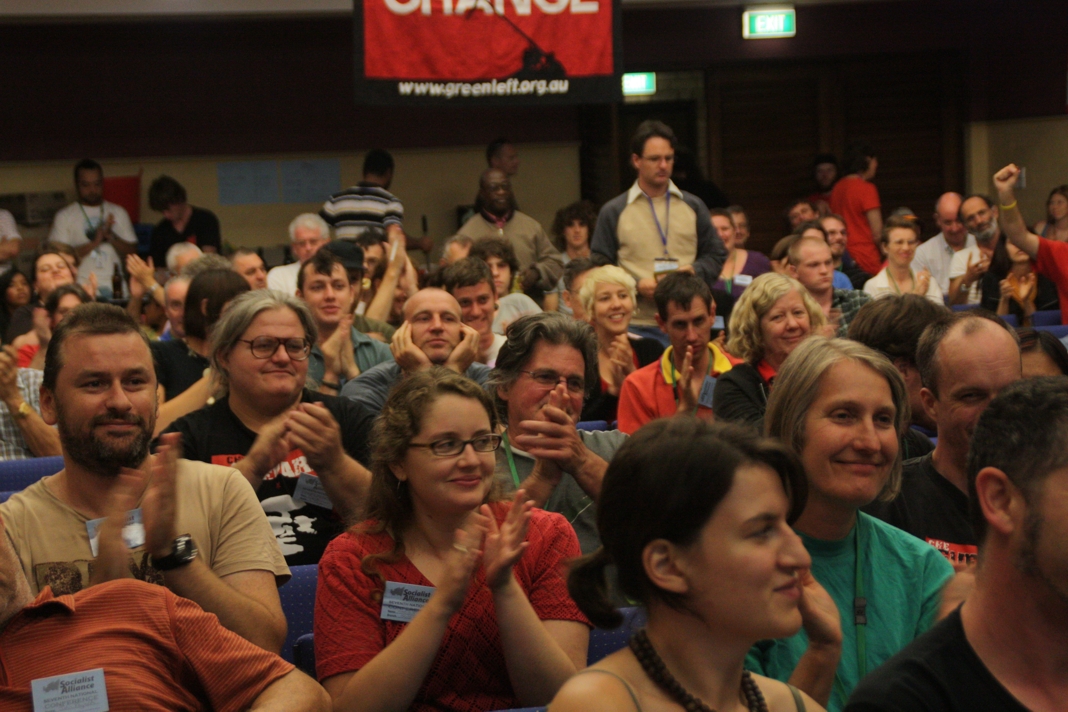
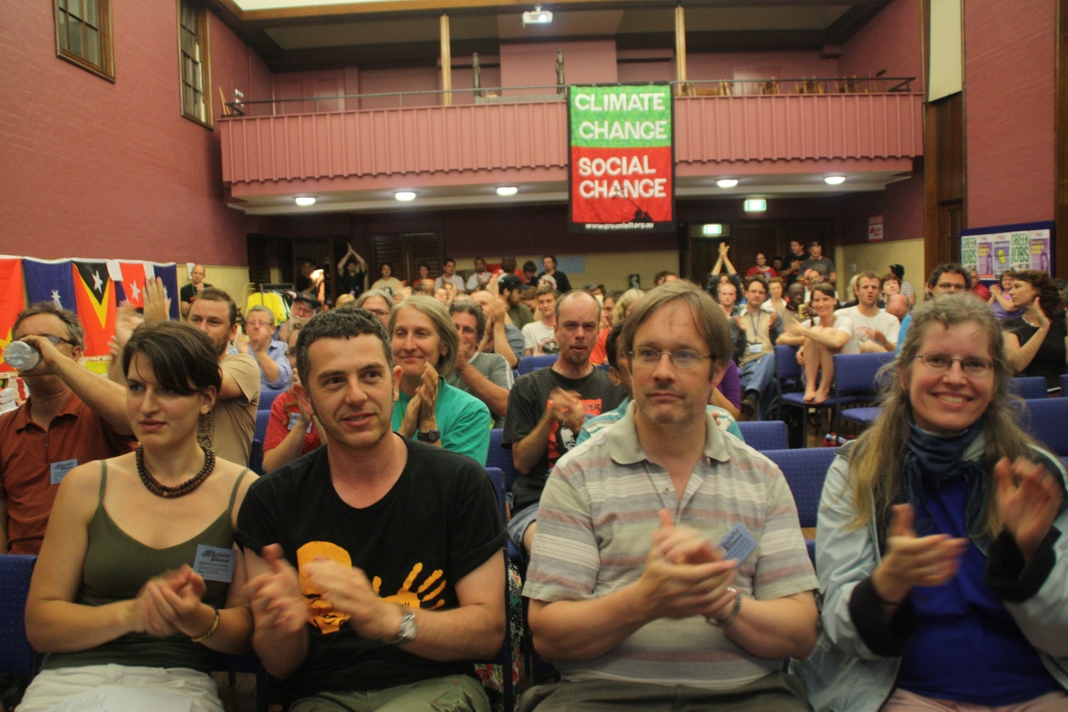
The written - and online -- pre-conference discussion for the 8th National Conference of the Socialist Alliance's finishes today  two days before the actual conference begins in Sydney.

The conference will be held at the new Activist Centre there which is big enough and flexible enough  to house a large mob.

Discussion has been vigorous in the pages of Alliance Voices   and there have been close to 100  documents,  proposals and amendments contributed.

The key focus has been the draft  resolution -- Towards a Socialist Australia -- which has already gone through a  few re-writes as part of an ongoing collaborative process.
The idea to put together a document which starts to encapsulate the answers to the questions “Why Socialism?” and “What Does the Socialist Alliance Stand For?” in a popular style came about late last year.... This process has been the result of positive collaboration within the Alliance and reflects our current practice with policy development and discussion on our campaigning e-lists.Assuming that the draft is approved at the conference, the next step will be to commence a process of continuing discussion about the document within the Alliance, as well as public consultation with our allies, collaborators and individual supporters, with a view to formally adopting it as a document of the Alliance at our 2013 National Conference. How branches choose to go about this consultation will be up to them, and dependent upon the particular circumstances in each city and state, but branches should start a discussion about this soon after the conference -- Susan Price : Rationale for the Towards a Socialist Australia document
Since I've been under the weather I haven't been actively engaged in party debates to the extent I was two years ago. But ever a meddler I contributed two discussion items on what I called 'Atlargeness' -- Article I and Article II.

The advantage of being at-large as I am is that you get to meditate on the condition.

A theme in some of the exchanges has been  identity which I think is  a political trap. I'm dedicated to judging an outfit on what it does and how it does it -- not on what it thinks it is. On the socialists left there is far too much boutique identity politics. After 40 years of it I've had my fill of shibboleth making and program posturing.

Ironically Towards a Socialist Australia  not only tries to  define what the Socialist Alliance is and strives for  but in its genesis it also suggests what the Alliance does.


Dec 30, 2011

The Socialist Alliance: ten years on

While I've been waylaid by a bout of ill health for the past 2 years and consequently disengaged from the political coal face, I'm still a Socialist Alliance groupie.

I mean that because I'm very supportive of the project since I was dragged into its factional furore in 2003. when the various far left affiliates were determined to prevent the 'alliance' moving forward and developing into  a  'multi tendency socialist party'. 

When I say factional furore I do mean it was heated stuff, the worst of it unbeknown to the bulk of observers on the left  and SA members. Then in dribs and drabs these affiliates who failed to win over the vast majority of the Alliance membership to their position , despite an open and extensive democratic debate,  quietly licked their wounds and withdrew.

So in the period between its formation in 2001 and the split in the Democratic Socialist Perspective in 2008,  the SA has been cause for much discord on the far left. 

Not bad for a purported  'unity' project.

But then when you consider the history of similar unity projects elsewhere with the same international partners -- such as in England and Scotland -- a similar  factional and divisive  story emerges in the experience of Respect, the English Socialist Alliance and the Scottish Socialist Party.

The Socialist Alliance success is that it has survived all this and still remains a viable enterprise. 
I'll get back to that point later : how viable is the SA?
The SA can still argue for a left unity  when  the various  tendencies on the far left have proven and stated often enough that are not the least bit interested in organisational unity for the foreseeable future. Consequently, these same elements have dismissed the Alliance as a failed exercise. 

So how viable is the Alliance as a unity project when the far left orgs won't have a bar of it?

What these naysayers don't  recognise is that the SA continues to unite socialists around a program of shared political activity. It continues its quest for left regroupment.  It is open and accessible in a way that other far left orgs are not. 

It is a step out of the far left ghetto because it has tried to develop an organisation that does not make a fetish over a boutique program or one that is ruled by its own 'circle spirit'.  What unites the SA membership is a unity of shared activity not  a coming together premised on a specific world view laid out in chapter and verse or shibboleth specific... 

This means that in matters of platform and party program  the SA develops slowly, even cautiously, as it tries to advance by dint of as much consensual agreement as possible.

It isn't line ruled.

This may, does and should have its handicaps but the Alliance nonetheless has survived a few sharp divisions within its ranks without the membership  falling out among themselves.  If you are trying to create 'a multi tendency socialist party' you are going to have divisions and differences. It will be par for the course. 

At stake is how you resolve those disputes without alienating layers within the party while sustaining their commitment and allegiance.

At the same time you cannot simply ignore contemporary politics by allowing yourself the cop out the Greens employ and simply default to no position (and 'no' position so often means the relapsing to inaction).

Ultimately, this has to come down to a democratic challenge: how much real  democracy there is.

Perhaps you could have a truly rooly democratic party but what's the point of it if it doesn't prosper?

And it's true that the Alliance has neither grown sharply over the last few years nor prospered at the ballot box. It has won one local government position -- Sam Wainwright in Fremantle -- but while the Greens may be seen as the main left alternative more general support for the Alliance at election time will have to wait.

Nonetheless, the Alliance is increasingly  recognized as the socialists  on offer come each polling day.

This handicap has not undermined what the SA gets up to the other 364 days of each year. This activity -- of being seen to always come out fighting in many and various campaigns while also standing in elections -- has drawn a mixture of people to its ranks: indigenous activists, people leaving the ALP, those  disenchanted with the Greens, various ethnic community activists...and people who are located 'at large' where no significant socialist history  exists, such as in rural and regional Australia.

This makes the Alliance a mixed bag of adherents -- a membership that is not readily summarized nor characterised --  of a nature that is not easily organised especially in the way far left  Leninist type outfits tend to be. It is of no special type. While the SA continues to explore various organisational forms and norms it still is a party in waiting, for now more on a promise than  at this moment on delivering the broad socialist party it set out to become.

It has occupied the green left niche in Australian politics and keenly advocated a sharp anti-capitalist agenda in response to Climate Change. In that way it is a major ideological challenge to the pragmatism and pro capitalism of The Greens and its platform is consistently  judged the most radical  but environmentally sustainable on offer at election time. 

Similarly, its trade union perspectives both day-to-day on the job and its campaigning advocacy, are absolutely pro worker. While the SA has the broadest trade union implantation on the Australian far left , some unions will donate to the Alliance, but none, thus far, will formally and publicly support it.

That's in part due to its shallow electoral success (esp in comparison to The Greens) and the still strong rule Laborism has over the trade union movement here.

But I think where the Alliance has born the best results has been where it has forged broad alliances in a series of important campaigns and strived to sustain and build on those links. 

The Alliance therefore exists on two levels: within itself in the form of a party associating and bringing different socialists together;  and more broadly as an exercise in forging and consolidating broader campaigning alliances.

With its 7th National Conference coming up in January 2012, the world is still the SA's oyster.


Dec 10, 2011

Graphics and politics : Bring back the red star

Source: Venezuela Translating the Revolution
Iconic symbols play a role in politics. Shapes and colours resonate and stand for ideologies and movements in ways that are historical rich and seeming substantial.

Red suggests socialism. Green, the environment movement. Pink -- gay and lesbian rights. Purple: Womens Liberation. The rainbow of colours -- a congregation and community of different peoples. Black: Anarchism.... Aboriginal Australia has its own three colours.

This colouring in of political allegiance has also been associated with shapes -- a shape to go with the colour. So Pink went with a triangle, and the Greens here snaffled the triangle shape to patent a Greens symbol by coloring it to preference. Further left, flags predominated and maybe clenched fists: Red flags. Graphics of black fists. But flags and fists have been the norm for the new left.
Aside: I've never been much of a fister. Only if pushed by immense peer pressure will I raise my fist aloft. It may be a traditional choreographed moment within the chorus of The Internationale ,  but usually hands -- my hands anyway -- are put to other uses.
For us socialists while there have been an array of symbolic shapes to draw upon historically -- the hammer and sickle, the red wedge or the red flag --  often the star has been neglected although in some countries it is banned!. Stars  were  a potent theme in the iconography of the old communist parties.  Unlike the Southern Cross on the Australian flag which denotes geography, stars on the flags of countries like Cuba can refer in the popular imagination to that country's politics.


So let's hear it for the  star -- the neglected red star of socialism.

But while we are celebrating the star -- dusting off the cob webs and polishing it up --  in Venezuela it is getting a  make over and the images above suggest how creative that make over can be.

Personally I'm so over red flags and outside a few bods on Mayday marches the red flag rarely gets an outing today. 

But a red star to match the Greens triangle patent....I like the idea. That it is here presented as a kite (and elsewhere as a flower to be nurtured and cared for) is a creative renovation of a theme.
Unfortunately, the five-pointed red star, a pentagram, doesn't make for good kite flying aerodynamics if one wanted to make it air born. as the boy above is represented. So cutouts, stencils, profiles and totems are the only way to go. Lettering inside the boundaries of the star is also problematical. But as a once-upon-a-time street theatre type and puppeteer, I think the red star has a lot of street promise.
One complication: on a red star, which way is up?

Sep 30, 2011

Climate Change: Social Change Conference LIVE STREAM Sept 30/Oct 3


Some sessions at the  Climate Change Social Change conference are livestreamed.
Welcome to Green Left TV1
These are trial broadcasts but between September 30 and October 3 we will be broadcasting live from the Climate Change Social Change Conference in Melbourne, Australia
For more information about this conference go to here. There will be 80 speakers, six major sessions and 40 workshops

Aug 23, 2011

Community Voice gears up for elections in two weeks

The Wollongong council election campaign is in its final two weeks now, and the Community Voice campaign is ramping up.


The CV campaign  has letter boxed nearly 60,000 houses across the three local wards, and candidates have  addressed numerous meet-the-candidates forums, while receiving sustained media coverage, with campaigning on the streets with stalls, door-knocking and more!

If you are in NSW and want to experience campaigning at the grass roots, help CV out for the last two weeks, and email Tim Dobson to volunteer.

The weekend edition of the Illawarra Mercury featured a half page photo of the CV meeting to decide  its preferences. 

Click here for TV coverage of CV launch of CV's youth unemployment policy.

The campaign to stop coal seam gas mining continues to gain strength too, and it's having an impact on the election campaign.

Stop CSG Illawarra's 200-strong meeting on Sunday is pictured above left.


Nearly every candidate (excluding Labor and Liberal) has pledged to back Stop CSG's demands if elected.
Check out WIN TV newsABC TV news and Illawarra Mercury coverage, all of which feature Jess Moore!


Click here for CV latest media release on the BlueScope sackings.

Feb 12, 2010

Socialist Alliance tribute to Alistair Hulett

It is with a great deal of sadness that we in the Socialist Alliance mourn Alistair Hulett’s recent death from cancer in his beloved Glasgow. It was much too soon for this comrade to die—he had so much ahead of him. Some of us remember Alistair performing in the 1980s at the “Sando”, Newtown’s famous Sandringham Hotel in King Street before it was gentrified. He became famous for the political songs he wrote and then performed with Roaring Jack—songs such “Lads of the BLF”, “Yuppietown” and “Cat Amongst the Pigeons”.

He supported the Builders Labourers Federation (BLF), the union deregistered and outlawed by Bob Hawke’s Labor federal government, the first Thatcherite Labor government in the world. This attack led to the hated Australian Building Construction Commission being created by John Howard’s conservative Liberal-National government and now kept and refined by Kevin Rudd’s conservative Labor government.

Alistair and Roaring Jack played benefits for many causes -- whether it was for the Aboriginal Deaths in Custody Campaign, the BLF Christmas picnic or during the three and half month strike/occupation at Cockatoo Island Dockyard in 1989. Alistair and Roaring Jack were playing outside Sydney’s Long Bay Goal in 42 degree heat for Tim Anderson, when he was framed for the Hilton Bombing. They performed Alistair’s song “Framed” on Australia’s MTV show. We won that fight and after the Royal Commission into Police Corruption came out, Tim’s three convictions of murder were overturned and quashed.

Alistair and Roaring Jack performed on the first Green Left Weekly Sydney Harbour cruise, which was interrupted by a visit from the Water Police. Later, we had to stop the boat for more beer! Alistair went on from those roaring days in the “Sando” to write a whole host of other cutting-edge political songs.

The Sydney Resistance Centre hosted another performance by Alistair Hulett and David Rovics in December 2008 brought back memories of many similar performances that same space in earlier times.

We join the many who knew, loved and respected Alistair -- his family, his many friends, his comrades in Socialist Alternative and in the broader left -- in a salute to a wonderful comrade. The famous last words of Joe Hill are appropriate: “Don’t mourn for me, organise!”

Socialist Alliance

Feb 7, 2010

VIDEO Stop Barnett's attacks on the public sector | Sam's Freo Report

The latest commentary from Sam Wainwright, Socialist Alliance councillor in Fremantle


more about "Stop Barnett's attacks on the public ...", posted with vodpod

Jan 24, 2010

Blogging is a serious business in the Socialist Alliance

...says he, hopefully.


I've been working on a renovation for the Socialist Alliance's Tasmanian blog

In the SA most branches only discover their web presence when an election is pending and one is indeed on the horizon in Tassie in March.Thus the refit.

So designing a setup that suits electioneering (while also fostering a greater confidence in blogging outside the polling times) is all part of the service.

Everyone to be on the same page.

While comrades are still stuck in the attitude that an online presence is only about showcasing your wares, my hope is that the SA can move collectively towards an online engagement which uses the web as a major in-house organising tool. This level of Web 2.0 utlisation hasn't quite registered...but give it time.My main argument is simply this: on the web you can get everyone to be on the same page (even if that page is more than one web page)
Perhaps because of my own illness,I respect the online digital universe as a very powerful organising medium. I have learnt to depend on its form to regulate what I do as it helps me think and plan.When you  compose content and format your material for the web, you are encouraged to be coherent as it's like note keeping and running your own to-do list collectively. It fosters planning ans d a certain by the-seat-of -your -pants logic It generates its own discipline which forces you to seriously address how you communicate. You are also given the power to access your archived stuff even more easily than you could on your own computer's desktop. Such 'cloud computing' nonetheless has a very shallow learning curve as in effect, if you can compose an email message you can use any online editing window or tool which uses the exact same interface. Dependency on paper handouts forgets that hard copy can be lost or read only once before being junked.Similarly, online information is not limited by space considerations and with the ease of graphic or image addition, can be more visually informational than most printed means that has to be carefully laid out and printed and distributed usually by hand.


I mean among that 'everyone'...
  • those who are non members and are interested in the SA and surf on over to investigate;
  • journoes and the like from the mass media outlets who background the party (this is why you need to make press releases easily accessible online as well as an image gallery);
  • SA members of branches in the locality  as well as at large members, 
  • SA members from around the country who want to check out what you are up to locally and learn from your campaign  experiences;
  • editors of SA's national journals seeking images, text, and reports for broader distribution and sharing--such as part of national newsletters or reports;
  • members of the various local SA campaigns who look to the blog for up to date information about gatherings, and resources they can download and use. Such a key element is an easily accessible events listing -- and preferably a calendar -- and an attached wiki (and all local blogs are paired with a wiki) which enables the branch to share files by sharing links to uploaded files on their blog. 
  • any and every one. This is especially true if you seek to share some multimedia. Why send people to YouTube or Picasa or Flickr  or  your own personal diary existence  on Facebook -- when you can share a link to your own party specific web presence with all the bits and pieces of your political existence attached. So embedding and sharing really comes into its own when you blog it.(On the Tassie blog you'll see slideshows, videos, Powerpoints,radio interviews and advertisements,  a map to the local Activist Centre..etc. all embedded and shared).
In that sense these web outposts are clearing houses that tick a lot of boxes and unlike other left parties, the SA can use such a tool to ensure its operations are open to scrutiny -- in a sense of what you see is what you get.

That's why what is posted to the SA national web site  has been a standard agenda item for our national convenors to discuss. The same attention needs to be drawn to the local web presences and be a concern of local bodies..

The SA needs to get away from single issue email postings which may verge on spamming and  generate regular local newsletters. It also needs to write , even the smallest of, reports on its local activities -- whether they are a  political or a social event, and post them webside as they are all part of the experience of membership.

Single posts with an event or report focus can easily serve as links in an emailed newsletter so that your newsletter can be an aggregated by simply posting to the blog and then later sharing links to its content. This is in fact how we do Alliance Voices.

And since everyone today owns a digital camera or a mobile phone that also  may shoot photographs -- your regular SA member should take photographs at events and share them on the local blog at least. I mean, why take photographs and not share them?

(Why not take photographs...?)

Considering the Tassie blog as a sample, the elements in situ are:
 In the works is a branch form which visitors can fill in and flag their interests and what they'd like to volunteer for but I'm hoping to make that generic and not Tassie specific,


Jan 23, 2010

Socialist Alliance: Public Transport campaigner to run in Kosky’s old seat - calls for free trains


Socialist Alliance candidate for Altona district Margarita Windisch has welcomed Transport Minister Kosky’s resignation as overdue but says Kosky was just a symptom of a larger problem for Victorians - the negligent ALP government. 
“Our state government has constantly failed people and the utterly shambolic public transport system is just one example”, says Windisch, adding that the ALP is nothing more than a political machine that puts profits before people and the environment.
While Brumby wines and dines those with enough money to buy his ear, struggling public services, soaring utility costs and opinion polls are ignored. James Packer gets extra pokie machines for his Casino, but bushfire victims are fobbed off and hospital queues increase.
Even though Victoria’s social services are in crisis, Brumby has prioritised spending over $300 million on refurbishing the Melbourne Park tennis centre! The ALP has also ignored the threat climate change poses to the community and refuses to take urgent action.
It’s time for a government that takes public opinion on climate change and public transport seriously.
Socialist Alliance believes that an expanded, well integrated, frequent and free public transport system is exactly what our environment needs, and is essential to provide the service Victorians deserve.
Working towards a zero emissions economy is critical, especially in the bay area where rising sea levels could threaten parts of our suburbs. That’s why Socialist Alliance advocates an urgent shift to 100% renewable energy to go hand in hand with a massive job creation program.
Margarita Windisch lives in the Western suburbs, is a former tram conductor and works   currently as a community welfare teacher. Windisch was part of the Dump Connex campaign in 2009 which involved campaigning on train platforms and carriages where hundreds of petitions were signed and over 100 000 pamphlets distributed to commuters. She is an active union member, has taken part in anti-war collectives and campaigns for civil liberties, women’s rights and public services.
If elected Margarita Windisch will prioritise:

  • An expanded, frequent and free public transport system that is run by the public
  • The creation of green jobs and working towards 100% renewable energy
  • Working towards sustainable water solutions
  • Investing tax payers funds into urgently needed social services and infrastructure
  • Bringing public utilities back into public ownership & community control
  • The phasing out of pokie machines
  • The abolition of all anti worker and anti union laws, including the Australian Building and Construction Commission, which unfairly targets building workers
Margarita is interested to know what issues concern you and will be holding a ‘Meet ‘n’ Greet’ at Logans Reserve (corner of Pier and Queen Street Altona) from noon on Sunday 31st  of January.  A relaxed BBQ - picnic including Eritrean food will be available.   
For more information on the campaign or on how to join and/or help out please by:
Authorized and printed by Sue Bolton, 5/407 Swanston Street, Melbourne 8005

Tim Gooden -- "where there is an injustice...have a go rather than just ignore it.”


Left to battle at Trades Hall

Andrew Mathieson


Colourful murals line a wall of Geelong’s Trades Hall car park.

Among the union slogans, one image features a worker draped in a Eureka flag T-shirt, arms raised in triumph.

The stocky figure’s head is shaven short and the moustache seems unmistakable.

A grinning Tim Gooden (pictured) quickly points out: “That’s not me.”

The Geelong Trades and Labour Council secretary has heard the comparisons before.

“A lot of people say ‘That’s you’,” he adds.

“I say ‘I’m not that fat’.”

Sandra Krantz painted the rank-and-filed metal workers a couple of years before Tim arrived at Trades Hall. And he was a carpenter.

“Some union officials have called us (Geelong unionists of the era) all extras out of a Mad Max movie,” Tim laughs.

“Most of them were metal workers, some were carpenters, and they had motorbikes.”

The 46-year-old shaved off his trademark moustache on return from a recent visit to Venezuela in support of the country’s solidarity movement.

He started the trip with a handlebar moustache and a goatee out of concern that a clean-shaven look would play havoc with his passport photo.

“We were in the tropics there and it drove me up the wall the whole time,” he tells, shaking his head.

“When I got back I was getting hayfever and thought ‘That’s it’, so I shaved it.”

Ventures to far-fetched locations are not uncommon for Tim. But casual holidays aren’t.

Attending a Socialism 21 conference in Nepal, the Manifold Heights resident preferred to mix with socialists of different persuasions than a climb a mountain with a local Sherpa.

“If you have to put down a theology, I would have to be a Leninist,” he remarks.

Tim is a contradiction at first sight.

Sitting at Trades Hall in his stubbies and work boots, he rattles off about Marxist scientific analysis and the histories of capitalism, feudalism and collectivisation of labour.

“There are two papers I always read every day: Australian Financial Review and Green Left Weekly,” he then says.

Before leading rallies and protests through the streets of Geelong, Tim first pocketed dollars working on a dairy farm near Wollongong aged just 10 and later as a dairy hand at a Coles supermarket.

A shift to Canberra to help build the new Parliament House was just a precursor of things to come.

“I intended to stay for six months but ended up remaining there nearly 18 years,” Tim ponders.

Union leadership had never been on the agenda until he spent time on a road gang as a bridge carpenter. Painters and carpenters were told to operate machinery and take on each other’s jobs.

They had never heard of multi-skilling back then.

The now defunct Building Industrial Workers Union took up the fight but needed a delegate to voice its concerns.

“Everyone turned to me and said ‘Well, you do it’,” Tim remembers.

“I don’t know why that was but I wasn’t even the leading hand.”

Also a part-time New South Wales rural service firefighter and later a public servant, Tim climbed high up the union ladder.

When the ACT Government purged the Canberra public service, a law degree then beckoned at 35.

Life has taken other twists, like fighting bowel cancer during university exams and suffering ear damage.

Tim lost half his hearing in both ears during an explosion on fire brigade duties.

Despite being one of the last 23 picked to join the ACT fire brigade from about 5000 candidates, his industrial deafness counted against him.

“I fought that for a few years and I eventually got an apology and acceptance I could do that (work as a firefighter),” Tim muses.

“I have always had this sense that, where there is an injustice, you should sort of have a go rather than just ignore it.”

Image: Alex Bainbridge

Jan 18, 2010

How should the left organise?

[Since I am occasionally engaged in online fracas and am known to comment at length I  have adopted the habit of archiving my interventions as a sort of running notation of my developing POV.  Here is one that I've dug up because it made more standalone sense than the many others. It was posted as part of an online comment thread to one of Derek's posts.]

 Derek Wall (Socialist Unity)Leninism is not what you think it is:


Just been blogging about the SWP crisis, its a wider crisis of a kind of Marxist political organisation that in my view simply does not work. I have never been a Leninist but Lenin may have been very different in his approach to what is normally imagined. The ever excellent Dave Riley let me know about this article, its food for thought, let me know what you think and lets not just use this as an excuse to bash each other. How should the left organise? 


If I can add a few comments…

(1)The complication of “Leninist Party” politics is that it is carried out by organisations who believe that they are indeed a “Leninist Party” without any reference to the actual living situation they may be at.They could be 5, 50, or 1500 members but they all presume they are working at Leninist best practice regardless of how embedded they are in the working class.They are “Leninist” because they say so.

(2)What’s happened through the sponsorship of Trotsky and the counterposition of “Trotskyism” to “Stalinism” is that programatic questions have been elevated to a level of some sort of Jungian archetype which only the ordained have access to.This idealist approach — one devoid of the living test of day to day struggle and roots in the class –is totally at odds with the approach of a dedicated Marxist materialism. It only leads to a cottage industry of boutique socialist patents competing with one another.

(3)In my experience of party organisations operating under ‘Leninist’ first principles there is always a sharp tension between being too tight and being too loose. This conundrum is always tied to the question of exclusivity and the overbearing pressure to maintain ‘party’ ‘norms’. I think this is real such that small parties tend to flip and flop between opening up and closing down/reaching out and returning to the bunker. One example I can think of is the response of the SP/CWI when it left the British Labour Party. Thereafter followed a relaxing of approaches to other currents and a dedicated reach out internationally.But in the wake of the loss of most of its Scottish section (which formed the SSP) and a dispute and falling out with its section in Pakistan (The Labour Party of Pakistan) the SP/CWI turned inward and retraced its steps to the bunker. Even the whole rationale of its “united front of a special find” melarky by the English SWP is premised on this tension — that there is a threshold and once passed you dilute/liquidate your politics and cease to be revolutionary. This spectral fear is what haunts almost all the parties of the far left. It is developed as a response to surviving the long haul and counterposing your politics to Stalinism in a position of isolation in the working class. This is, if you like, the conditions and responses that congeal as sectarianism.

(4)After years of surviving the long detour the conditions we now face — with the self evident deference of social democracy to neo liberalism, the world wide collapse of Stalinism in the wake of 1989, the biggest economic crisis capitalism has faced since 1929, and a major ecological catastrophe bearing down on humanity — the conditions under which we operate has changed greatly so that there is no reason whatsoever to believe that the comfort of ‘business as usual’ will suffice. Old habits die hard. Old cultures persist. The far left, in fact, becomes entwined in and entrapped by its own rhetoric. While there may indeed be more than one way to proceed, as socialists, Marxists and activists we must know that left unity is our most powerful weapon. But how we proceed to do that — regroup the left — requires not only reach out ways and means but a considerate re-formatting of our own internal perspectives. It is in this context that the study of Lenin has taken another course — away from just referencing his writings into a more considered and broader approach to the actual history of the Bolskevik party; and as Kellog (and Liebman) argues it is not what we may have thought.

(5) What divides the far left today — if we put aside the shibboleths born as they were in the context of the Cold War — are tactical questions.Essentially day to day that’s always tended to be the case.Nonetheless even with those differences in mind what divides us is very small indeed given what unites us. And what specifically unites us is that despite the rigors of the last few decades we collectively enter the 21st century as committed revolutionists with skills and savvy but without the large numbers adhered to our banner.

(6) That doesn’t mean we enter a mea culpa historical moment. What it does mean is that we shift our perspectives and open up our politics like no other time in our historical experience. And, if you like, our task is adapting what we know of “Leninism under Lenin” to the challenges of the here and now. Personally and theoretically this is a major challenge because the new conditions we may choose to embrace don’t lend themselves to easy schemata. NOR is it an excuse to embrace a free fall liquidation of our hard won organisational and political assets. The dialectics of this change are very complex and in each country they are likely to follow different paths as no one size is gonna fit all.We also face the complication that a ruling on early experiments in this new Left politics has not reached a consensus in the way that in the 1920s the far left wanted to replicate the experience of the Bolsheviks and , as Kellog points out, were encouraged to import it as a one size fits all party template.

(7) It is not our role to rejig the politics of social democracy and create a left-of-Labour Labour Party. Some on the left believe that and with the example of Germany and Die Linke as well as the rise of Green Parties internationally in front of us we should junk all the criteria of revolutionary socialism for the sake of a very much broader and very much softer political relevance buoyed up be a dedicated electoralism. But is that what we want — a sort of stage-ist approach to generating revolutionary politics? Marx via the route of practical reformism? A corollary of this perspective is the belief — that today dedicated broad socialist parties cannot be built and win mass support. This is the view of the SWP I’m sure (even if it is not stated)and is no doubt the standard response of most left orgs while en route back to the bunker. But if you check, the approach of Lenin was very different while still adhering to the core goal of socialist revolution. I remember one quote from whoever that tells us so much, ” You all know Lenin forged a great revolutionary socialist party, but you don’t realize what he had to forge it with.” And inherent in the outlook of the far left orgs is a elitist fear that straying too far from programatic purity etc only serves to dumb down our politics.

(8)While we are all familiar with the role of imperialism and the way the reformism gutted the 2nd International but really is that what we should allow to haunt us? The drowning of the 2nd International in competing jingoistic reformist currents occurred in a very precise context of world history. While similar conditions may prevail today, we are here requesting of currents who have survived the political challenges of the last few decades, and remained revolutionary, to lead this new process of broadening out. That’s a big difference. To not see it in those terms only encourages a certain functionalism — a belief that these new parties will arise because the space exists for them to do so. But then, taht space can be filled just as ‘functionally’ by outfits like the BNP. So who leads this process is crucial to what sort of party is created.

Comment by Dave Riley — 27 December, 2009 @ 3:23 am


Jan 16, 2010

VIDEO:The Socialist Alliance 7th National Conference


In the face of global environmental, economic and social crises that threaten billions of lives, if not the very survival of humanity,  the Australian Socialist Alliance held its 7th National Conference in January 2010.
Formats available: Quicktime (.mov)

Jan 13, 2010

The Socialist Alliance Conference: a participant's account


Maybe it seems strange that when one conference closes another one opens.  But that's what happened  on January 2nd this year. The Democratic Socialist Perspective which was formed  38 years ago  ( its founding conference was in January 1972 ) formally closed up shop and merged with the Socialist Alliance.

The merger was a foregone conclusion as no one, as far as I'm aware,  either in the DSP or the Socialist Alliance,  opposed the the merger from the day it was first raised -- some time after  April 2009.

 I won't go into the discussion that preceded this decision as the main markers are logged on the DSP website. Nonetheless, as Peter Boyle told the opening public meeting for the Alliance conference:
Sadly,it is an unusual and rare thing for socialist groups, like the DSP, to break from the idea that they are the “true” party of socialism, with the sole correct political program, and seriously embrace left unity.I say this not to boast but more by way of an apology and excuse for the DSP taking so long to take this step. After all, the Socialist Alliance was launched in 2001 and now it is 2010!

But then what may seem self evident in hindsight may not always be   that way  as the delay in merging -- first flagged in 2003 -- was checked by a succession of  "issues" that  obscured  the DSP's perspective and  the vigor of the  its orientation towards the SA.

The experience , first of the DSP conference, then engaging with the Alliance one,was  a liberating  journey all in the space of four very intense days.  While the DSP never caucused  its work in the Socialist Alliance or pre-empted participation by its membership, it was still a collective with its own cultural attributes, loyalties and  esprit de corps ethos separate from the rest of the SA membership.

"Putting the DSP down" (so to speak) and moving on politically was an essential first step  toward broadening the collaboration and opening  up  to a deepening  of the  partnerships that sustain the SA.

I'm not saying that for the sake of justification but rather I'm reporting on what began to happen as these January days ticked over. The ex-DSP membership -- now no longer made up of DSP members --  seemed, to me anyway, to embrace the SA conference as bona fide political activists without the personal complication of a previously composed agenda. The niggling secondary loyalty that decreed a certain hesitancy of engagement -- and even a reluctance   in  political confidence -- was sidelined by a direct and absolute focus on the politics to hand.

So what ensued was a level of  enthusiasm I have not experienced in any decision making conference I have attended in the past (and that's going back 40 years). Consequently, the SA conference became an exceptional political event because this fostered a certain  galvanizing of 100% attention and focus that really took off in the workshops where it was all in -- with  DSP exers and  the rest alike jumping in to share their two bob's worth of POV.

We had so much discussion that on some matters we decided we did not have enough of it and held over deciding  so that we could canvas more broadly in the Alliance by extending our exchanges. As long time Indigenous activist Pat Eatock said of the conference:
It's been such a comfortable conference – energising, inspiring, but most of all it's one big family, it's an extended family and Kooris can really relate to that....This is the only organisation ... it took me a long time to become a member. I became a member last February and I'd been sort of hanging around with this mob for over a year before I made that decision. But that decision was based on the fact that the processes I see are so good. I don't really know how they have dispute resolution because there doesn’t seem to be any dispute!
Of course disputes do occur but I guess what the conference confirmed once again -- this is in fact a SA habit -- is that the SA does strive for consensus -- although it is not brutally ruled by it.There is indeed  so much unity in the Alliance because we get the priority right and strive to work together in action rather than allow ourselves to be bogged down in disputation over political differences where we may disagree with one another -- at least for now. It is indeed a very grand unity of (socialist) purpose rather than one contained by a boutique ideology

The SA is not so much a red wedge but a political envelope that moves forward  despite the fact that  members are not all  in step with one another. And the way the conference unfolded was a great example of that process in action.

But then you have to be part of it to get my meaning...

As Dave Kerin reminds us:
It's a tremendously creative period of change that's now going to enable people like myself of the historic left who have been, if you like, almost unattached, to have a home now that provides us with support in our work. We've never ceased doing the work as socialists, but when you're doing that work alone you feel more worn out...I'm a year and a half off 60 and, to see that goal, for my remaining life on the planet I'll be fully engaged in that along with Socialist Alliance.
Photographs: This post and related pests: Alex Bainbridge

Coming very soon: RatbagMedia's own short vox pop video montage of the SA conference.

Some blog comments on the Socialist Alliance Conference

DSP merges into Socialist Alliance


We may not be in the apex of the world revolution but the process of rethinking the left regroupment agenda here in Australia has led to this: DSP merges into Socialist Alliance Speech to the opening rally of the 7th national conference of the Socialist Alliance on January 2, 2010, by Peter Boyle, former national secretary of the Democratic Socialist Perspective.

Green Left Weekly will run reports on the conference and process engaged with between the Alliance partners.

The DSP and SA conferences were held back to back and the one day DSP event was mainly taken up with discussing a (very small) minority position that the DSP continue to exist in some public form as well as continuing with the SA merger.

This very broad endorsement of the broad party perspective  follows after  nine years of SA activity and occurs following  intense debate in the DSP about its SA orientation -- especially since 2003 --  which included an almost three year long factional dispute (2005-2008) in the party.

These comments -- Vox pops from Socialist Alliance's 7th National Conference -- will give you a sense of the verve and feeling of expectancy that was generated.

Nov 25, 2009

Latest Alliance Voices Volume 9, No 5, November 2009


alliancevoices.blogspot.com

Current Issue - Volume 9, No 5, November 2009

Download pdf version for printing


SEVENTH NATIONAL CONFERENCE

DISCUSSION
______________________________

  • Deadline for national conference resolutions and Alliance Voices

    The November 19 meeting of the SA national executive set a deadline of midnight on December 15 for all submissions to Alliance Voices this year. This deadline will allow the comrades who produce the discussion bulletin to get the final pre-conference issue published before taking a break for Christmas. All draft resolutions for the Seventh na...


  • Resolution on Afghanistan

    By Trent Hawkins (Melbourne), Pip Hinman and Tony Iltis (Sydney) are presenting this policy draft for consideration at the 7th National Conference. We think that Socialist Alliance should formally adopt the position we have been campaigning on: to demand the Rudd ALP government withdraw the troops from Afghanistan.* Preamble: The Socialist A...


  • Resolution on child-care policy draft

    By Kerryn Williams, Sydney West Preamble: Over the past two decades, the childcare sector has become increasingly corporate-dominated. This shift began when in 1991 the federal Labor government ended public subsidies to non-profit childcare centres and instead began providing payments to individual parents to use at a childcare centre of their...


  • Ecosocialism: why we need it

    [The following article is based on a presentation by Aaron Roden of Sydney West Socialist Alliance.] Let’s start with the climate science. The CSIRO website offers some data. Over the past century the global average surface temperature has risen by 0.74 ºC. In Australia there has been a 0.9ºC warming since 1950. Average northern hemisphere temp...


  • Assimilation is genocide

    By Pat Eatock, Sydney Central [The following talk was given at the launch of The Aboriginal Struggle and the Left on November 22 in Sydney West. We are here to launch Terry Townsend’s book, Aboriginal Struggle and the Left. I may also refer sometimes to Socialist Alliance’s other recent publication, the policy document on Abori...


Contact the Socialist Alliance

Nov 19, 2009

Australia: Elected socialist's goal of `campaigning' local council gained wide support


Sam Wainwright with Justine Kamprad.
Justine Kamprad is a co-convenor of the Fremantle branch of the Socialist Alliance, in Western Australia (WA), and was the party's campaign director for the October 17, 2009, Fremantle City Council election, which saw socialist Sam Wainwright top the poll and get elected with 33.44% of the vote. Wainwright is the first member of the Socialist Alliance to be elected to public office in Australia, and one of only two socialist party members currently in an elected local council position in the country. Jim McIlroy spoke to Kamprad about the successful campaign.
* * *
What were the main aims of Sam Wainwright’s election campaign?
The main goals of the campaign were to engage the local community, and create the hope that their activism could be effective. That was a huge part of the campaign. When Sam announced he was going to run a number of people approached him about forming policy with him and actively engaging in developing community interest.
The clearest example of this is the disability rights area. There were many people who came to Sam wanting to become involved as individuals and with their organisations in writing quality policy for the Fremantle council around disability support services.
But also they had the respect for Sam as an activist who they thought they could work with to try to get that policy implemented, knowing full well that even if Sam was elected he wouldn’t hold the majority of votes on council.
The Socialist Alliance wasn’t running as a ticket to take over the council, to create a council that would be able to do all these things on behalf of people. Sam was running as a councillor to give a community voice for peoples’ campaigning, to be another tool in the campaigning arsenal in the Fremantle area.
Often we know that for all the good intentions of the councillors, sometimes policy doesn’t get voted on or isn’t exactly what people want, or it gets trapped in the bureaucracy or the committee stage.
This was about getting an activist onto council, rather that somebody who wanted to be involved in the bureaucracy.
Sam is a declared socialist, well known in the local area, and had run for the Socialist Alliance in the previous state government by-election for Fremantle. What was the structure of this campaign? Did he get support from other groups and individuals to run for the council?
Sam has been a longstanding candidate for the Socialist Alliance in the Fremantle area. He has been living in the community for about six years. He is very well known as an activist.
But in this case, there was additional support that was quite deep and came from a variety of political backgrounds. There were a number of reasons for this. One was that most people believed his campaign was winnable. And another was that they believed that Sam was a very genuine activist, non-sectarian and that he would work tirelessly for the community and its campaigns.
Sam has built up that level of credibility over a long time. Those things coming together meant that there were a number of people who would not necessarily support us in other elections who were prepared to support us this time.
Also we received a large amount of publicity during the Fremantle by-election. In some ways Sam was already a well-known public figure. During the course of the council campaign, people walked up to him in the local hardware shop and supermarket saying, “You’re that Sam guy, good on you”, and that kind of thing. So he was already well recognised when the council campaign started.
What did the local Socialist Alliance membership see as the purpose of the campaign?
As a co-convenor of Socialist Alliance, I was really supportive of Sam’s campaign, and there were a number of reasons for that. One is that to have an open socialist elected in the way that Sam was brings a degree of legitimacy to socialism in Western Australia. It brings a level of respect to all those who talk about being socialists and wear that badge quite proudly.
The other part of it is that the Socialist Alliance is genuinely engaged in campaigning in Western Australia. We believe that Sam winning this position won’t be a panacea for the various campaigns. It certainly won’t fix some campaigns that are huge on our radar like the campaign against uranium mining and export.
But what [the election result] will do is put an extra tool in the toolkit for activists to draw on and to use to further their cause.
What made the Socialist Alliance’s campaign different from other parties?
All of the policies Sam campaigned on are values the Socialist Alliance supports. In particular, in the election policy leaflet, Sam clearly stated that he was co-convenor of Socialist Alliance in Fremantle and had served on the state executive. He explained that as a trade unionist [he is a member of the Maritime Union of Australia] and as a socialist, he had learnt important skills that would help him represent the community in a positive way.
It wasn’t about saying, “I am qualified to do this job because I am a socialist”, but rather, “These are the skills that being a socialist brings me, and means that I will bring to you in supporting your campaigns.”
So the election campaign strongly supported the ideas of socialism. And for me, one of the strengths of the Socialist Alliance is that we are a collective of activists, a collective of people who want to change the world.
All the things the Socialist Alliance is fighting for, if they were fundamentally implemented, would make Fremantle a better place. And some of them would make the world a better place. And that’s what Sam’s campaign was all about.
It’s about having hope as well. It’s was about having the hope that we can campaign and that we can win by openly being who we are, as socialists. That we can speak openly to the community as socialists, not shying away from the fact.
What were the main policy planks of Sam’s campaign?
First, we said we wanted to make Fremantle a “fight climate change” council. There have been many environmental campaigns that have a strong base in Fremantle. There’s a large base of the Sea Shepherd environmental group in Fremantle. There’s also an organisation called the Fremantle Anti-Nuclear Group. They had a little bit of a break for a year or so. Unfortunately due to the election of the Liberal Party state government, there’s very much pressure on WA once again to be part of the nuclear industry.
Climate change is one of the issues around which Fremantle residents are very conscious. If Sam’s plans for council action on climate change are implemented, it will serve as a model in WA for how councils can shift to a less wasteful and more climate-friendly footing.
But it also puts responsibility on the councillors to speak out against wasteful things and negative things in terms of our environment. When someone is elected on that platform it allows him or her to engage with and help the climate movement — climate change activists — who want to make a difference.
The second plank was better public transport, including linking Fremantle to [the suburbs of] Beaconsfield, Hilton and Samson with free Central Area Transit (CAT) buses. That links in with the first policy. Public transport is one of the practical steps that we need to take in order to de-congest our roads, to stop spending the inordinate amount of money that we are now on roads and also to get people out of their cars and into public transport.
The original CAT buses were in Perth. The fundamental principle of the CAT bus is that it is a free service. There are only two such services in WA. One is the Perth Free Transit Service and the other is the CAT bus, which runs basically as a tourist service in Fremantle — and it only goes to suburbs that you have to have a lot of money to live in the first place. We should provide free public transport for the people who live in the poorer suburbs of Hilto, Hamilton and Willagee to give them more of a chance to engage in our community.
We would like the Fremantle City Council to have a look at the needs of the community, and fundamentally shift from being a car-based community to being a public transport and bicycle-based community.
Sam's campaign also focused on fighting for the rights of council and community workers. This is quite a hot topic. In the Fremantle state by-election there was a lot of debate. The outgoing mayor had been preselected for the Australian Labor Party (ALP) for the seat of Fremantle.
One of those who spoke out and urged people not to vote for him was the union that represented the employees of the Fremantle City Council, the Australian Services Union (ASU). Council workers are now on a non-union collective agreement. And some work conditions have been undermined for future workers.
The existing workforce managed to keep hold of what they had, but some provisions of the new agreement adversely affected new workers. The ASU and its members didn’t want that to go forward. They thought that it essentially meant taking [rights and conditions from] the next generation of workers. Their opposition created a large amount of conflict within the council.
Sam’s position was clearly to support the right of workers to be unionised. One of the things that he’s done since he’s been elected has been to engage with his union (the Maritime Union of Australia), and a number of other unions, to organise a community float for the Fremantle Festival, which is called “Unions: Part of the Fremantle Community”. The ASU was one of the initiators of the float. It was about putting Fremantle back on the map as a trade union town, has it has been for a long time and needs to stay that way. That we need to respect workers’ rights within our institutions.
Another big campaign issue for the Socialist Alliance was maintaining the area’s beaches, parks and green spaces for everyone. Fremantle is a beautiful place. The beaches are very nice. And there’s a lot of open community space. But there has been the move to privatise those spaces, and sell some of them off for high-density urban development. This includes the Three Harbours Project, which was trying to create a Dubai-style development in WA. Sam was involved in the campaign to stop that. But more fundamentally, we need to keep the beaches as public property — available to everyone.
For a long time Fremantle was a poor working-class area, but when people caught on to the idea that it was a beautiful place they started to move there. And unfortunately that has been a contradiction. Although we welcome people to our area, it has resulted in development pressure on beaches and so on. We want to make sure we maintain the green spaces that we do have. But not only the big ones like the beaches, but we want to maintain in our suburbs places for children to play and places for people to walk and to enjoy the green spaces when they want to.
All this makes us a more healthy community.
Next, we said council rates should be based on the ability to pay. I’m quite excited about this. We have a really massive problem in Fremantle, which is that there is a lot of land which is exempt from rates -- educational institutions, state government-owned properties and those kinds of things.
Where the state government isn’t putting in its fair share, we need to be looking at making sure that this is actually happening. And that includes land such as that owned by the Fremantle Port Authority, and other places like that. But also we need to make sure that where educational institutions are private and run for profit, that they’re not taking advantage of the rates situation.
Notre Dame University owns quite a lot of land in Fremantle’s western end, and many of the buildings there have been saved because of council orders around heritage. It is a rapidly growing institution, which is run for profit. The ironic thing is that every time Notre Dame buys another building, that undermines the council rate base. So there’s a memorandum of understanding between the council and Notre Dame University and it needs to be reviewed to make sure that it is paying at least the equivalent of business rates that would be paid by any other private profit venture.
We have a lot of long-term residents who may have bought their properties before Fremantle became a trendy place to live in. We want to make sure that those older and longer-term residents are valued and that they are encouraged to stay in the area.
I don’t think there is any magic formula in terms of rates, but it really does need to be looked at by the community, as to how we keep these people, whether it’s rate freezes, or banding like they have in England. There, they have a number of different bands, which can mean that some residents are exempt from rate rises.
Nearly all the rates in our area, whether it be Melville Council or Fremantle, have gone up much higher than inflation and we need to look at how we are going to address this problem in Fremantle.
And the last major issue we raised, a big one, is “council democracy”. As socialists we argue for more democracy. More democracy in the council arena is definitely a good thing. But what we need to do is to give the community real control over its resources, how money is spent and where it is spent, and also how we address key issues.
At present there are regular precinct meetings, which allow residents to bring up issues. But there is no binding mechanism on the council to actually address issues that are raised. We need a discussion about how we can get people more involved, and how we can bring new standards of democracy to the council. But what it is really about is encouraging activism, and valuing our activists. We need to get people speaking their minds and thinking of real solutions to the problems that we face.
Could you clarify the concept of a `campaigning council'?
It’s about saying that the council needs to more than just be a functional institution for running local government. It should have a deeper role in our community than that. One of the things the council can do is to get behind and support key campaigns that they know the Fremantle community is on board with. For example, we know that the Fremantle community is overwhelmingly against the nuclear industry and has been for a long time.
It’s not just about standing up periodically and saying we’re against the nuclear industry, but looking at a real plan for how we can support those campaigns being run by the anti-nuclear groups and deciding what the council is willing to do to prevent the expansion of the nuclear industry in WA. That’s the question that Sam will be looking closely at.
It seems ironic that the council has a formal position of being anti-nuclear, and yet there was a large uranium mining conference held here only months before the state election.
What about the campaign for Aboriginal people's rights?
There’s a large Indigenous community in the electorate, mainly in the suburb of Hilton. There is also a very vital campaign being run in regard to the death of an Indigenous elder, Mr Ward, in a prison van. It is very important that we build support for that campaign in Fremantle.
But more broadly than that, we have to look at the criminalisation of our young Indigenous people and the huge incarceration rate they suffer.
One of the things that we do need to look at is how to make positive community change. There’s the Nungar patrol that’s happened in Fremantle for a long time. Basically it’s a service to make sure that Nungar people [the local Aboriginal people] are not left on the streets, when they are vulnerable to attack. At night it helps Nungar people get home and it is also a culturally relevant service in terms of conflict resolution and so on.
Part of Sam’s campaign was to support the Nungar patrol being extended into the suburbs. It is a culturally relevant solution, rather than criminalisation.
How did this relate to Neighbourhood Watch?
Essentially, there are a layer of people in our community who are older and are frightened, and to whom law and order issues are very real. And they do feel threatened. We have to make sure that the solution that the community comes up with doesn’t just mean more criminalisation of young people. We have to actively engage in this dialogue, rather than just shut it out and say, “Oh that’s just law and order politics, and socialists just don’t do it.” It is not ok to abstain in these discussions. We want to have an open dialogue with Neighbourhood Watch that says that if there are police in our community, they have to be accountable. We have to recognise the negative role of the police, but we also have to look at ways to make our communities a better place to live in, which includes stopping the cycle of violence and criminalisation in our communities.
And if we can open that dialogue up with people who are campaigning around law and order issues, it will be a much more positive dialogue — rather than the one that tends to happen, because the mainstream media presents all of this fear-based politics.
The main solution currently offered is: if we lock everyone up, all of the community’s problems will be solved. That hasn’t worked, and we need to engage with the community members directly, to find out what the their concerns really are.
A lot of work went into the election campaign. How did it develop?
Sam and others did a lot of work during this campaign. But we did use a formula, devised by the campaign team at the start of the effort. Essentially that formula went something like this: Sam had to tell people exactly who he was, but he also had to ask people what their opinions were.
A very powerful tool that he used was to survey every household in the community, asking people what their priorities were for their community. Sam doorknocked the majority of people in the area. He held community BBQs and picnics in an attempt to find out the issues that were impacting on the community. Because there is no point saying you want to represent people if you don’t know that community, if you’re not genuinely interested in the views and concerns the community has.
Now that you have a socialist elected to the Fremantle council, what is the future for the community and the campaign for socialism?
It’s a very positive sign for socialists. There were a lot of people who said, “Look, people really like you, but this socialist thing really scares them”, or “You can’t do that if you want to get elected”.
Despite this, Sam said clearly on the front of all his leaflets that he was a socialist. He was running because he was a socialist, he was committed to left-wing principles, and if people didn’t want to vote for that, they shouldn’t vote for him.
And it was a really positive sign that he was elected. It is positive for the Socialist Alliance, but also for activists in WA. The state needs more activism. We need more people to get out on the streets and get into all these different forms of campaigning to effect some real change from the grassroots level.
Sam will be a spirited activist in favour of that form of change, and I’m sure he will lead the way in that area. I’m really excited about what he’ll be able to achieve, and what socialists in WA will be able to achieve.
There are a lot of positive lessons that socialists around Australia can learn out of the campaign. But what it clearly shows is that people aren’t afraid of socialist ideas. The community in general isn’t afraid of people campaigning on principled ideas.
One crucial idea is that capitalism has had its day. And we need to replace it with something that is more positive, more humane and more environmentally sustainable.
That a socialist could be elected in Fremantle, or anywhere, to represent that idea, and be proud to wear that badge, is a really positive change.
It’s breaking out of the idea that the inner-city “left ghettoes” of Sydney and Melbourne is where change and activism happens. It shows the outlying capitals and the regional areas have just as much to contribute in terms of conscious political change as those other places do, and just as much power to make it happen.