INTRODUCING Mr Karl Marx's Labor Theory of Value & an exploration of “Surplus Value” with a special guest appearance by Finance Capitalby Dave Riley
I had to give a talk on Marxism today as it related to the current capitalist crisis. I delivered this presentation after screening
Brendan Cooney's excellent video on 'Capitalist Equilibrium'.It's very dense material but if you work hard enough comprehending the basic concepts/definitions you're on your way.
We ran the seminar beginning with an overview of the crisis followed by the above as an exploration of underlying Marxian concepts. We then concluded with a review of solutions from a socialist perspective.
While I said my piece in my limited time (as we had to rush back from a local Indigenous rally and march over Lex Wotton's case) in my summing up I tried to present capitalism's perspective from hereon.
The conundrum seems to be that any and all bailouts can only feed greater
financialisation of the capitalist economy which would be further complicated by inflation as demand drove up the prices of investment detritus in the finance sector . But underlying that phenomenon, and formatting it, the productive economy will still be as stagnant as it has been for the last thirty years.
While it should be possible to assume that the market collapses over the past 25 years -- such as in 1987, that of the " Asian Tigers" and the 2000 fall -- should impact on debt accumulation, the phenomenon has been that while debt accumulation is dented briefly it continues nonetheless to rise despite that proven volatility.
So on what basis will any bailout strategy impact on the practices and consequences that now rule the finance markets? In essence it merely rewards it , like with like, while fostering opportunities for greater monopolisation as bigger banks , insurance companies, etc buy up smaller ones as they all take a bath.
So if that approach can't work what's the way out of the mess? The 'way out', is straightforward: for the greater good(and in one sense, to also 'save' the economy) you need to produce stuff and the stuff that warrants being produced has to be primarily
use values rather than commodities. So if capitalism wanted to pursue a way out, the one workable option is for governments to mount a massive program of public works and the like . Of course unless there's a profit in it that's hardly something that would survive for very long under capitalist scrutiny.That, nonetheless, is a primary element in any
socialist program of 'recovery' -- especially one which aggressively turns the economy towards environmental sustainability.
While there's a self evident logic in that approach, to comprehend the underlying dynamic -- which essentially has to be a turning away from capitalism -- you need to brush up on Marxist economics. And if you don't take your socialism
all the way the capitalists will simply carry the economy back to the horrific practices that we now are trying to deal with.




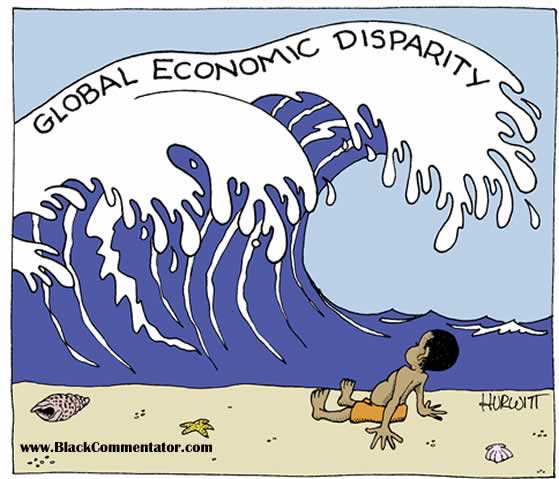
 With simple materials found around the house, you too can conduct an experiment to see what has happened to the economy.
 Why would a

 Can we afford a roof over our heads?