Showing posts with label Permaculture. Show all posts

Sep 28, 2011

Roberto Perez Rivero: Permaculture's Use of Water in Time of Climate Change - the Cuban Experience

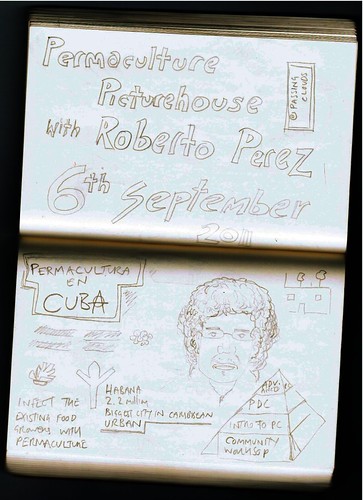
Roberto Perez 1This is a very useful over view of Cuba's Permaculture strategy. The presenter, Roberto Perez toured here in 2008. See resources.

This presentation was delivered to the Tenth International Permaculture Conference (IPC10).

Image at left:London Permaculture.

.

Presentation Files:

Oct 6, 2009

Learning from Cuba's Footprint [ Robyn Francis]

Robyn Francis’ presentation at the Climate Emergency Conference, Adelaide, October 2008. The article contains a selection of slides from the accompanying visual presentation.

This presentation shares observations from a 40-day exchange visit to Cuba, Apr 28-Jun 6, 2008, visiting 40 permaculture and related projects throughout Cuba. The visit was funded by the Cuba-Australia Permaculture Exchange) CAPE, a project of Erda Institute in Australia and my Cuban host organisation was the Foundation for Nature & humanity, based in Havana.

The 2007 State of the Planet report from the World Wildlife Fund identified Cuba as the only nation on earth living within its ecological footprint and at the same time achieving a high standard in the United Nations Human Development Index. I was curious to see and experience ‘first hand’ a society living within its ecological footprint . Hence this presentation is titled Target One Earth – living within our footprint, what we can learn from Cuba.

Read more...


Sep 16, 2009

Community Gardens :Is Growing Food, Growing a Movement?

I posted a comment to the GLW List about community gardens. I pointed out that the Socialist Alliance often argues for community gardens in its local government election campaigns such as the one currenty in Fremantle.

Many members of the Alliance are enthusiastic about the urban farming movement in Cuba especially in the wake of Roberto Perez tour here last year.
GLW coverage of tour
Transitions to sustainability
Cuban experience: the challenge of fossil fuels and climate change [ Roberto Perez ]
Roberto Perez 's tribute to Australian permaculturalists
Roberto Perez on bio-fuels, agribusiness & the food crisis
Cuban permaculturist: "Climate change means we must change"
Roberto Perez Live in the NinFM Studio
Roberto Perez - Empowering Community - Part 1
Roberto Perez - Empowering Community - Part 2
Roberto Perez - Empowering Community - Part 3
Roberto Perez - Empowering Community - Part 4

We utilize the documentary The Power of Community in our reach out work and the Perez tour itself was a partnership between socialists and permaculturalists. I know one SA member who had also been part of Permaculture teaching tours to Cuba going back to the 1990s.

But there's a bit more to the story.

I can't speak for other centres, but here in Brisbane we have a regular presence at the city's largest City Farm at Northey Street and have conducted workshops there on the environment movement. To the north of the city we have a regular weekly presence at the local vegetable markets and initiated a community garden project in Sandgate-- at the PCYC in fact.

So we're not strangers to urban agriculture which we tend to package under the heading Permaculture or community gardens. However, aside from the greening of our cities what's the political point?

The political point?

I think there is a significant political point to be gained from engaging with the community garden movement:
  • For the political activist it enriches your environmental understanding and your respect for the complexity of ecology. So it's a course in biology.
  • Gardening like this also humbles you because you soon realize that despite your own efforts so much more food has to be produced elsewhere to feed you.us. So how can it done sustainably?This means that your outlook gets located within a new focus that is very concrete and very basic .
  • When you join with others in a community gardening situation -- while many cannot and will not grow beyond the green thumbs aspect, you are networking with others in your local community in a project that is ongoing. Within that context the whole environment change and climate change challenge is unavoidable -- thats' the stalking monster.
  • To be frank, too, that's where the environment movement is at for the moment generally -- into sort of rarefied good deeds, into individualism and local engagements -- rather than building broad mobilisations. But it is among these sorts of networks that we can work towards the organising that such a movement will require.So its' like 'consciousness raising' I guess.I mean that in the same sense as the womens' movement began through a process of consciousness raising initiatives.
  • We're also finding that we can open up a dialogue by deploying such tools as the documentary The Power of Community which has in this neighborhood locale gone down extremely well.We can pull 30 to a screening. In like mode we've addressed similar crowds over the new democracy process in Venezuela. and 21st Century Socialism. So we are indeed putting down green roots while raising red solutions to climate change and community empowerment.
  • But once you begin to explore the whole 'urban farm' thing the logic of suburbia begins to break down and more questions keep cropping up.So , in the case here, where there is a debate over the future use of the Deagon Race Course -- we advocate a people centred agenda: community housing, city farms, etc rather than one driven by profit centred real estate development.
While I've written often here about the merging of socialist perspective with sustainable environment management theories like Permaculture, Norm Dixon sent me a link to this post about Growing Food, Growing a Movement on a blog called Working Class Perspectives.

Sherry Linkon notes the divide that separates organic vegey gardeners colonising inner city gentrified suburbs, from the working poor . She then goes to point out something else:
One more urban farm won’t, of course, revive our national economy, nor will it soon solve the problems of hunger among poor and working-class residents of the city, or even of this one neighborhood. But livable wage campaigns and sustainable urban agriculture programs offer good models for how to improve the quality of life in low-income neighborhoods.
In the US there are projects that are engaged with these issues, --such as in Youngstown -- but here the urban farming movement either tends to be made up of a middle class layer of hobbyists , or is the province of marginalised ethnic communities, such as the new layer of migrants from Africa, who garden to produce the vegetables they used in their homeland. For the moment it isn't essentially politically engaged -- despite the location of some of these farms in what were suburban political hotspots in the past -- or consciously aligned to the working class.

But I think Linkon has a point . The sort of hippiefied greening that embraced the inner urban left ghettoes of the sixties and seventies advocated collectives and cooperatives as ends in themselves. While there's no doubt that a potent impulse exists to grow your own, the challenge still is, I feel, to nurture and develop that impulse into something that is not limited to mulching.

This conflict was evident during the Perez tour where farming and politics seemed to collide and many audience members could not accept that his was a political message not just an agricultural one.

The fact is, I think, that like the new environment movement itself we are still experiencing early days and while we can stand on the shoulders of the alternative culture movement -- a la Nimbin -- it is the limits of that movement that we need to address while being aware and deferential of its achievements. But it would be a mistake to ignore those achievements. and not seek to advance them further by broadening the political context beyond the neighborhood.

Sep 1, 2009

Eat Your Meat

The Vegetarian Myth
Reviewed in Permaculture Activist

By Peter Bane
Permaculture Activist #72, Summer 2009

This book almost literally blew in the door one March day recently and I found myself still engrossed in its captivating story an hour after tearing open the brown padded wrapper. That doesn't very often happen.

Lierre Keith has written a compelling tale of her own near self-destruction from a vegan diet and a broadside against its being perpetrated upon or adopted by any other victims. She has converted 20 years of pain and suffering, and permanent damage to her health into a galvanizing passion to demolish the myth that she believe underpins the worldview of most who adopt vegan diet: "I want to eat without killing." You can't, she says, and if you try you'll die.

The arguments are compelling, and bluntly presented in three large chapters addressing moral, nutritional, and political vegetarians. Every field of grain or soybeans kills ecosystems and a myriad of creatures mostly too small to be seen and thus wept over. But they are just as dead as steers stunned and gutted in a meatpacking plant. At this point the enterprise of agriculture threatens all life on planet Earth.

Humans, unlike ruminants, cannot eat grass and survive. Our digestive systems are tuned for a variety of foods, always including meat. Many vegans, she reports from personal experience, do not know this, and fantasize worlds in which the lamb and the lion shall lie down, if not together, then at least on either side of a big fence from each other—eating the same uncomplaining plants. Can modern people actually be this ignorant? It seems so. Traditional diets have universally recognized the importance of flesh foods, especially animal fats, as the researches of Weston Price and many others have confirmed for over a hundred years. But modern people devoid of dietary or any other cultural traditions have picked up deadly memes, and many, especially younger people, have killed themselves trying to atone for civilizational violence.

Read more....

Aug 25, 2009

Cuba's organiponicos -- it's cool to dig!

The BBC has a interesting short presentation on Permaculture in Cuba: The vegetable gardeners of Havan
Havana has almost 200 urban allotments - known as organiponicos - providing four million tonnes of vegetables every year - helping the country to become 90% self-sufficient in fruit and vegetables...
If you check out the permaculture Label here on Leftclick You'll access much more about this phenomenon.


But hey! The Cubans have made so radically chic to be a red green thumb as my a refit of my own kitchen garden (pic above) attests. I call it Little Havana.

It's now so very cool to dig!

Apr 16, 2009

VIDEO:Urban food growing in Havanna, Cuba

A clip from the BBC's "Around the World in 80 Gardens" (2008) showing some of the urban food gardening in Havana, Cuba. This series began last Tuesday night on ABC TV. Its' a fascinating series but the Havanna segment is especially potent.

I shared this a year ago, but if you missed the segment here it is.


FLEXABLE POLITICAL WILL

The biggest enabling factor for the success and eventual integration of the work was flexable political will. This is especially true when it comes to land-use policy. Support for sustainable food systems came direct from the top (Fidel) and laws were altered and practises adapted that suited the development of urban agriculture. Roberto noted that this type of change is not so easy in a capitalist system where land has, what he described as, 'different value'. A good example of this flexability is the clearing and cleaning of vacant lots in Havana. As is common in Britian, vacacnt city lots in Havana gathered rubbish and debris (especially in the 1980s). Masses of red tape and petty quarrels between neighbours often kept these lots in a state of dis-repair. Changes in policy allowed these lots to be cleared and used for gardens. Roberto says that in other countries this would probably never happen. In other countries we often see vacant lots gathering rubbish with chain link fences around them preventing any useful use! In Cuba land only has value related to its usefulness, rather than speculative value.

--Robeto Perez


How Cuba Survived Peak Oil --great documentary on the Cuban experience.


.

Nov 9, 2008

Vlog:Making biological sense of chaos

by Dave Riley
Since I've been a touch handicapped of late, it's nice to know that biologically what you lose on the swings you can gain on the slides...

It's a process, of course. Within the massive social chaos we are victim to and regardless of your individual endeavours you can register a footprint and learn from the exercise.

Ummmm.....

That's my meaning anyway. From little things big things grow:

Sep 11, 2008

'Ethical eating', meat eating and sustainability

by Dave Riley

Food politics is never very far from the dinner table and the local ecomedia news feed has offered the snippet that vegetarian diets are more greenhouse friendly.

Based on a lifestyle piece in the Sydney Morning Herald ecomedia asserts that in a new book Ethical Eating, becoming a vegan would save more greenhouse gas emissions a year than switching to a hybrid car.

I'd think there are a lot of switches that would be environmentally friendlier than trading up to a hybrid vehicle --switching to public transport for instance -- but the logic isn't strong enough. If it's a choice of not driving a car or giving up on lamb chops, eggs, milk, yoghurt and cheese I'd rather forgo the car.

But the argument isn't that simple for my own lifestyle or your's.

Since it seems that there is little hope that ruminants' methane production can be contained by inoculation or transposition of intestinal flora (such as an exotic importation of kangaroo gut flora to the insides of cattle) there's a very real threat that meat eating -- at least of ruminants like cattle and sheep -- is a luxury that we may not be able to afford.

Part of the core problem is rising meat consumption. In China for instance meat consumption has risen from 20kgm in 1980 per capital to 50 kgm in 2007. While some research suggests that chicken is the most eco friendliest of farmed meats --
  • Chicken turn less than two kilograms of grain feed into a kilogram of body weight while the ratio for pork is about 4:1 and beef at least 7:1.
  • Chicken also required the least energy to produce and emitted the least amount of greenhouse gases
--sentencing the planet to vegetarianism seems a drastic solution to our climate woes. I suggest that it aint going to happen. Nonetheless, some meat production is extremely conducive to global warming effects so we have to look at the carefree ease with which we consume vast quantitites of lamb or beef.

Does that mean we have to cut back on our meat eating and encourage pandemic vegetarianism?

Cut back -- yes. Forgo -- no.

The logic of sustainable farming has to rely on a mix of elements which has to include the use of livestock as part of an ongoing sustainable recycling chain. The most obvious recyclers are poultry and pigs. But open range grazing animals in large herds produce a lot of methane if those animals are all ruminants.

But what if they're not? What if we switched our meat production from cattle and sheep to.. . kangaroos. This has been an ongoing discussion in marsupial Australia despite our massive cattle and sheep numbers. I think there's a strong argument for the protein detour.

Roos are many times environmentally friendlier than cloved footed sheep and cattle. They don't fart and burp massive methane volumes. The problem is the cultural cuisine shift --and as an avid sheep eater I am loaved to switch to kangaroo because I don't like the taste -- I think. I also dislike the recommendation to lightly cook such wild game. Its' not a question of taste but of concern about parasitic infections.

So me and roo have a few issues to sort out before I cross over and embrace kangaroo steak, lightly done. Goat's fine by me -- so its' just a working through to see how my recipe archive will pan out with a new ingredient.

What we want is an everyday kangaroo cook book.

Near me, an excellent Indian restaurant offers as well as superb goat fare,
  • The Vindaloo Roo:Chef's special recipe(very hot)
  • Kangaroo Korma:Delicately flavored and enriched in a mild aromatic cream sauce (just Right)
  • Kangaroo Curry:Tender cubes simmered in aromatic spices
So that's my marker. I've even located a recipe for Kangaroo Tagine!

I'm saying it is possible to make a dietary shift because that's a good part of the joy of food -- there's always something new you can try --different ingredients, different cooking methods.

And when it comes to lifestyle issues -- while I'm not one to be ethically challenged by what I put in my mouth("First the belly; then morality," wrote Bertolt Brecht) -- these ruminants are a problem for the planet if they are to be continually farmed in such massive numbers.

The same can be said of most fish species as our present catch is unsustainable. (I can only personally hope that farmed black mussels and anchovies remain kosher).

So it is not a simple case of becoming a vego as though that's the one option.

I used to breed rabbits and for a rodent, they make very sustainable fare which was excellent tucker even when taken from the wild. Southern Vietnam now has a growing industry farming rats (good eating I'm told) and in Peru the guinea pigs ( cavy ) are fattened up on kitchen scraps (on the kitchen floor) before going into the pot.

It seems logical to me to eat critters that may be a pest on occasion --such as rabbits or feral goats.

If
you can guarantee disease free meat I'll eat it.

Maybe before I'll eat ratus ratus I'll have to do some homework -- but I guess it's like tripe, some people just can't stomach the thought of it if they knew it was in the soup.

So I'll eat Skippy -- just so long as he's well cooked.And I'll eat Skippy because it's for the good of the planet.

That's me being ethical.

And I may even get to like him well done
See also:

Aug 9, 2008

Can carbon farming with live stock help save us from global warming?

by Dave Riley

I find 'carbon farming' (see below) very interesting as a means to sequest carbon.

I'm no way an advocate of carbon trading for all the reasons we in the green left movement have explored.... but .... carbon farming to me seems a exception to that hesitancy. Given that farms are standalone working enterprises it makes sense to pay farmers to farm a certain way -- and the carbon farmers generally are keen to be paid for the amount they sequester as well as for their farm product.

The logic of this is evident in the way systems like Permaculture manage biomass but it isn't so clear cut when it comes to livestock -- especially because cattle and sheep are enteric fermentators and produce by belching and farting large quantities of Methane Gas.

The irony is that carbon farming would work much better if land was held and used in common rather than being divvied up into so many private properties. This aspect changes the way we need to consider land management and it tallies extremely well with the chronic problem of over-grazing in Australia. To some degree during drought periods 'framers ' touched on that practice as 'ranchers' will move their herds and flocks -- often to feed on road verges -- where there is fodder.

I guess my main concern is that by the time we change the direction of this planet in regard to global warming it may be too late and any numbers of multipliers would have kicked in. But if we were to consider top soil as a tool to reverse or ameliorate the process of CO2 emissions -- then we have a built in means to feed our populations sustainably while doing the good deed of sequestration.

Well here's an excerpt from a longer post from World Changing on the matter as it relates to herding and sequestration:
Carbon sequestration is not a new idea. It figures prominently in the popular carbon off-setting programs in which people pay a firm to plant trees—which absorb atmospheric carbon in their trunks, branches and roots—to compensate for their carbon emissions from air or auto travel. Coal companies and the Bush Administration have also floated the idea of massive engineering projects to sequester carbon underground, which have been greeted with intense skepticism by most environmentalists due to the cost and the unproven nature of the technology.

But initiatives to sequester carbon in soil through growing crops and grazing animals are less common, but perhaps more promising than planting trees since croplands and grasslands cover more of the earth’s surface than forests and they grow at a faster rate.

Scientists agree that organic matter in topsoil is on average 50 percent carbon up to one foot in depth, and bumping that upward by as little as 1.6 percent across all the world’s agricultural land, according to John Wick and Abe Collins, would solve the problem of global warming. Soil scientists studying the issue are more measured in their predictions, but still enthusiastic about the potential of soil sequestration of carbon to reduce the threat of global warming.

The central idea of carbon farming is to move the animals frequently—as once happened with wild herds chased by predators—so grasses are not gnawed beyond the point of natural recovery and plant cover remains to fertilize the land and sequester carbon. The sequestration process works like this: The grass takes in carbon from the atmosphere; the animals trample the grass into the soil, where the carbon is absorbed; new grass sprouts and the process is repeated over and over again, absorbing more and more carbon.

This was the natural cycle before the enclosure of the commons. Bison roamed the great American plains, as did other large herds in wild lands throughout the rest of the world. Even in places where livestock farming prevailed, the grazing lands were still held in common and animals wandered freely under the watch of shepherds or small farmers. With the privatization of grazing land, this ecological system was disrupted to the point where today raising livestock is rightly seen as one of the most environmentally destructive industries.

Carbon farming is an attempt to recreate the natural conditions of a commons even under the structure of private property in order to reverse the effects of global climate disruption.


Quantum Shift.tv --Soil: The Secret Solution to Global Warming - CAN

Canada version: Research by the Rodale Institute reveals that sustainably-farmed soil holds up to 30% more carbon than conventional agriculture. Converting all of Canada's farmland to organic would reduce CO2 emissions by 20%. The extra carbon in the soil also increases food nutrients, which could greatly reduce health care costs. In this Quantum Shift special report, organic farmer Percy Schmeise...

Jul 29, 2008

Power of Community to empower the communities.

by Dave Riley

It's nice to get out and about in South East Queensland.

So last Sunday a car of comrades --that deserves a name surely: comradabile -- traveled to the Gold Coast from Brisbane, a journey of 95 kilometres. On board were the paraphernalia for a film showing.

Our destination was the Gecko Environment Centre in Currumbin. There we rendezvoused with local Socialist Alliance members and showed before an audience of about 20 the documentary The Power of Community: How Cuba survived Peak Oil.

This was a very cold Sunday afternoon and everyone in attendance were as rugged up as a Melbournian. The chill snap that had even bought snow to the Warrick highlands wasn't enough to keep the crowd away.

So we showed the film and got into the discussion for afters.

The irony is that most Alliance members live on the northern reaches of the Gold Coast and here we were talking up the environment within cooee of the NSW border --some 20 or so kilometres from Surfers Paradise. The irony also suggest a tyranny of distance.

The Gold Coast event wasn't without its difficulties. It is very hard to find community space to use for public political events. In a region like the Gold Coast with no significant radical history it isn't easy to organise the way it is standard within our inner city left ghettos. This underscores the achievement of the Gold Coast SAers in actually raising a red flag along the coast there. But as they have proven, maybe even the dormitory suburbs of the nation's capitals could be colonized by us good guys if we had the means and the will to do so.

This is where Power of Community kicks in. We have begun this project in Queensland of taking the film around the suburbs to see what sort of environment traction we can generate. And if you can build such an event on the Gold Coast -- which , last time I looked, was a politically sterile slice of real estate -- then maybe there's a niche worth attending to.

The film itself is fascinating and if you haven't seen it either buy yourself a copy from Resistance Books online or get in touch with your local Socialist Alliance and get them -- and help them -- to organise a local screening. There are ways and means...

On the way back into the big smoke we were talking about the film with its major permaculture theme and it was interesting how much our car load was into that sort of hands on stuff. What with our worm farms and compost heaps we'd hardly fit the standard greenie caricature of the left. Even the film itself suggests an epilogue in that it should have been an Australian documentary because it was Australian permaculturalists who took so much of the good design oil to Cuba back in 1992 .

And this year in partnership with Robyn Francis' Cuba Australia Permaculture Exchange Green Left Weekly helped to sponsor an Australian tour of one of the 'stars' of the film , Roberto Perez. Back in town -- in Brisbane -- the Alliance has been running occasional discussion groups at the Northey Street City Farm which is as permacultural as you can get locally. We even campaign for Brisbane to become a 'permaculture city'.

So when we take our politics to the edges of the Pacific Ocean on the Gold Coast we know what we are talking about and the "power of community" is a banner we keenly embrace.

The challenge is to take that idea out to the communities where it can draw traction.

More screenings are being scheduled. Book now!

Jul 10, 2008

Will environmental vegetarianism save the planet from global warming?

by Dave Riley

I was eating my morning portion of rolled oats and milk products today when I was contacted by a producer from JJJ TV. This does not happen everyday here at Maison Dave. I can usually make it past lunch before the media come a calling.

JJJ was hoping to do a piece on vegetarianism and it seems than I'm a registered "non-vegetarian environmentalist" because it said I was in Wikepedia:
Some environmental activists point out, adopting a vegetarian diet may be a way of focusing on personal actions and righteous gestures rather than systemic change. Dave Riley, an Australian environmentalist, echoes the views of some <>non-vegetarian environmentalists when he states that "being meatless and guiltless seems seductively simple while environmental destruction rages around us," noting that animals can contribute to the food chain. "For instance, yams, which keep poorly, are stored inside pigs, and today's rotting apples attracting fruit fly are tomorrow's bacon.
The reference in question is sourced from an article I wrote for Green Left Weekly in 1993 : Does meat make the meal?

Since then I've surely eaten my fair share of critters -- deceased lambs and chickens as well as the occasional dead cow or pig.

My argument nonetheless wasn't simply about cuisine options but rather that even if I wanted to take the world's problems on my shoulders -- or into my stomach -- I would not be able to solve them by diet customisation alone. My argument was against individualising "solutions".

But in the age of gaseous compounds and global warming we dedicated meat eaters are being let down by the cow's and the sheep's back and front end. While a fart has no nose, ruminant belching post eating is nonetheless proving to be a strong -- albeit wiffy -- argument.

What you may do -- accidentally of course -- while in mixed company out and about isn't the issue. But what passes wind from enteric fermentation is.

Most of us mammals are monogastric and get by on just the one stomach. But your everyday ruminant -- you moo cow and your baa lamb -- get to work in stereo by breaking down their tucker via microbial fermentation which produces methane gas (CH4). And when there are many million more of them than there are of us within the four walls of Australia -- 24 million beef cattle (ref) and 100 million sheep (ref) -- that's a lot of gas! So much that it is the main component of greenhouse gas emissions emanating from the agricultural sector -- and the agricultural sector is the second largest source of greenhouse gases after standalone energy production.

With 100 million sheep out there and out back -- there's still a lot of lamb roasts to be had for many months of Sundays. If they -- the local flock -- could only keep their table manners in control, everything -- well maybe not "everything", but most things culinary-- would be sweet and we'd live together all very much bon appetit.

It remains to be seen how effective the voluntary immunisation program designed to combat enteric fermentation will be -- but I'm wondering if these figures are suggestive of a shallow analysis. Given that a percentage of the cattle herd is made of dairy cows --
In 2001 there were about 12,000 Australian dairyfarmers milking about 2.2 million cows (ref)
not all sheep are eaten. In fact of these 100 million local sheep in 2007 -- 88% were Merino, 9% were crossbred and 3% were made up of other breeds.(ref)

I know I'll have to do more research -- and I will! -- but you could just as gainfully suggest that the environmental problem is not that we eat meat from sheep -- but that we wear (and other people on this planet wear) wool. Our problem is a fibre one rather than simply a food one.*

The question is basically this: how many Merinoes end up on the dinner table? Crossbread and non Merino sheep (Poll Dorset, Suffolk,Border Leicester and Lincoln) are preferred table fare. This means , for instance, that in 2005 approximately 18 million sheep (Ref) were slaughtered in Australia. While that figure excludes live sheep exports (sheep who are grown here and killed elsewhere) the point is that this isn't a simple problem of meat eating. Belches and such of methane gasses are more likely to be produced growing wool than making meat.

There are a few related issues -- such as the sort of pasture land you graze the sheep and cattle on and the degree that can be harnessed for carbon sequestration despite the grazing. This is why there has' been a bit of ecological interest in various forms of mixed production -- such as sheep with wheat and related eclectic symbiotic partnerships of plants and animals.

But hard core agricultural science aside I have to say that it is not a simple to- eat- or- not- to- eat- meat question. You may as well ask how you preferred not to go about naked by not wearing cotton or not wearing wool or not wearing leather because of their association with greenhouse gas emissions.

* The related problem fibre contributing greatly to Australian greenhouse gas emissions is cotton production. So with no wool and no cotton we'd have to forget about smoking the mayjhane and start wearing it more by selecting a wardrobe in hemp..

May 18, 2008

Cuba - The Accidental Revolution

To watch this video you need to refresh your page by going here.
The documentary is in ten parts. Start at first video snapshot by mousing over and clicking its box then proceed through the rest as you watch each instalment

May 7, 2008

Composting with worms-- another sustainability lesson from Cuba

The English Green Party's Derek Wall dug up (so apt!) this piece by Matthew Werner on worm farming in Cuba for compost week.Worms as Charles Darwin insisted are important critters.

"Food for worms..." can be almost anything as the medieval Church and Shakespeare's Hamlet have pointed out. Food like...very dead human beings.

Not where he eats, but where he is eaten:
a certain
convocation of politic worms are e'en at him. Your
worm is your only emperor for diet: we fat all
creatures else to fat us, and we fat ourselves for
maggots: your fat king and your lean beggar is but
variable service, two dishes, but to one table:
that's the end.
Worms are also highly efficient carbon sequestors. By taking organic matter underground, the worms reduce carbon release into the atmosphere as carbon dioxide and worm farming is akin, in my estimation, to such practices as Agri Char (aka Terra Preta) in the role it could play -- rather quickly -- to ameliorate global warming.But no major Vermicompost project has been initiated with that thesis in mind.

David Murphy's book , Organic Growing With Worms addresses that possibility in its pages with great verve such that the irrepressible Peter Cundall writes in regard to it:
"This is an amazing, inspiring book..it should be on the bookshelf of every farmer, gardener, conservationist, scientist or anyone who comprehends the environmental dangers now threatening all life forms on earth."
Murphy writes that "...if [the world's agricultural soil] were raised to 5 per cent [organic matter] to a depth of 25 cm, 150 billion tonnes of carbon dioxide would be sequestered into the soil ".
Healthy soil could sequester up to 350 tonnes of carbon per hectare (Jones 2007), this being equivalent to about 1,285 tonne of carbon dioxide per hectare removed from atmosphere....This exceeds the estimated 15 billion tonnes per annum global emissions of carbon dioxide from all sources (Murphy 2005) 10 times over.

Hence soil represents the largest potential sink (storage capacity) for carbon - if natural soil quality is restored and maintained -- Sunnyside Projects.

*Yep. Worms are really something to get excited about -- not only as a means to bed down waste (3% of national carbon emissions) but also as a means to invigorate the extremely poor nature of Australian soils while helping to reduce the share agriculture plays in our total carbon emissions. -- 16% from Agriculture (larger than transport-- 13%-- and second only to stationary energy ).


Trends in carbon dioxide equivalent emissions from the agricultural sector, 1990-2004


Sixty percent of emissions from the agricultural sector come from enteric fermentation in livestock. These are emissions associated with microbial fermentation during digestion of feed by ruminant (mostly cattle and sheep) and some non-ruminant domestic livestock. Emissions associated with agricultural soils (e.g. disturbance of land by cropping, improved pastures and the application of fertilisers and animal wastes) and prescribed burning of savannas also account for a significant proportion of net emissions.
While enteric fermentation is the main driver of emissions from agriculture, to replace that caloric output with plant foods behooves a major shift in soil management .

--Dave Riley


Cuba's Composting!

by Matthew Werner

Caught in a vice of economic sanctions, political pressures and faltering production, Cuba has been forced to find alternatives to its reliance on imported fossil fuels, fertilizers, pesticides, animal feed and the like. Agricultural imports have been cut by as much as 80%. Consequently, the Cuban government has established new soil management programs and has made earthworms a key agent in the drive for agricultural sustainability. Cuban scientists are finding that vermicompost performs better than regular compost. With select earthworm species, they have developed a technological package for the production of vermicompost.

Cuba's verimcomposting program started in 1986 with two small boxes of red worms, Eisenia foetida and Lumbricus rubellus. By 1992, 172 vermicompost centers were producing 93,000 tons of worm humus annually. Several different institutions and companies are involved in vermiculture, but research is primarily conducted by the Institute of Soils and Fertilizers and the National Institute of Agricultural Sciences.

Compost Production

Vermicompost production requires a mixture of worm castings, organic material and bedding in various stages of decomposition. Most vermicomposting operations in Cuba use cow manure as the primary source of organic material. Other sources include pig and sheep manure, filter press cake from sugarcane, coffee pulp, plantains and municipal garbage.

First, manure is aerobically composted for approximately 30 days then transferred to open vermicompost beds. The beds are approximately 1.5m wide and vary in length. The compost is mixed with soil and "seeded" with earthworms. At certain sites, the beds are in the shade of large mango trees that benefit from nutrients leached from the piles.

Vermicompost beds are watered to maintain optimum moisture and temperature levels. The worms feed on the freshly applied compost at the top of the beds and deposit their castings in the lower levels. Compost is continually applied until the beds reach a height of approximately 0.9m, after about 90 days. The worms are concentrated in the top 10cm of the pile and are either scraped off or separated from the vermicompost in a screening process. The humus is sold in bulk or used on-site as a soil amendment and fertilizer.

The Benefits

The humus produced in vermicomposting provides binding sites for plant nutrients, helps control plant diseases and stimulates plant growth. Humus also increases water permeability and water retention, contributing to better plant health and more efficient use of soil moisture. Cuban researchers have found that nitrogen concentrations are higher in vermicompost than in aerobic compost piles. Earthworm castings are 1.5 - 2.2% nitrogen, 1.8 - 2.2% phosphorous and 1.0 - 1.5% potassium, and remain in the soil for up to five years. Worm populations under vermiculture can double in 60-90 days.

Worms not used to seed new compost piles are dried and used as a supplemental protein for animals. Earthworms are high in protein and contain the amino acid methionine (4%), which is absent from feed grains. Cuba's future plans include production of earthworm excrement to be used as substrate for bacteria, which in turn will be used as biofertilizer.

Extension and Expansion

Five experimental stations located in different parts of the country are training worm growers. An annual national conference on vermicomposting provides a forum for growers to acquire and exchange information. National television programs and newspaper articles help educate farmers, school children and the general public about vermiculture.

The Soil Institute is presently spearheading efforts to market and sell worm humus in 40 kg, 1 kg and 1/2 kg bags under the trade name Midas. However, humus production in Cuba has not reached levels that permit significant export. Income generating schemes have focused on joint production ventures and the sale of technical assistance for start-up vermiculture programs outside Cuba. Altogether, Cuban vermiculture is proving to be a promising substitute for imported goods.

Gersper et al., Summer 1993, Agriculture and Human Values, Vol. X, number 3, pp.16-23. Werner, Matthew, Summer 1994, Cuban Agriculture Looks to Vermiculture, The Cultivar, Vol. 12, No. 2.

Contact:

Matthew Werner
Center for Agroecology and Sustainable Food Systems
University of California
E-mail: werner@zzyx.ucsc.edu

Video on large scale vermiculture in India


.

Apr 20, 2008

Low-Energy Lifestyle: Lessons from Cuba


Low energy lifestyle lessons from Cuba, an excellent documentary on living locally and sustainable living.

Permaculture

by Dave Riley

So that visitors to LeftClick can access the aggregated material on Permaculture I've created this post so that I can offer a readily accessible link for the Permaculture label on LeftClick.

The link also aggregates all the Roberto Perez material I've collated on site.

The core link is:
which if opened will give you a very long page. However you can subscribe to that link in a feed reader and receive all updates.

But you can just as easily utilize the link for this post as a bookmark:

or if you want to subscribe via email, use this address:

Permaculture content:

Apr 19, 2008

Audio and video guide to the Climate Change Social Change Conference

This guide will be updated as more media items are made available. For updates subscribe to media via feed or by email.

A conference to strengthen radical social action to stop climate change
April 11-13, 2008, Sydney, Australia


AGENDA

Friday April 11 Redfern Community Centre

10.30-­12 noon

Major workshop:


Indigenous communities, climate change and the struggle for country [Audio]--

  • Sam Watson, Biri Gubba, Munnejarl man from the Brisbane Murri community; activist since high school
  • Pat Eatock, Kairie community elder, Aboriginal Rights Coalition, Sydney, secretary NationalAboriginal Alliance

1­ 2.30pm
Major workshop

Nuclear is still not the answer [Audio]
Jim Green, Friends of the Earth anti-nuclear campaigner
Wenny Theresia, Australian Student Environment Network
Genevieve Kelly, anti-Lucas Heights reactor campaigner, lecturer University of Western Sydney

2.45­4.15pm
Concurrent workshops

  • Elite co-option of the environment movement, Mike Barker ­ doctoral candidate, Australian School of Environmental Studies
  • Griffith UniversityCamp for Climate Action, Wenny Theresia
Sydney Girls High School

6 for 6.30pm:

Public meeting:

Climate change and its social roots [Audio]
John Bellamy Foster, editor of Monthly Review; author of Marx's Ecology: Materialism and Nature [Video]
Patrick Bond, University of KwaZulu-Natal; editor of Climate Change, Carbon Trading and Civil Society
David Spratt, Carbon Equity, co-author Climate Code Red
James Goodman, social researcher, University of Technology in Sydney


Saturday April 12 Sydney Girls High School

9.30-­11am
Plenary

Climate change solutions: what role for the market? [Audio]
Patrick Bond
John Kaye, Greens NSW MLC
Stuart Rosewarne, co-editor Journal of Australian Political Economy and Capitalism, Nature, Socialism
Renfrey Clarke, Green Left Weekly
11.15am ­ 12.45 pm
Major workshop

The Cuban experience: the challenge of fossil fuels and climate change [Audio]
Roberto Perez, Cuban biologist and permaculturalist, Antonio Núñez Jimenez Foundation for Nature and Humanity, Cuban NGO
Concurrent workshops

  • On the precipice: why climate is an emergency, David Spratt
  • Protecting jobs and the environment [Audio] Tim Gooden ­ Secretary Geelong Trades and Labour Council; Ben Courtice ­ AMWU Victorian branch environment activist; Cam Walker ­ Friends of the Earth Melbourne; Steve Phillips ­ Rising Tide

1.45­3.15 pm

Plenary

Ecology, capitalism and socialism --John Bellamy Foster [Audio]

3.30 ­ - 5pm
Major workshop

Power privatization and the environment [Audio]
Matt Thistlethwaite, Unions NSW deputy assistant secretary
John Kaye, Greens NSW MLC
Dick Nichols, author Environment, Capitalism, Socialism, Socialist Alliance national coordinator
Concurrent workshops
  • Marxism and the environment, John Bellamy Foster [Audio]
  • Are liveable cities just a dream? Dave Holmes, Green Left Weekly and managing editor Resistance Books; Peter Droege ­ professor, Faculty of Engineering and Built Environment, University of Newcastle, author, Urban Energy Transition: from fossil fuels to renewable power
  • Climate change and the global South ­ beyond Third Worldism [Audio], James Goodman, IanMacGregor, University of Technology, Sydney
  • Biomass, biofuels and meat production: shifting to sustainable, low emission agriculture, Zane Alcorn and Trent Hawkins ­ Resistance; Katrina Byrne ­ Animal Liberation
6pm
Conference dinner
  • Roberto Perez: Cuba ­ from economic collapse to sustainability
Roberto is a Cuban biologist and permaculturalist, Antonio Núñez Jimenez Foundation for Nature and Humanity, Cuban NGO


Sunday April 13 Sydney Girls High School

9­10.30 am

Plenary

Transitions to sustainability [Audio & Slideshow]
Mark Diesendorf, Institute of Environmental Studies, University of NSW
Adrian Whitehead, Zero Emission Network
Stephanie Long, Friends of the Earth Australia's international climate justice spokesperson
Roberto Perez
10.30­10.45 am
Conference Greetings
Minister Counsellor Nelson Dávila Lameda,
Venezuelan Chargé d'Affaires in Australia
10.45am ­ 12.15pm
Major workshop

Sustainable energy solutions [Audio & Slideshow]
Mark Diesendorf -- Institute of Environmental Studies, University of NSW
Concurrent workshops
  • Why we must ration the future [Audio] , Damien Lawson
  • Climate refugees, adaptation issues in the global south, Stephanie Long
  • Individual and collective solutions: getting the balance right [Text], Terry Townsend ­ Democratic Socialist Perspective and editor of Links; Lauren Carroll-Harris ­ Resistance
  • Cutting emissions, ditching coal, Graham Brown ­ former coal miner; Angela Nagle ­ RisingTide
  • Food security, eating oil and the future of agriculture: permaculture solutions, Robyn Francis­ international permaculture design and sustainability consultant, educator and facilitator
12.15­1.15 pm

Venezuela Solidarity Action [Video]

1.15­ 2.45pm
Major workshop:

Radicalising the Australian climate change movement [Audio]
Simon Cunich, Resistance
Vanessa Bowden, Climate camp
Mel Barnes, Students Against the Pulp Mill
Ben Courtice, World Environment Day, Melbourne
Concurrent workshops
  • Adelaide ecosocialist network, John Rice
  • Securing water in a warmer Australia, Renfrey Clark ­ Green Left Weekly
  • Drought-resistant plants and fart-free pastures: can GM crops save us? Adam Breasley ­former researcher, Australian Gene Ethics Network; Frances Murrell ­ Mothers Against Genetic Engineering (MAdGE); Louise Sales ­ Greenpeace
  • Energy revolution: Cuba and Venezuela, Tim Anderson ­ political science lecturer, Sydney Uni,Marlene Obeid ­ solidarity activist
3 ­ 4.45 pm Plenary & resolutions

Strategies for winning [Audio]
Dick Nichols
John Rice, Adelaide Ecosocialist Network
Patrick Bond
John Bellamy Foster
4.45 ­ 5pm
Conference close

Apr 18, 2008

Cuban experience: the challenge of fossil fuels and climate change [ Roberto Perez ]

Talk at the Climate Change Social Change Conference Sydney April 12th, 2008

Speaker
Roberto Perez, Cuban biologist and permaculturalist, Antonio Núñez Jimenez Foundation for Nature and Humanity, Cuban NGO
.
Popout

Apr 4, 2008

Cuban permaculturist: "Climate change means we must change"

Cuban permaculturist Roberto Perez, one of the keynote speakers at the Climate Change|Social Change conference organised by Green Left Weekly in Sydney April 11-13, explains how the world can learn from how Cuba confronted its "Peak Oil" crisis in 1991.